
 3 months ago
71
3 months ago
71
- The CFTC has approved the listing of a true Bitcoin perpetual futures contract on a regulated U.S. exchange.
- CFTC Chairman Mike Selig says the move is part of a broader effort to bring crypto derivatives back onshore.
- The decision could pave the way for one of crypto’s largest trading markets to operate under American regulatory oversight.
For years, one of the biggest contradictions in crypto was impossible to ignore. The United States maintained some of the world’s most influential financial markets, yet many of the largest Bitcoin derivatives platforms operated outside its borders. Regulators often warned investors about offshore exchanges, but traders continued flocking to them in search of products that simply weren’t available at home.
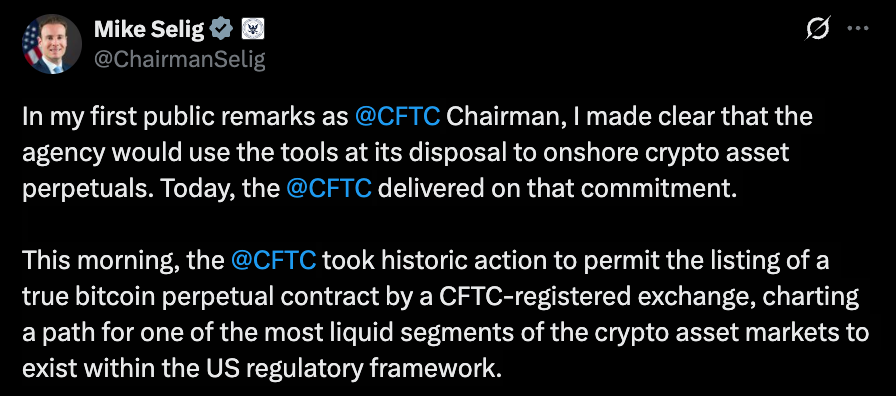
That dynamic may finally be beginning to shift. CFTC Chairman Mike Selig recently announced the approval of what he described as a true Bitcoin perpetual futures contract on a CFTC-regulated exchange. The decision marks a potentially significant milestone for the digital asset industry and signals a growing willingness among U.S. regulators to bring crypto trading activity back within established financial frameworks.
Why Perpetual Futures Dominate Crypto Trading
Outside of crypto circles, perpetual futures can sound complex. In practice, they have become one of the most widely used trading instruments in digital assets. Unlike traditional futures contracts that expire on a fixed date, perpetual contracts allow traders to maintain positions indefinitely while using funding mechanisms to keep prices aligned with the underlying asset.
That flexibility has helped perpetual futures become the backbone of crypto trading worldwide. On many trading days, perpetual futures markets generate more volume than spot exchanges themselves. Traders value the liquidity, leverage, and around-the-clock accessibility these products provide, making them one of the most important components of modern crypto market structure.
Bringing Crypto Derivatives Back to the United States
Selig has consistently argued that pushing crypto activity offshore does little to protect investors. Instead, his recent comments suggest regulators are increasingly exploring ways to accommodate innovation within existing regulatory systems rather than forcing market participants to seek alternatives abroad.
The approval of a regulated Bitcoin perpetual futures product reflects that changing mindset. Rather than watching billions of dollars flow through foreign platforms, U.S. regulators appear more open to allowing similar products under domestic oversight. For the broader industry, this could represent a major step toward integrating crypto derivatives into traditional financial markets.
Institutions May Finally Get the Access They Want
One of the biggest barriers to institutional participation in crypto derivatives has been the lack of regulated venues offering products comparable to those available offshore. Many investment firms, pension funds, and financial institutions face strict compliance requirements that prevent them from using unregulated exchanges regardless of potential demand.
A regulated perpetual futures market could help solve that problem. By operating within an established regulatory framework, these products may offer institutions a pathway to participate in one of crypto’s most active trading markets without stepping outside their compliance obligations. That could unlock new liquidity and attract participants who previously remained on the sidelines.
A Major Shift for the Future of Crypto Markets
The approval of a Bitcoin perpetual futures contract may ultimately represent more than the launch of a new trading product. It signals a broader effort to bring crypto’s most successful market structures into the American financial system. Just as Bitcoin ETFs opened the door for regulated spot exposure, perpetual futures could provide a similar bridge for derivatives trading.
If this trend continues, the next phase of crypto adoption may look very different from the last. Rather than watching activity migrate overseas, regulators and market participants may increasingly work together to build competitive crypto markets within the United States. For an industry that has long operated between innovation and regulation, that shift could prove highly significant.
Disclaimer: BlockNews provides independent reporting on crypto, blockchain, and digital finance. All content is for informational purposes only and does not constitute financial advice. Readers should do their own research before making investment decisions. Some articles may use AI tools to assist in drafting, but every piece is reviewed and edited by our editorial team of experienced crypto writers and analysts before publication.






 English (US) ·