
 1 month ago
54
1 month ago
54
- JPMorgan, Citi, Bank of America, Wells Fargo, and other major banks are building a tokenized deposit network targeting a 2027 launch.
- The system aims to provide instant settlement, 24/7 payments, and programmable transactions while keeping funds within traditional banks.
- The initiative is widely viewed as a response to the rapid growth and success of stablecoins such as USDC and USDT.
For years, major financial institutions treated crypto as a curiosity at best and a threat at worst. Stablecoins, in particular, were often viewed as products operating on the fringes of the financial system. Fast forward to today, and many of the largest banks in America are actively building infrastructure that looks remarkably similar to the technology they once dismissed.
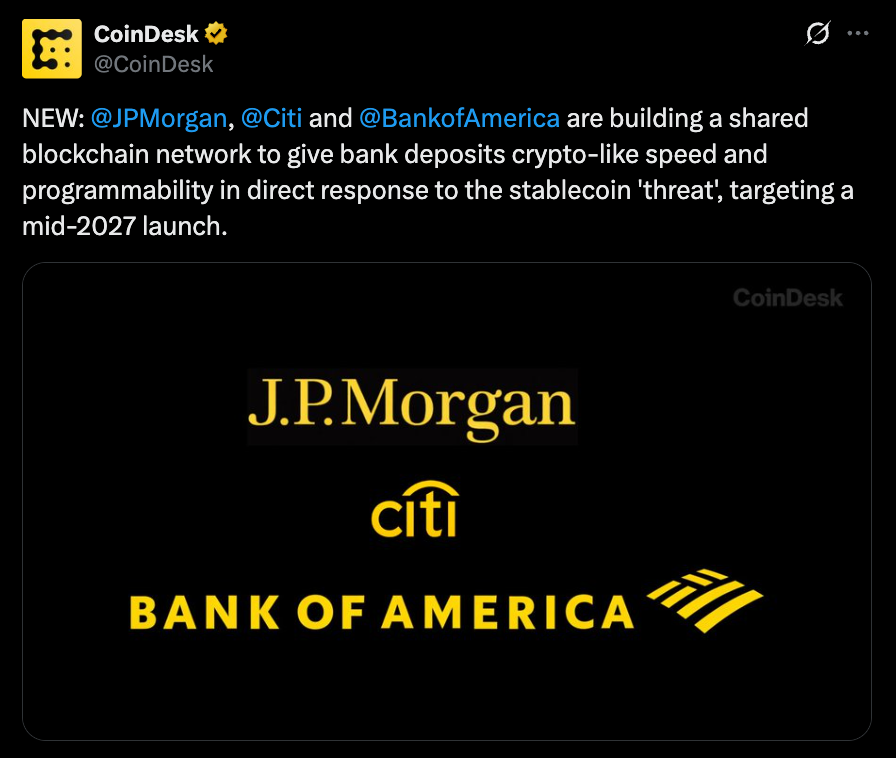
According to reports from The Wall Street Journal, JPMorgan, Citi, Bank of America, Wells Fargo, and several other major institutions are working through The Clearing House to develop a nationwide tokenized deposit network that could launch as early as the first half of 2027. The objective is straightforward: offer the speed and efficiency of blockchain-based payments while ensuring customer funds remain inside the traditional banking system. In many ways, it represents Wall Street’s clearest acknowledgment yet that the future of money is changing.
Banks Are Bringing Blockchain Into Traditional Finance
The proposed network would allow tokenized bank deposits to move across blockchain infrastructure with near-instant settlement and around-the-clock availability. Users would gain access to programmable payment functionality, a feature long associated with crypto and smart contract technology.
Unlike stablecoins such as USDC and USDT, however, these tokenized deposits would remain liabilities of regulated banking institutions. Funds would stay within the existing financial framework while benefiting from technology designed to improve efficiency and reduce settlement delays.
That distinction is important. Rather than replacing traditional banking, the system seeks to modernize it using concepts that first gained traction within the crypto industry.
Stablecoins Have Become Serious Competition
One of the most revealing aspects of the initiative is what it says about stablecoins themselves. A decade ago, few would have predicted that digital dollars issued on public blockchains would become significant enough to influence strategy at the largest banks in the world.

Today, stablecoins process enormous transaction volumes and have become essential infrastructure across crypto markets. Their ability to move value quickly, operate continuously, and settle transactions without traditional banking hours has highlighted limitations within legacy payment systems.
The decision by major banks to develop competing blockchain-based solutions suggests that stablecoins are no longer viewed as niche products. They are increasingly being recognized as legitimate competitors in the broader payments landscape.
The Industry Is Following Crypto’s Playbook
Ironically, one of the strongest endorsements of blockchain technology may be coming from the institutions that were once its biggest skeptics. The world’s largest banks are not investing years of development and significant capital into these projects because they expect traditional payment systems to remain unchanged.
Instead, they are adopting many of the principles pioneered by digital assets. Instant settlement, programmable transactions, continuous availability, and blockchain-based infrastructure were all concepts popularized within crypto long before they entered boardroom discussions at major banks.
What was once considered disruptive is increasingly becoming mainstream financial strategy.
Validation May Matter More Than Competition
Some crypto investors may initially view tokenized bank deposits as competition for stablecoins. While that concern is understandable, the bigger story may be what this development represents. Rather than fighting blockchain technology, banks are increasingly embracing it.
Whether consumers ultimately prefer stablecoins issued on public blockchains or tokenized deposits issued by regulated banks, the end goal appears remarkably similar. Money is becoming faster, more programmable, and available around the clock. Blockchain rails are emerging as the foundation supporting that transformation.
For the digital asset industry, that may be the most important takeaway. The debate is no longer about whether blockchain technology has practical value. The world’s largest financial institutions have already answered that question. They are now racing to implement it.
Disclaimer: BlockNews provides independent reporting on crypto, blockchain, and digital finance. All content is for informational purposes only and does not constitute financial advice. Readers should do their own research before making investment decisions. Some articles may use AI tools to assist in drafting, but every piece is reviewed and edited by our editorial team of experienced crypto writers and analysts before publication.








 English (US) ·