
 1 month ago
103
1 month ago
103
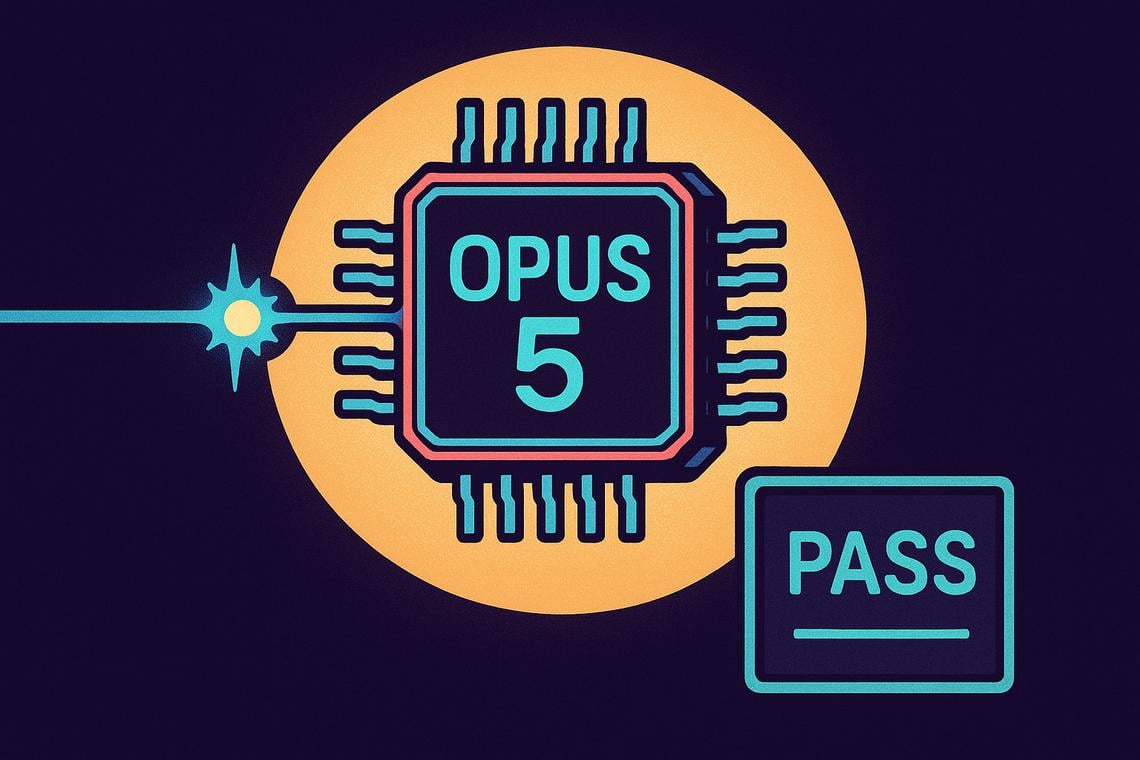
Anthropic’s Opus 5 launch on July 24, 2026 arrives with a counterintuitive pitch: a smaller, cheaper model that actually beats its bigger sibling on several benchmarks. That’s not how model releases usually work — and it’s precisely why developers are paying attention.
Key takeaways
- Anthropic launched Opus 5 on July 24, 2026, just two months after Opus 4.8 became available on May 28.
- Opus 5 is smaller and cheaper than Fable 5 but outperforms it on several benchmarks, priced at $5 per million input tokens and $25 per million output tokens.
- Safety classifiers engage 85% less frequently on Opus 5 than on Fable 5, and the model is exempt from the 30-day data retention policy applied to Fable and Mythos.
- A new beta feature called Automatic Fallbacks routes API requests to less powerful models when safety classifiers trigger, replacing error messages with functional responses.
- Only the lightweight Haiku model still awaits an upgrade to the 5 series.
Anthropic launches Opus 5, improving on predecessor models
Opus 5 slots into a crowded release calendar. Mythos 5, Fable 5, and Sonnet 5 all landed in June, and Opus 4.8 had only been available since May 28 — making this a two-month turnaround. With Haiku being the sole holdout, Anthropic has now essentially refreshed its entire model lineup within a single season.
Core performance and cost advantages
The headline number from Ars Technica’s reporting is hard to ignore: $5 per million input tokens and $25 per million output tokens — on par with Opus 4.8 but cheaper than Fable. Benchmark charts from Anthropic show Opus 5 performing at approximately the same level or slightly ahead of Fable on coding tasks, while also outpacing Opus 4.8 and OpenAI’s competing GPT-5.6-Sol across most task categories, according to Ars Technica.
That framing matters for how businesses are thinking right now. As Ars Technica noted, the dominant conversation among engineering managers isn’t about raw capability — it’s about cost. Opus 5 is Anthropic’s answer to that pressure: more performance for no additional token spend compared to its predecessor, at a price point well below Fable.
Still, Ars Technica characterizes this as an iterative step rather than a breakthrough — closer in spirit to an efficiency release than a capability leap. The benchmarks show forward movement, but not the kind of jump that redefined agentic coding when earlier versions arrived. For most practical use cases, though, that distinction may be less important than the price-to-performance ratio.
Enhanced capabilities and relaxed restrictions in Opus 5
Beyond the numbers, Opus 5 carries a meaningful shift in how much it constrains developers. Anthropic described the model as “much stronger at verifying its work and iterating carefully until it succeeds” — pointing to benchmark tests in which the model wrote its own computer vision pipeline in response to an incomplete prompt as a concrete example of that self-correction loop.
Data retention policy differences compared to Fable and Mythos
One of the more practically significant differences involves data handling. Opus 5 is not subject to the 30-day data retention policy that applies to both Fable and Mythos — a requirement that had raised concerns among privacy-sensitive users and enterprise customers since Fable’s release. Opus 5’s exemption aligns it with its predecessor and removes a compliance friction point that was already shaping adoption decisions.
It’s also worth understanding why Opus 5 carries fewer restrictions overall. Ars Technica’s reporting points to a deliberate training decision: Anthropic intentionally avoided giving Opus 5 cutting-edge training on cybersecurity tasks. That means it lags substantially behind Fable and Mythos on vulnerability exploitation — and because the risk profile is lower, fewer guardrails are needed. The relaxed restrictions are, in part, a consequence of a model built with a different threat ceiling in mind.
Safety features and cybersecurity safeguards
Fewer restrictions doesn’t mean no restrictions. Anthropic drew a clear boundary around one specific cybersecurity use case: scanning software binaries for vulnerabilities is off-limits. Scanning source code for the same purpose is permitted, on the basis that the latter is more consistent with defensive security work.
Reduced engagement of safety classifiers
The broader signal is quantified. Anthropic expects its AI safety classifiers to engage 85% less frequently on Opus 5 compared to Fable 5. That’s a dramatic reduction — and a direct reflection of the lighter risk footprint the company assigned to a model that was trained with deliberate capability ceilings on the highest-risk tasks.
For developers building production applications, this reduction has real workflow implications. Fewer classifier interruptions means fewer broken pipelines, fewer edge cases to engineer around, and more predictable API behavior at scale. The 85% figure isn’t just a safety metric — it’s effectively a reliability metric too.
New features to enhance API user experience
Even with classifiers engaging far less often, Anthropic moved to address what happens when they do fire. The answer is a new beta feature called Automatic Fallbacks.
Introduction and function of Automatic Fallbacks
Rather than returning an error when a prompt triggers a safety classifier, Automatic Fallbacks automatically reroutes the request to a less powerful model and delivers a functional response. API users can opt in to the feature, and when enabled, the experience shifts from a hard stop to a graceful degradation.
This is a meaningful quality-of-life change for developers who rely on consistent API output in production environments. Error messages in response to classifier triggers create downstream failures that require custom handling; a functional fallback response removes that engineering burden. It also signals a broader philosophy: Anthropic is moving toward safety guardrails that interrupt workflows less, rather than simply lowering the guardrails themselves.
With competition intensifying — Ars Technica flagged that the Chinese open-weight model Kimi K3 offers similar performance at just $15 per million output tokens — the pressure on Anthropic to keep reducing friction and cost is real. Opus 5 addresses both, but the window for any single model to hold a cost advantage is narrowing fast. The more durable bet may be on tooling like Automatic Fallbacks: features that make the entire platform stickier, regardless of where token prices eventually land.
FAQ
How does Opus 5 compare to Fable 5 in performance and cost?
Opus 5 is smaller, cheaper, and less restrictive than Fable 5 while outperforming it on several benchmarks. It is priced at $5 per million input tokens and $25 per million output tokens, making it more affordable than Fable for most use cases.
What safety measures does Opus 5 implement?
Opus 5 uses safety classifiers that engage 85% less frequently than those applied to Fable 5. It also prevents the model from being used to scan vulnerabilities in software binaries, while allowing source code scanning for defensive security purposes.
What is the Automatic Fallbacks feature in Opus 5?
Automatic Fallbacks is a beta feature that API users can opt into. When a prompt triggers a safety classifier, the system automatically routes the request to a less powerful model and returns a functional response instead of an error message.
Is Opus 5 subject to the 30-day data retention policy like Fable?
No. Opus 5 is not subject to the 30-day data retention policy that applies to Fable and Mythos models, which had been a concern for privacy-conscious users and enterprise customers.
Article produced with the assistance of artificial intelligence and reviewed by the editorial team.





 English (US) ·