
 3 months ago
72
3 months ago
72
- Zcash plunged 38% after developers disclosed a critical vulnerability involving the Orchard Pool.
- Arthur Hayes exited his entire ZEC position, citing uncertainty surrounding the network’s historical supply integrity.
- More than $82 million in liquidations followed, creating the largest ZEC wipeout since October.
Privacy-focused cryptocurrency Zcash suffered one of its most dramatic selloffs in years after developers revealed a critical vulnerability tied to the network’s Orchard Pool. While the issue has reportedly been patched and there is currently no evidence that the flaw was exploited, the disclosure exposed a much deeper concern that quickly rattled investors.
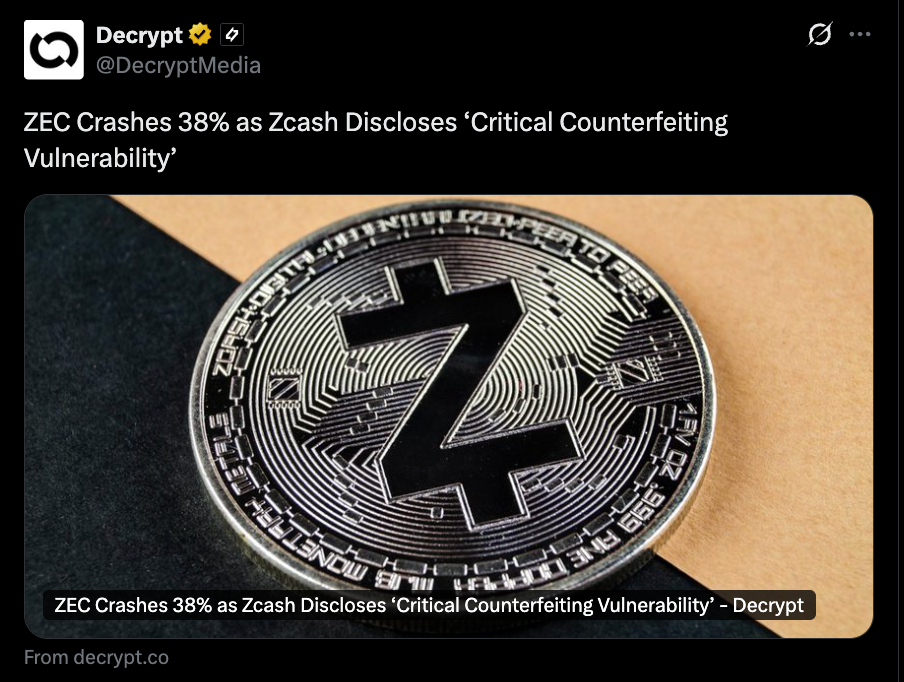
According to developers, the vulnerability created a scenario where it could not be cryptographically proven that counterfeit ZEC had never been generated while the flaw existed. That distinction proved significant. In cryptocurrency, uncertainty surrounding supply integrity can be far more damaging than many technical bugs because it strikes directly at trust in the asset itself.
A Vulnerability With Uncomfortable Questions
The issue was not simply the vulnerability itself.
Blockchain networks regularly discover and patch software flaws. What made this situation different was the uncertainty surrounding potential historical consequences. While developers stated there was no indication that anyone exploited the bug, they also acknowledged that proving the absence of exploitation may not be possible.
That creates a unique challenge.
Investors generally prefer clear outcomes. Either a vulnerability was exploited or it was not. In this case, the possibility that definitive proof may never exist created an additional layer of risk that markets struggled to price.
Arthur Hayes Pulls the Trigger
One of the most influential reactions came from BitMEX co-founder Arthur Hayes.
Hayes publicly revealed that he had sold his entire ZEC position following the disclosure. His reasoning was straightforward. The concern was not necessarily that counterfeit coins existed. The concern was that the possibility could never be fully eliminated.
For many investors, that may seem overly cautious.
For large market participants managing significant capital, however, uncertainty often matters just as much as actual losses. When confidence in an asset’s monetary integrity becomes questionable, some investors prefer to step aside entirely rather than gamble on future clarification.
Hayes chose the latter approach.
Liquidations Accelerate the Decline
Once confidence began weakening, leverage amplified the damage.
More than $82 million worth of ZEC positions were liquidated as traders rushed to reduce exposure and forced liquidations cascaded through the market. The combination of negative headlines, a high-profile investor exit, and leveraged positions unwinding created a powerful feedback loop.
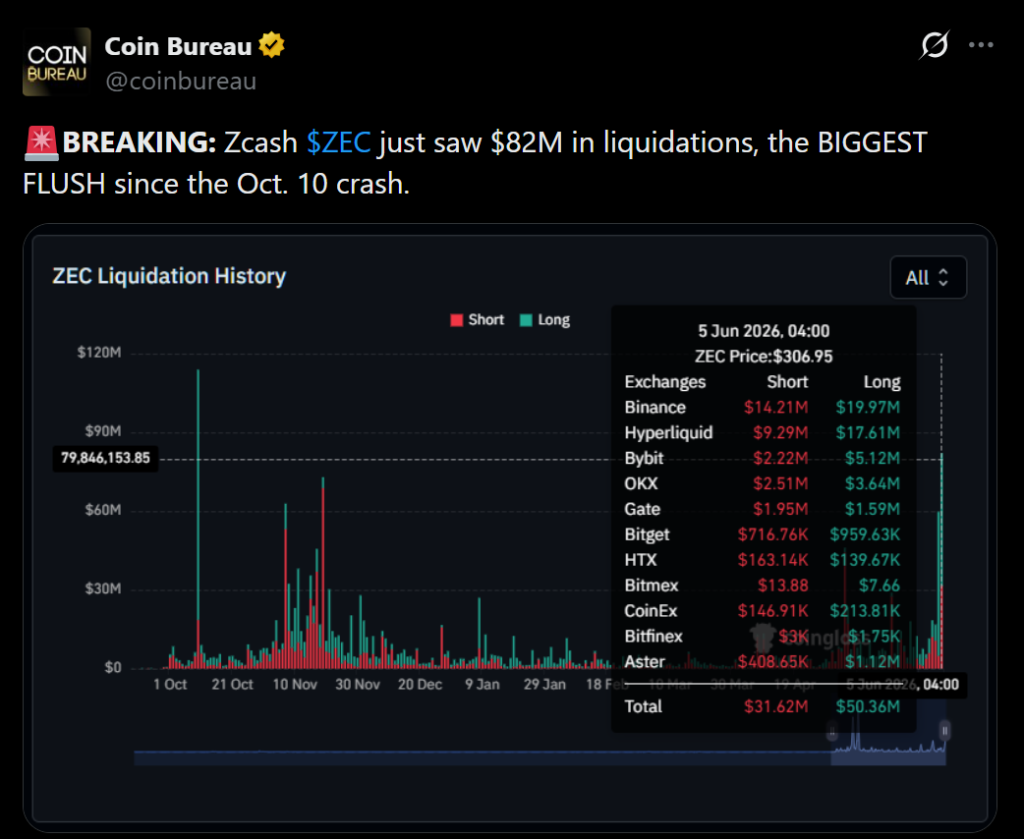
As prices fell, additional liquidations triggered further selling pressure, accelerating the decline.
The result was the largest liquidation event for ZEC since October and one of the most severe single-day drawdowns the asset has experienced in recent memory.
Why Privacy Coins Face Unique Risks
Privacy-focused cryptocurrencies operate under different assumptions than many other blockchain networks.
Their value often depends heavily on trust in complex cryptographic systems that are difficult for the average investor to independently verify. While those technologies provide important privacy benefits, they also create situations where technical disclosures can have outsized market impacts.
When questions emerge about supply integrity, privacy systems, or cryptographic guarantees, investors may react more aggressively because understanding the actual risk requires deep technical expertise.
In many cases, markets simply default to caution.
Can Confidence Recover?
The next phase will depend largely on transparency and communication.
Developers have already patched the vulnerability and maintain that there is no evidence of exploitation. However, rebuilding confidence may take time, particularly after such a dramatic price decline and public exit from a prominent investor.
Historically, crypto markets have shown a willingness to forgive technical issues when teams respond effectively and demonstrate that long-term fundamentals remain intact.
Whether Zcash can achieve that recovery remains the central question facing investors.
Conclusion
The Zcash selloff was not driven by a confirmed exploit, a network failure, or a collapse in functionality. Instead, it was driven by uncertainty. A vulnerability raised uncomfortable questions about supply integrity, Arthur Hayes publicly exited his position, and liquidation cascades amplified the market’s fears.
Ultimately, the future direction of ZEC will depend on whether investors regain confidence that the network’s monetary system was never compromised. Until that confidence returns, volatility is likely to remain elevated. In crypto, certainty often carries a premium. This week, Zcash discovered exactly how expensive uncertainty can become.
Disclaimer: BlockNews provides independent reporting on crypto, blockchain, and digital finance. All content is for informational purposes only and does not constitute financial advice. Readers should do their own research before making investment decisions. Some articles may use AI tools to assist in drafting, but every piece is reviewed and edited by our editorial team of experienced crypto writers and analysts before publication.








 English (US) ·