
 2 months ago
35
2 months ago
35
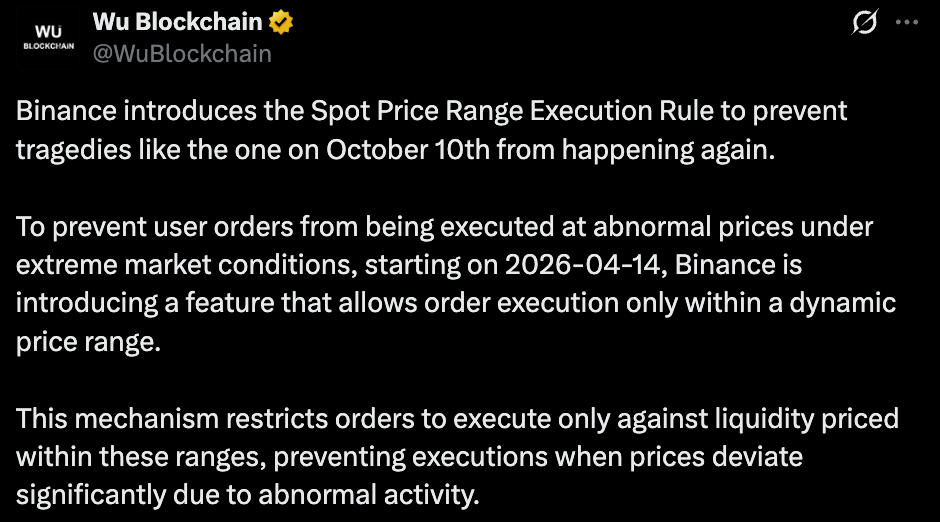
- Binance introduces PRER to prevent extreme price slippage
- Orders will execute only within a dynamic price range
- Spot trading gets safeguards similar to futures markets
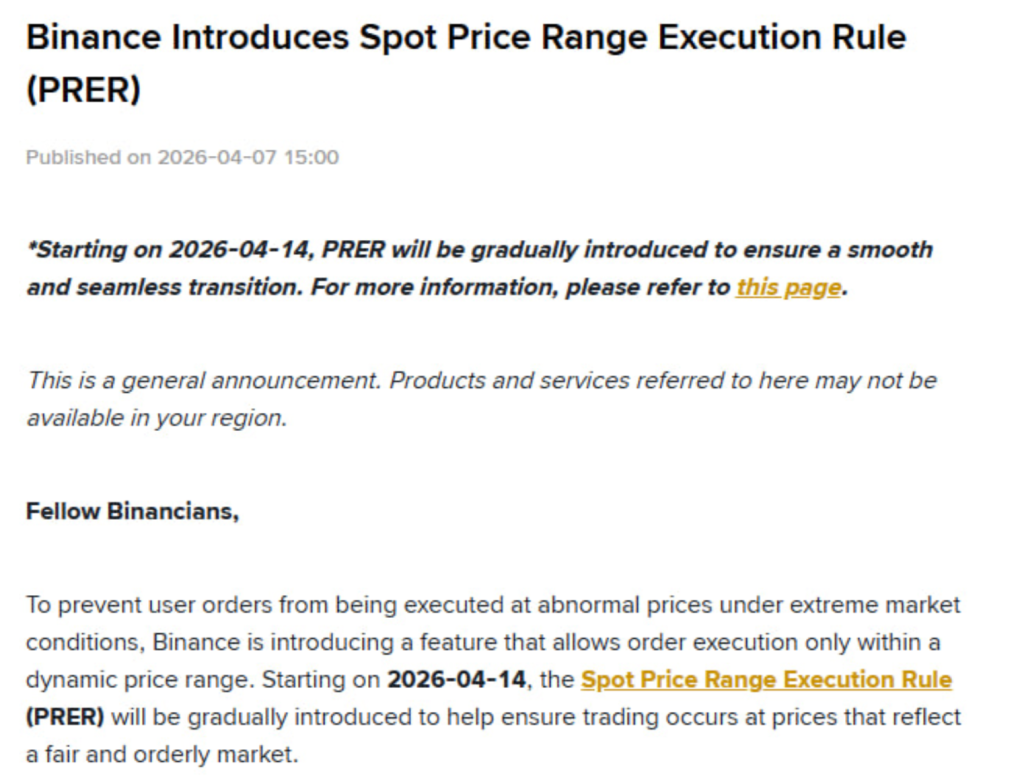
Binance is quietly rolling out a change that most traders won’t notice, until they really need it. Starting April 14, the exchange will introduce the Spot Price Range Execution Rule, or PRER, a mechanism designed to stop orders from filling at extreme prices during volatile market conditions. It’s not flashy, but it addresses a very real problem.
Anyone who’s traded during a sudden move knows how messy things can get. Liquidity disappears, spreads widen, and suddenly your market order fills at a price that feels… wrong. Not technically broken, just far from what you expected. PRER is meant to reduce those moments.
A Built-In Guardrail for Spot Trading
The idea behind PRER is fairly straightforward. It creates a dynamic price band around where trades can execute. If the price moves outside that band, the order simply won’t fill at that level.
That band isn’t fixed either, it adjusts in real time based on market conditions. So during calm periods, it stays tight, but when volatility spikes, it expands. It’s more of a flexible boundary than a hard limit.
Market Orders Feel This the Most
This change mainly affects traders using market orders, especially in fast-moving or low-liquidity situations. Those are the moments where slippage can get severe, and where this kind of protection matters most.
In some cases, orders may now partially fill or even expire if the market moves too quickly beyond the acceptable range. That might feel frustrating in the moment, but it’s generally better than getting filled at a price that doesn’t reflect fair value.
Spot Trading Is Catching Up to Futures
What’s interesting is that this kind of safeguard already exists in futures markets. Derivatives traders have had similar protections for a while, so this move brings spot trading a bit closer in terms of risk management tools.
It’s not a major overhaul, but it’s a structural improvement. And in markets where volatility is constant, small protections can make a noticeable difference over time.
A Quiet Upgrade That Fixes a Real Problem
For traders who mostly use limit orders, this probably won’t change much day to day. But for anyone who’s ever hit a market order during a sharp move and regretted it immediately, this is quietly good news.
It’s one of those updates that doesn’t get much attention, but solves something that’s been sitting in the background for years.
Disclaimer: BlockNews provides independent reporting on crypto, blockchain, and digital finance. All content is for informational purposes only and does not constitute financial advice. Readers should do their own research before making investment decisions. Some articles may use AI tools to assist in drafting, but every piece is reviewed and edited by our editorial team of experienced crypto writers and analysts before publication.









 English (US) ·