
 1 hour ago
20
1 hour ago
20
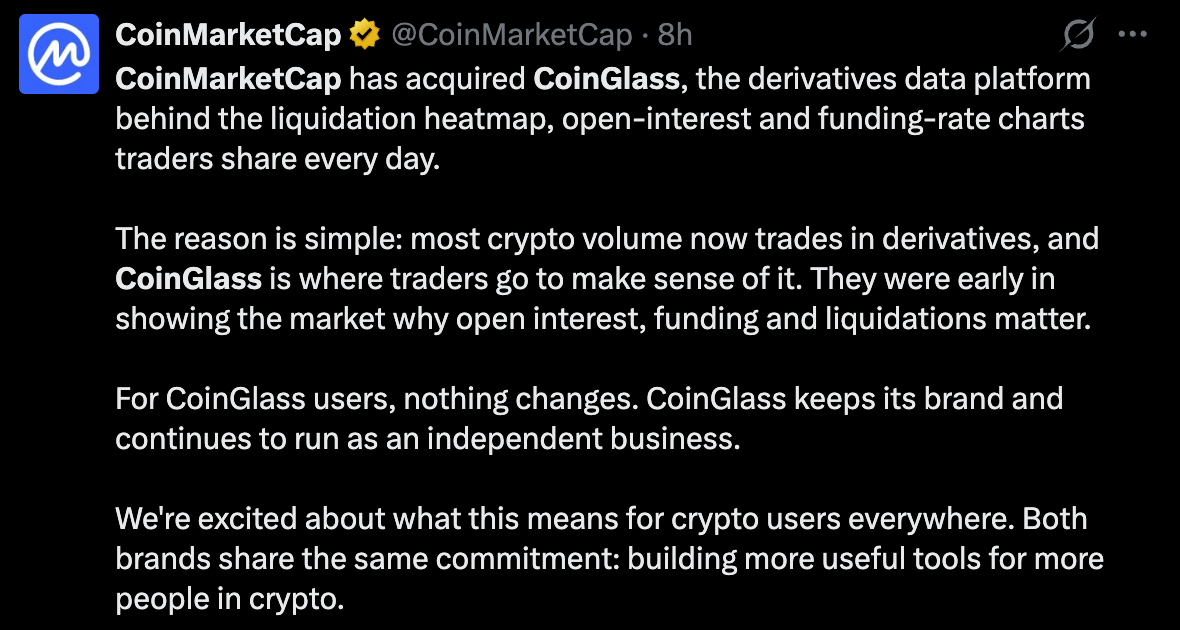
Coinmarketcap has acquired crypto derivatives analytics platform Coinglass for an undisclosed sum, adding open interest, funding rates, liquidations, and options data to one of the industry’s largest market-data platforms. Coinglass will continue operating independently for now, but the deal has already sparked debate over data concentration, as Coinmarketcap is owned by Binance.
Key Takeaways
- Coinmarketcap acquired Coinglass, adding derivatives data across 28 exchanges and 2,500+ instruments.
- The deal gives Coinmarketcap deeper leverage data for 115M monthly users, raising concentration concerns.
- The next question is whether Coinglass will continue to stay independent as Binance-linked ownership deepens.
Coinmarketcap Adds Coinglass to Build Deeper Crypto Market Data
Coinmarketcap is expanding from price tracking into the deeper plumbing of crypto market structure.
The company’s statement on Friday, Sept. 25, said that it has completed the acquisition of Coinglass, the derivatives data platform widely used by traders to monitor open interest, funding rates, liquidations, long-short positioning and options activity.
Financial terms were not disclosed.
Coinglass covers 28 exchanges and more than 2,500 instruments, while reportedly serving over 5 million monthly users, with more than 10,000 API customers. Coinmarketcap says its own platform reaches roughly 115 million users each month.
That combination gives the buyer access to a much broader view of how leverage is building across crypto markets.
 Source: Coinmarketcap on X
Coinglass Data Will Feed Into Coinmarketcap
The strategic logic is straightforward.
Coinmarketcap already dominates the retail-facing layer of crypto market data, including prices, rankings, and asset information. Coinglass adds the derivatives side, where much of the market’s risk is expressed.
“Derivatives are where most of the market’s risk is taken, and Coinglass is where most people go to see it,” Coinmarketcap CEO Rush said.
Coinmarketcap plans to integrate Coinglass data into its broader market-data offering, including open interest, liquidations, funding rates and options metrics. For users, that could mean fewer jumps between platforms to understand both what moved and why.
Coinglass Says Its Product Will Stay Independent
Coinglass will continue operating under its existing name. The company said its website, mobile app, free tools, APIs, and pricing will remain unchanged for now.
“Coinglass will continue to operate as an independent business under the Coinglass brand,” the company said.
That reassurance matters because Coinglass has built a distinct following among active traders who use its heatmaps and derivatives dashboards as part of daily crypto market analysis.
Binance Ownership Raises Data-Concentration Questions
The acquisition is attracting attention because Coinmarketcap itself was acquired by Binance in 2020.
The transaction price was never officially disclosed, though reporting at the time suggested the deal could have been worth as much as $400 million, with much of the consideration reportedly structured in equity and BNB.
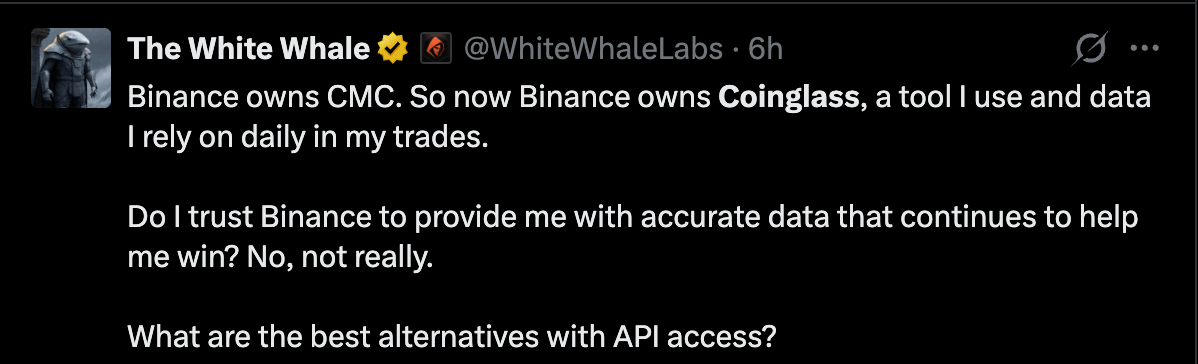
That ownership link is now prompting concerns from some crypto traders.
White Whale Labs questioned whether data from Coinglass would remain fully trusted under the broader Binance umbrella. Web3 educator Katherine described the deal as creating a more vertically integrated data stack, with spot prices, rankings, open interest, funding rates, liquidations, and options increasingly sitting within the same ecosystem.
 Source: White Whale Labs on X
Those concerns are about perception as much as product functionality.
Coinglass says nothing is changing for users today. But strategically, the acquisition is significant: one of crypto’s most-used price platforms now owns one of its most-used derivatives intelligence tools.
For traders, the result could be a more powerful data product. For the industry, it also raises a bigger question about how much crypto market information should sit under one corporate roof.






 English (US) ·