
 1 month ago
57
1 month ago
57
- Bitcoin rebounded toward $74,000 after Trump announced plans to lift the Strait of Hormuz blockade.
- More than $136 million in short liquidations across crypto markets helped accelerate BTC’s recovery.
- Bitcoin remains below critical resistance at $75,000, while geopolitical developments continue driving market sentiment.
Bitcoin staged a notable recovery after President Donald Trump announced that the U.S. Navy would lift its blockade of the Strait of Hormuz, easing fears surrounding one of the world’s most important shipping corridors. The announcement immediately improved risk sentiment across global markets, helping BTC rebound from levels near $72,000 to trade around the $73,900–$74,000 range. While the move may seem modest compared to Bitcoin’s historical volatility, it reflected how sensitive markets remain to geopolitical developments, particularly those involving energy routes and international trade.
Trump stated that vessels caught within the Strait of Hormuz could begin returning home as restrictions are lifted. At the same time, he revealed that discussions regarding a potential agreement with Iran were entering a critical phase, with final decisions being reviewed from the White House Situation Room. According to Trump, any deal would require Iran to permanently forgo nuclear weapons while ensuring that maritime traffic through the Strait remains open in both directions without tolls or restrictions. The proposal also reportedly includes the removal of remaining naval mines and the coordinated handling of enriched nuclear material alongside Iranian authorities and the International Atomic Energy Agency.
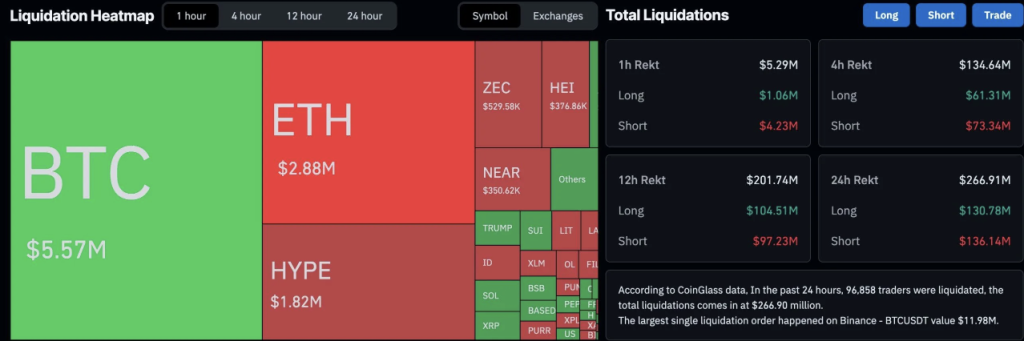
Short Liquidations Help Fuel Bitcoin’s Recovery
Bitcoin’s rebound wasn’t driven solely by improving geopolitical headlines. Crypto derivatives markets added another layer of momentum as short sellers found themselves caught on the wrong side of the move. Data from CoinGlass showed that Bitcoin recorded approximately $5.57 million in liquidations during the observed period, making it the most liquidated asset among major cryptocurrencies.
Across the broader crypto market, total liquidations climbed to roughly $267.5 million over a 24-hour period. Interestingly, short positions accounted for about $136.7 million of that total, slightly exceeding long liquidations. When traders betting against the market are forced to close positions, they effectively become buyers, creating additional upward pressure on prices. That’s exactly what appears to have happened as Bitcoin pushed toward the $74,000 level.
One liquidation stood out in particular. An individual BTC position worth nearly $12 million on Binance was reportedly wiped out during the move. Events like these often accelerate short-term rallies because forced buying creates momentum that feeds into already improving market sentiment. In crypto, where leverage remains common, liquidations can sometimes move prices almost as much as the news itself.
Iran Deal Discussions Remain a Key Market Focus
While traders welcomed signs of easing tensions, uncertainty surrounding the proposed U.S.-Iran agreement remains very much alive. Trump indicated that portions of the framework had already been agreed upon but emphasized that no funds would be exchanged until further notice. His comments followed reports suggesting the deal could involve a reconstruction fund worth as much as $300 billion for Iran, potentially supported through an international investment structure facilitated by the United States.
Earlier reports indicated negotiators had reached an agreement on extending the ceasefire by an additional 60 days, though Trump had not yet formally approved the arrangement. Discussions reportedly cover a broad range of issues, including sanctions relief, frozen Iranian assets, shipping access through the Strait of Hormuz, and oversight of Iran’s nuclear program.
Complicating matters further, conflicting narratives have emerged from both sides. Trump claimed that enriched uranium would eventually be removed and destroyed under international supervision. However, Iranian state media rejected suggestions that Tehran had agreed to abandon or eliminate its enriched uranium stockpiles. Iranian officials reportedly described portions of Trump’s announcement as a mixture of truth and exaggeration, leaving several key details unresolved. For markets, that uncertainty means volatility could remain elevated until a final decision is reached.
Bitcoin Faces a Critical Test Near Major Resistance
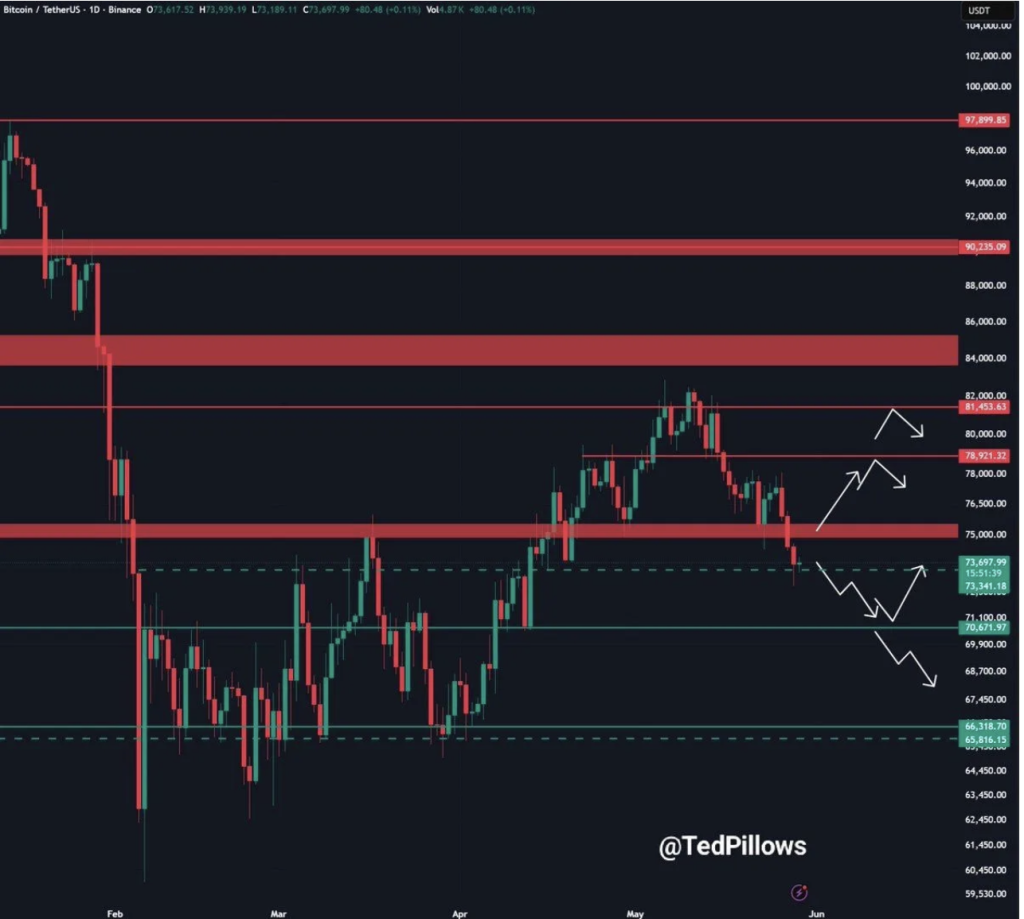
From a technical standpoint, Bitcoin is now approaching one of the most important areas on its chart. The cryptocurrency continues trading just below the key $75,000 resistance zone, a level many analysts view as the dividing line between a simple rebound and a broader bullish continuation.
A daily close above $75,000 would strengthen the case that buyers are regaining control of the near-term trend. Should that breakout occur, upside targets around $78,921 and $81,453 could come into focus relatively quickly. Beyond that, the broader supply region between $84,000 and $85,000 may become the next battleground for traders looking to assess whether a larger rally is developing.
However, the bullish case is not without risks. Failure to reclaim resistance could trigger another wave of selling pressure, with support levels sitting near $71,100 and $70,671. If those areas fail to hold, Bitcoin could revisit lower zones around $69,900, $68,700, and potentially the broader support region between $66,318 and $65,816.
Adding another layer of caution, on-chain data continues to show relatively subdued activity among larger holders. Whale wallets holding between 1,000 and 10,000 BTC have remained largely unchanged since February 2026, while so-called dolphin wallets containing 100 to 1,000 BTC have formed lower highs since late 2025. Meanwhile, long-term holder supply has climbed to a record 15.8 million BTC. While that may sound bullish, analysts at CryptoQuant note that it could simply reflect reduced coin movement rather than fresh demand entering the market.
For now, Bitcoin finds itself balancing improving geopolitical sentiment against lingering uncertainty and cautious on-chain signals. The next move may depend less on technical indicators and more on how the evolving situation surrounding Iran and the Strait of Hormuz ultimately unfolds.
Disclaimer: BlockNews provides independent reporting on crypto, blockchain, and digital finance. All content is for informational purposes only and does not constitute financial advice. Readers should do their own research before making investment decisions. Some articles may use AI tools to assist in drafting, but every piece is reviewed and edited by our editorial team of experienced crypto writers and analysts before publication.




 English (US) ·