
 2 hours ago
13
2 hours ago
13
Bitcoin has lost the $80,000 level as selling pressure and market uncertainty converge on a price structure that analyst Rei Researcher has identified as one of the most sensitive zones Bitcoin has occupied in this entire cycle. The breakdown is not simply a technical level failing — it is a price entering a specific intersection of holder cost bases that creates a structural conflict between the forces trying to push Bitcoin higher and the forces preventing it from going there.
Rei Researcher’s analysis draws on CryptoQuant’s Holder Metrics chart to map exactly where Bitcoin currently stands relative to the cost basis of different participant cohorts. The picture that emerges is of a market caught between competing pressures at precisely the level where those pressures are most evenly matched.
Bitcoin recently completed a recovery wave that carried it meaningfully above the April lows — a move that returned a significant cohort of short-term holders to profitability for the first time since the correction began. That recovery brought the price directly toward the Short-Term Holder cost basis — the average entry price of participants who acquired Bitcoin within the past several months and have been sitting on losses throughout the decline.
At that level, the dynamic shifts. Holders who endured weeks of losses and finally returned to breakeven face a decision the data says they have consistently made the same way: they sell. The STH cost basis is not simply a technical resistance level. It is a behavioral threshold, and Bitcoin approaching it from below has met the same supply every time.
Between The Floor Institutions Built And The Ceiling Holders Created
Rei Researcher’s analysis identifies the constructive element that prevents the current breakdown from being read as unambiguously bearish. Despite losing $80,000 and trading near $77,000, Bitcoin is still holding above the cost basis of institutional fund flows — the average entry price of ETF capital that has accumulated since the spot Bitcoin ETFs launched.
That level functions as a crucial support buffer in the current environment, representing the price below which institutional investors who entered through regulated products would begin sitting on unrealized losses.

The implication of breaking that support is direct and significant. ETF holders who have been absorbing volatility from a position of profit would shift to a position of loss — a psychological and structural change that historically triggers accelerated outflows and reduced institutional appetite for adding exposure. Rei Researcher identifies a break below the ETF cost basis as the specific condition that would trigger a negative trend rather than continued consolidation.
Bitcoin at $77,000 is therefore positioned in the most contested price zone of this cycle — supported from below by the cost basis of the most structurally significant new category of buyer, and weighed down from above by the combined resistance of the STH cost basis and the 200-day moving average.
The medium-term trend will not be established by gradual drift in either direction. It will be established by a decisive break above or below one of those two cost basis zones — a break accompanied by the volume and follow-through that confirms a genuine regime change rather than another test that reverses at the boundary. Until that break arrives, Bitcoin is consolidating at the exact price where the market’s next directional decision is being made.
Bitcoin Weekly Structure Shows Indecision
Bitcoin is trading near $76,700 on the weekly chart after failing to reclaim the major resistance zone between $78,000 and $80,000, an area that now acts as the market’s primary structural ceiling. The rejection reinforces the broader corrective structure that has dominated price action since Bitcoin topped above $110,000 late last year.
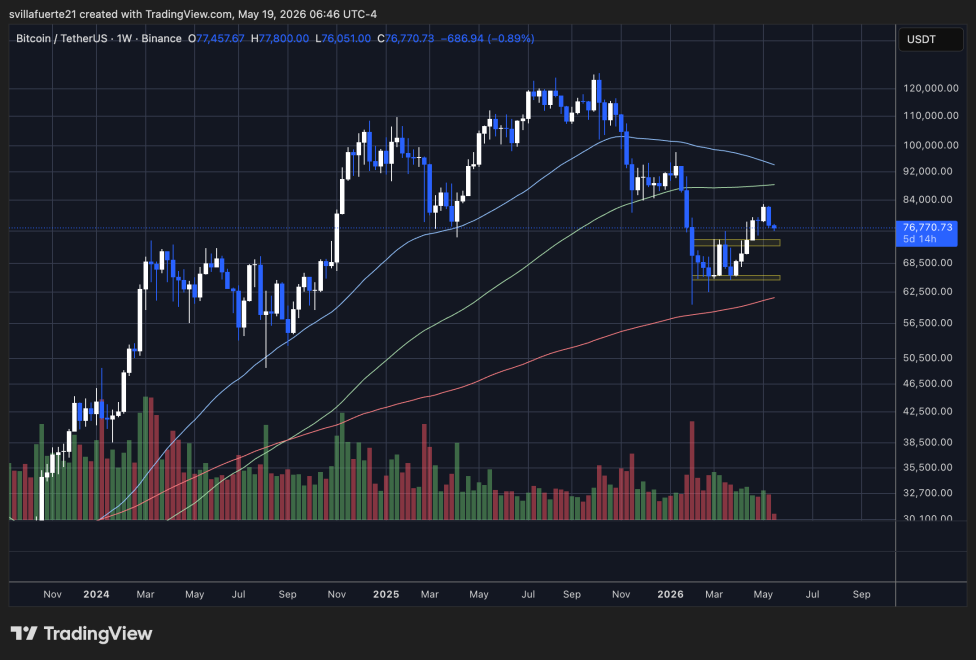
The chart shows BTC attempting to stabilize after the sharp capitulation event that briefly pushed price toward the low-$60,000 region earlier this year. Buyers successfully defended the broader demand zone between $64,000 and $68,000, allowing Bitcoin to recover back toward the weekly 50 moving average. However, momentum weakened significantly once price approached the overhead resistance cluster formed by the 50-week moving average and previous breakdown levels near $80,000.
Importantly, Bitcoin continues trading below the weekly 100 moving average, while the weekly 200 moving average remains far below the current price near the long-term macro trend zone. This positioning reflects a market still structurally bullish on higher timeframes but facing meaningful medium-term weakness and uncertainty.
Volume has also declined during the latest rebound attempt, suggesting the recovery lacks the aggressive spot demand that characterized previous bull continuation phases. For now, the market remains trapped between key holder support zones below and heavy resistance overhead. A decisive breakout above $80,000 would likely shift momentum back toward bullish continuation, while losing the $68,000 region could trigger a broader market reset.
Featured image from ChatGPT, chart from TradingView.com









 English (US) ·