
 2 months ago
34
2 months ago
34
For over a decade, Bitcoin has been championed as a financial system beyond the reach of government institutions or elite influence. Its decentralization narrative, built on open-source code, distributed consensus, and a global network of participants, has made it a symbol of financial independence. However, fresh waves of speculation tied to the Epstein files are now challenging that perception, pushing the conversation into more uncomfortable territory.
Who Actually Influences The Bitcoin Network In Practice?
A narrative is spreading that the Jeffrey Epstein Files reveal that Israel hijacked control of the Bitcoin network over a decade ago. The Matrixbot revealed on X that Israel was paying salaries of 60% of BTC core developers and offered highly exclusive gifts behind the scenes.
Furthermore, Epstein and Israel were also the major investors in Blockstream, a company that works with Tether and exerts significant influence over BTC. They can manipulate the BTC price by issuing unbacked Tether, controlling the network code because they hired most of the developers, and own a majority of the nodes.
According to Matrixbot, this claim shows that Israel has direct access to the code and influence over the BTC. The idea of decentralization is clearly illusory, and it is deeply concerning that the network could be manipulated by a single state operating behind the scenes.
Record Realized Losses Signal Extreme Market Stress In Bitcoin
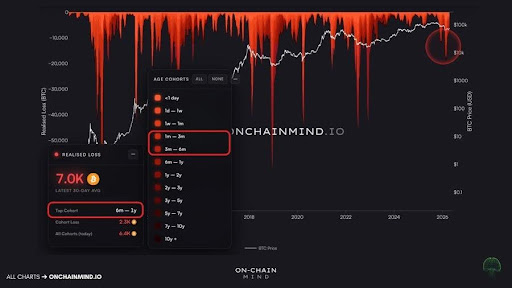
This bear cycle has driven Bitcoin into one of the largest aggressive realized losses in dollar regimes in its history. OnChainMind has noted that at the peak of the downturn, the network recorded nearly $1 billion per day in net realized losses. Data shows that the bulk of the early selling pressure originated from investors who had entered the market just 3 to 6 months ago, often referred to as weak hands.
Currently, a more resilient cohort of holders who held for 6 to 12 months is beginning to show signs of strain. Historically, when progressively stronger hands begin to capitulate, it signals a late-stage bear market dynamic.
Crypto trader known as ctm_trader has also pointed out that Bitcoin has been grinding higher, with 7 out of the last 8 two-day candles closing green. This kind of non-stop upward price action is often difficult to sustain, leading to massive liquidations.
The last time BTC printed a similar structure, the price pulled back nearly half the move within hours, triggering large-scale liquidations and wiping out millions. Now, the liquidity sitting below is even larger.
At the same time, indicators are flashing an overbought market. As the recent price action and structure are bearish, and BTC just swept the recent highs, it raises the possibility that the market could be positioning for a larger move to the downside.







 English (US) ·