
 1 hour ago
23
1 hour ago
23
Every 2,016 blocks, i.e. roughly every two weeks, Bitcoin automatically resets how hard it is to mine a block, a self-correcting rule that swung from an 11.16% cut on Feb. 7, 2026 to a 14.7% hike just 12 days later, the network’s sharpest whipsaw since 2021.
Key Takeaways
- Bitcoin resets mining difficulty every 2,016 blocks to hold the 10-minute block target.
- Winter Storm Fern drove an 11.16% difficulty drop and a 14.7% rebound within 12 days in Feb. 2026.
- A roughly 10% drop hit June 13, 2026 as price pressure and an AI-mining pivot cooled output.
The Rule Nobody Votes On
Bitcoin has no manager setting mining difficulty with its math, hard-coded into the protocol such that every 2,016 blocks, the network compares how long that batch of blocks actually took to mine against the 20,160-minute (two-week) target implied by the 10-minute-per-block design.
If miners found those blocks faster than schedule, difficulty rises for the next stretch. If they found them slower, difficulty falls. Nodes calculate the new value independently from the same block timestamps, so there’s nothing to negotiate (i.e., a node that disagreed with the math would simply be on a different chain).
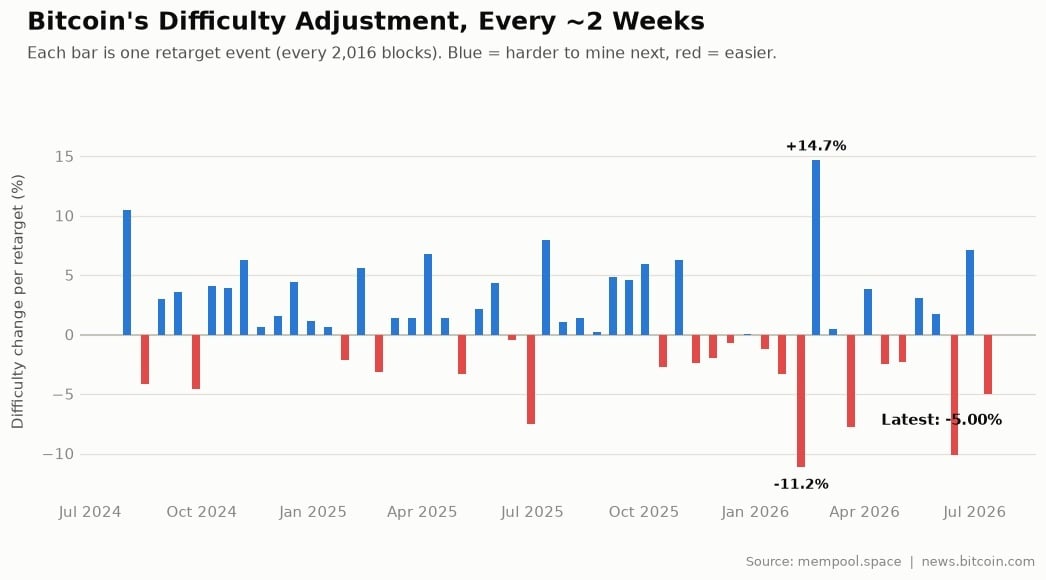
The adjustment isn’t unlimited and consensus rules cap any single retarget at a 4x increase or a 75% decrease, a ceiling designed to stop a single catastrophic data point (like a miner lying about a timestamp) from breaking the network in one step. In practice, most retargets move by low single digits. A double-digit swing, like the ones Bitcoin saw twice in 2026, is rare enough to make headlines in mining circles.
The mechanism exists because Bitcoin’s issuance schedule depends on block timing. The 10-minute target is what makes the halving land roughly every four years and the 21 million supply cap arrive on schedule.
Simply put, without a difficulty adjustment, a wave of new mining hardware would speed up block production, front-load issuance, and throw the entire monetary schedule off. The adjustment is what keeps the clock honest regardless of how much or how little computing power is pointed at the network at any moment.
When the Rule Got Tested: Winter Storm Fern
The theory became a live case study in early 2026 when Winter Storm Fern brought extreme cold to Texas and other major U.S. mining regions in late January, forcing large-scale miners to power down rigs to keep the electrical grid from being overwhelmed during peak demand.
Bitcoin’s hashrate (which is the total computing power securing the network) fell an estimated 30-40% from a prior peak near 1.13 ZH/s to a seven-month low of roughly 663 EH/s/. Two weeks of slower-than-scheduled block production later, the network’s math caught up, i.e. difficulty dropped 11.16% on Feb. 7, 2026, one of the largest downward corrections in years.
But cutting difficulty makes mining the next set of blocks proportionally easier and more profitable, and Texas miners came back online faster than the storm receded. Hashrate snapped back toward 1 ZH/s, blocks were found well ahead of schedule for the following two weeks, and on Feb. 19 the network responded with a 14.7% jump, the largest percentage increase since 2021, pushing difficulty to a record 144.4 trillion even as bitcoin’s price was sliding at the same time.
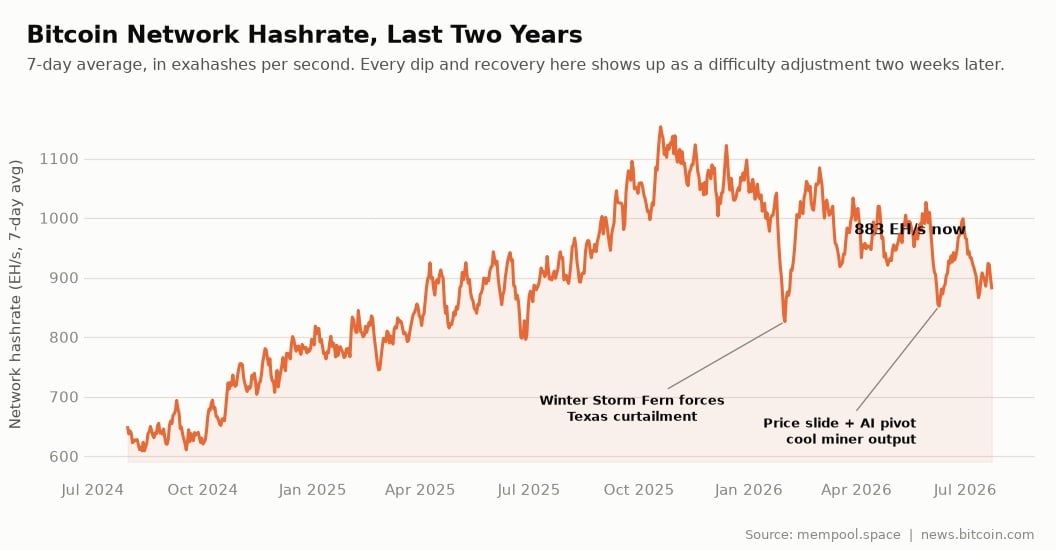
That 12-day round trip (down double digits, then up double digits) is the difficulty adjustment working exactly as designed under stress, i.e. correcting for an external shock (a storm) rather than a change in the network’s underlying security budget.
June’s Drop Was a Different Animal
Most recently, difficulty fell again in June 2026 (down roughly 9.91% on June 13), the second-largest negative adjustment of the year after February’s. But this one wasn’t weather. A roughly 15% slide in bitcoin’s price squeezed margins for miners running older or less efficient hardware, and the retarget period itself ran 15.6 days instead of the usual 14, evidence that hashrate was leaking off the network gradually rather than falling off a cliff.
Several publicly listed mining firms had also been redirecting rigs and data-center capacity toward AI and high-performance computing workloads, where returns looked steadier than mining at depressed bitcoin prices. Texas’s summer “four coincident peak” season, when large power users curtail usage to avoid setting next year’s transmission costs, added a seasonal drag on top.
The separation is important to note because while February’s whipsaw was a temporary supply shock that fully reversed itself within a month, June’s decline was an economic decision by miners about where their hardware and power are best spent.
As of late July, the network is roughly 80% of the way through the current 2,016-block epoch, with early data pointing to a modest downward adjustment of about 1.2% at the next retarget near block 959,616. It’s a small move by 2026’s standards but still a reminder that most of the difficulty chart’s history is unremarkable, and that’s the point. The rule isn’t built to produce headlines; it’s built to make Bitcoin’s issuance schedule indifferent to whether a storm knocks Texas miners offline or a mining firm decides AI compute pays better than block rewards. Every two weeks, it does the correction anyway.









 English (US) ·