
 4 months ago
56
4 months ago
56
Bitcoin is struggling to hold the $70,000 level as persistent selling pressure weighs on market sentiment and momentum. After months of volatility, recent price action suggests a fragile structure, with buyers repeatedly failing to reclaim higher resistance zones. Analysts increasingly warn that downside risks remain elevated as short-term investors continue to absorb losses rather than stepping in aggressively to accumulate.
A recent report from analyst Axel Adler highlights mounting stress among short-term holders. Data from the Bitcoin Short-Term Holders SOPR indicator shows that many participants are now realizing losses, with this cohort sitting roughly 25% below their average acquisition cost. The SOPR metric, which compares selling price to purchase price, has dropped to 0.949, while its 7-day average remains near 0.97. Values below 1.0 confirm that coins are being sold at a loss, often reflecting forced liquidations or reactive selling behavior.
Notably, the indicator has stayed below this threshold since mid-January, signaling sustained pressure rather than a short-lived correction. Historically, prolonged SOPR weakness alongside price stabilization can indicate seller exhaustion. However, a decisive move back above 1.0 would be required to confirm a shift in market regime. Until then, the risk of further downside cannot be ruled out.
Short-Term Holder MVRV Signals Deep Unrealized Losses
Axel Adler also points to the Bitcoin Short-Term Holder MVRV indicator as further evidence of mounting stress among recent market participants. This metric compares the current market price with the average acquisition price of short-term holders, offering a clear view of unrealized profitability. When MVRV falls below 1.0, it indicates that this cohort is, on average, holding positions at a loss rather than in profit.

Recent data shows the STH MVRV dropping sharply to around 0.752, with the cohort’s realized price near $95,400. With Bitcoin trading close to $71,700, short-term holders are roughly 25% underwater. The gap between market price and their cost basis—about $23,700—is currently the widest observed in this cycle, highlighting the scale of recent downside pressure.
Historically, MVRV readings approaching or falling below the 0.8 level have often coincided with accumulation phases or local market bottoms. However, such signals are not sufficient on their own. Confirmation typically requires price stabilization alongside a recovery in SOPR above 1.0, indicating that forced selling has eased. Until those conditions emerge, the data suggests continued fragility despite increasing signs of capitulation.
Bitcoin Breaks Key Weekly Support As Downtrend Accelerates
Bitcoin’s weekly structure shows clear deterioration after price decisively broke below the mid-range support that had previously held near the $75K area. The latest candle reflects strong downside momentum, pushing BTC toward the $70K zone while trading well below the 50-week moving average. Historically, sustained trading under this average tends to coincide with corrective or transitional bear phases rather than bullish continuation.
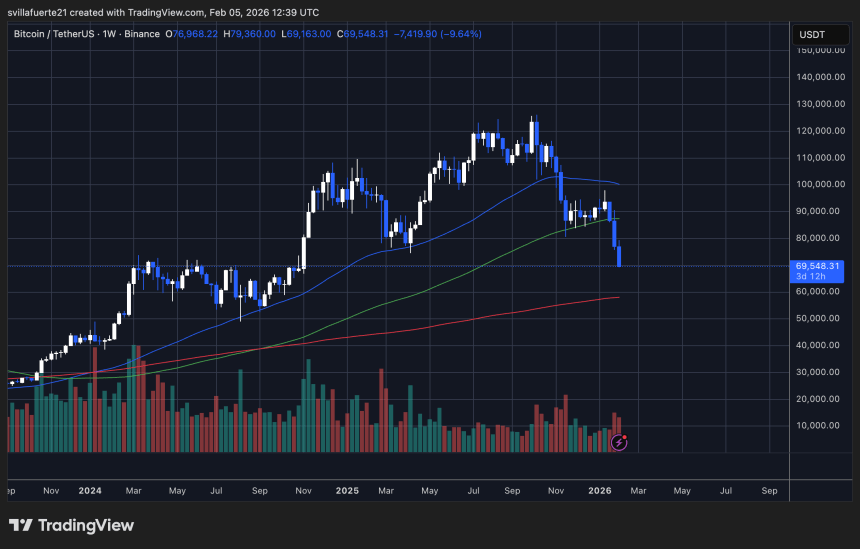
The 100-week moving average, currently positioned slightly above $80K, has shifted from support to resistance. The market requires a reclaim of this level to stabilize sentiment. Meanwhile, the 200-week average continues to trend upward near the $55K–$60K region, marking a deeper macro support band if selling pressure persists.
Volume expansion accompanying the latest decline suggests active distribution rather than low-liquidity drift. However, capitulation phases often show similar volume characteristics, meaning interpretation depends on whether follow-through selling continues or begins to fade.
Structurally, BTC now faces a critical test. Holding above the $68K–$70K range could allow consolidation before a potential recovery attempt. Failure to stabilize there would increase the probability of a deeper retracement toward longer-term moving average support, keeping the broader market cautious despite growing oversold conditions.
Featured image from ChatGPT, chart from TradingView.com









 English (US) ·