
 2 months ago
59
2 months ago
59
- Ethereum continues leading institutional tokenized finance through liquidity and established trust.
- Solana is targeting scalability and lower transaction costs to attract future financial activity.
- XRP Ledger, Avalanche, and Polygon are focusing on banking infrastructure and enterprise adoption.
The race to dominate the tokenized real-world asset market is starting to intensify, and honestly, it’s becoming one of the most important battles happening across crypto right now. Major blockchain networks including Ethereum, Solana, XRP Ledger, Avalanche, and Polygon are all pushing into institutional finance, though each one is approaching the opportunity from a very different angle. Some are focusing on liquidity and settlement speed, while others are targeting banking infrastructure, enterprise systems, or tokenized securities.
What’s becoming clearer is that this probably won’t end with a single winner controlling everything. Instead, the market is beginning to split into specialized segments where different networks handle different parts of the financial stack. That shift matters because institutional adoption is no longer just theory anymore, large firms are already testing these systems in real-world environments.
RWA race
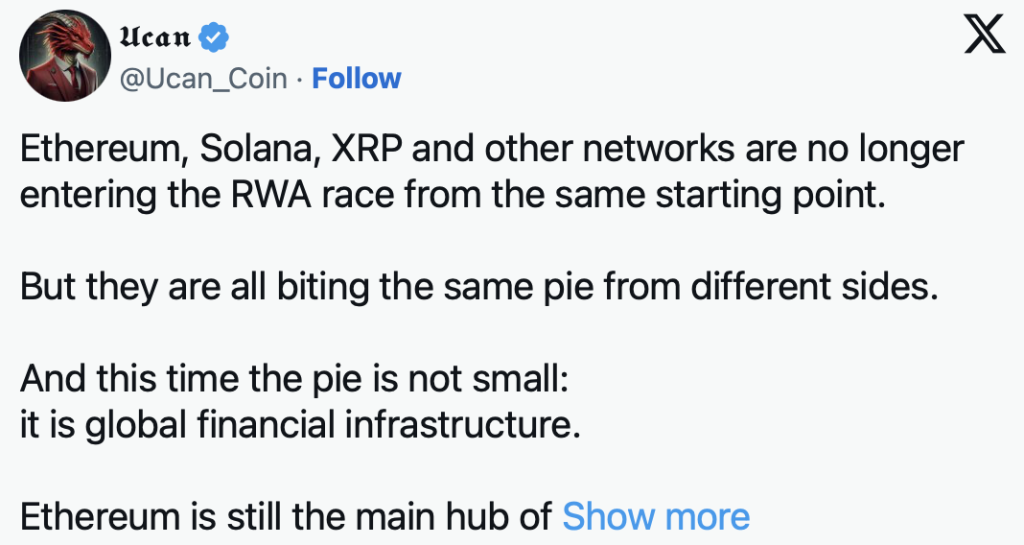
Ethereum Still Leads Institutional Liquidity
Ethereum continues holding the strongest position overall when it comes to institutional tokenized assets. A huge amount of liquidity still flows directly through Ethereum infrastructure, particularly across products tied to tokenized treasuries and regulated financial instruments. BlackRock’s BUIDL fund, Franklin Templeton’s blockchain-based financial products, and several major treasury-related initiatives all remain deeply connected to Ethereum’s ecosystem.
Protocols like Ondo Finance, Maple Finance, Centrifuge, and Securitize have also helped strengthen Ethereum’s lead during this latest expansion cycle. The network still benefits from something many competitors struggle to replicate — trust. Institutions already understand Ethereum, liquidity is deep, and the broader decentralized finance ecosystem remains highly interconnected through composability.
Right now, estimates place Ethereum’s tokenized asset ecosystem somewhere between $15 billion and $17 billion in total value. That concentration continues reinforcing Ethereum’s role as the dominant settlement layer for institutional capital markets. In many ways, Ethereum has become the default starting point for large financial firms entering tokenized finance.
Still, Ethereum’s dominance comes with tradeoffs. High transaction costs and scalability limitations remain persistent problems, especially as activity increases. And that’s exactly where Solana has started applying pressure.
Solana Pushes Speed and Lower Costs
Solana is taking a very different approach in the RWA race. Instead of competing directly on trust or legacy adoption, the network is positioning itself around speed, efficiency, and lower operational costs. The pitch is simple really — if institutions can move assets faster and cheaper, liquidity may eventually follow.
The ecosystem has expanded aggressively through tokenized asset projects and high-frequency financial applications. At one point, Solana even briefly surpassed Ethereum in total real-world asset holders, signaling growing interest from both retail users and market makers. That caught a lot of attention because it showed institutions may be willing to experiment outside Ethereum’s ecosystem if performance advantages become large enough.
Solana’s broader strategy focuses heavily on execution efficiency. Faster settlement speeds and lower fees create a much smoother environment for large-scale financial activity, especially for applications that require constant transactions or rapid clearing. The network isn’t necessarily trying to replace Ethereum overnight, but it clearly wants a large slice of future institutional liquidity.

XRP Ledger Targets Global Banking Infrastructure
XRP Ledger, meanwhile, is mostly avoiding the broader decentralized finance competition altogether. Instead, it continues focusing directly on banking systems, cross-border payments, and institutional settlement infrastructure. That’s been Ripple’s long-term strategy for years, and the network still positions itself as a bridge between traditional finance and blockchain-based settlement systems.
Discussions around CBDCs and international payment rails remain central to XRP Ledger’s growth strategy. Its compatibility with ISO 20022 standards also strengthens interoperability between blockchain systems and traditional financial messaging networks, which is a pretty important advantage for banks looking to modernize without rebuilding everything from scratch.
Recent commentary surrounding XRP Ledger emphasized that the network is intentionally avoiding direct competition inside wider DeFi markets. Rather than chasing retail speculation, the ecosystem continues prioritizing interbank settlement, institutional communication systems, and payment infrastructure. It’s a narrower focus, sure, but potentially a very lucrative one if adoption keeps growing.
Avalanche and Polygon Expand Enterprise Adoption
Avalanche is also carving out its own institutional niche through customizable blockchain infrastructure. Its subnet architecture allows financial institutions to launch isolated blockchain environments while still maintaining privacy and operational flexibility. That model has started attracting growing experimentation across tokenized products and private financial markets.
A lot of institutions prefer dedicated blockchain systems rather than exposing sensitive operations directly onto fully public networks. Avalanche seems to understand that demand pretty well, and its infrastructure reflects that enterprise-first mindset.
Polygon, on the other hand, continues positioning itself as a more accessible entry layer for traditional companies exploring tokenized finance. The network has attracted several corporate pilot programs and keeps leaning heavily into zero-knowledge scaling technology. Many traditional firms appear comfortable testing blockchain-based financial products through Polygon without completely abandoning their existing systems and workflows.
At this stage, the broader market no longer looks like a single race with one eventual winner. Instead, the competitive landscape is becoming fragmented, with different networks specializing in liquidity, settlement, payments, scalability, privacy, and enterprise integration.
Boston Consulting Group estimates tokenized assets could eventually grow into a $16 trillion market by 2030. That projection alone is enough to explain why competition between blockchain ecosystems is becoming so aggressive. Everyone wants a piece of the future financial infrastructure, and the battle is only getting started.
Disclaimer: BlockNews provides independent reporting on crypto, blockchain, and digital finance. All content is for informational purposes only and does not constitute financial advice. Readers should do their own research before making investment decisions. Some articles may use AI tools to assist in drafting, but every piece is reviewed and edited by our editorial team of experienced crypto writers and analysts before publication.




 English (US) ·