
 1 hour ago
11
1 hour ago
11
Michael Saylor said Bitcoin has moved far beyond its early life as a niche protest and now reaches individuals, companies, banks, capital markets, and governments.
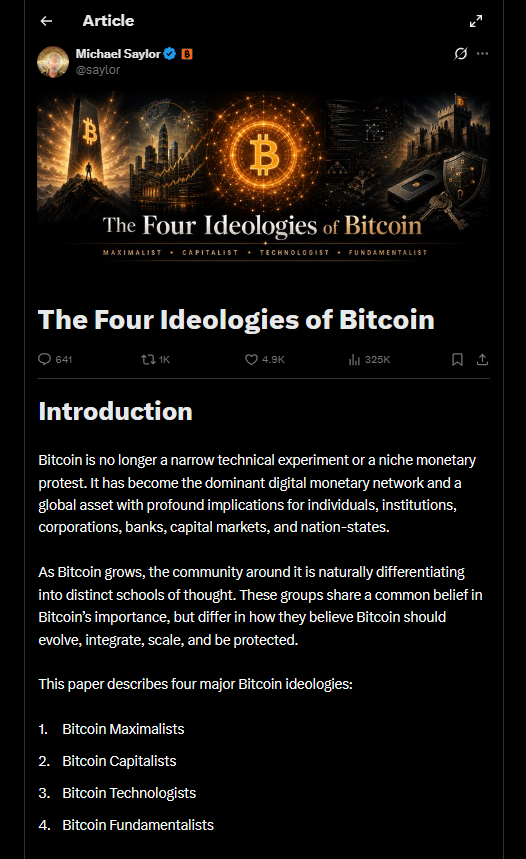
In a new paper posted on X, he grouped the Bitcoin world into four camps and argued that the split reflects growth, not collapse.
Four Camps, One Network
The four labels are Bitcoin Maximalists, Bitcoin Capitalists, Bitcoin Technologists, and Bitcoin Fundamentalists. According to the paper, they all see value in Bitcoin, but they disagree on how far it should stretch, how fast it should change, and how tightly it should tie itself to the financial system.
Saylor cast Maximalists as people who see Bitcoin as the main digital monetary network, a form of sound money, and a shield against inflation and weak currencies.
— Michael Saylor (@saylor) June 5, 2026
He also said this group gives Bitcoin moral clarity, while still leaving open the question of how the network fits with banks, public companies, and governments.
Bitcoin Capitalists, in his view, push in the other direction and want the asset embedded in portfolios, balance sheets, credit products, custody systems, and market infrastructure.
Saylor described them as the group most comfortable with corporate treasuries, institutional custody, and financial tools built around Bitcoin rather than just on top of it.
Protocol Pressure Points
The technologist camp, Saylor said, wants Bitcoin to keep improving on issues like scalability, privacy, security, wallet design, usability, custody, and even future threats such as quantum computing.
He warned that upgrades carry risk, because Bitcoin’s base layer holds value in part because users trust it not to change carelessly.
He drew a hard line around the Fundamentalists, who focus on self-custody, personal nodes, decentralization, immutability, and censorship resistance.
Their concern is that banks, governments, custodians, leverage, and financial engineering could push Bitcoin away from the purpose that made it worth defending in the first place.
That wider argument lands while Strategy, the company Saylor leads as executive chairman, is under fresh market pressure after a rare Bitcoin sale drew attention last week.
Reports said the firm sold 32 BTC for about $2.5 million, its first Bitcoin sale since 2022, as Bitcoin traded near $60,000 and ETF outflows weighed on sentiment.
Can Saylor Stop The Rivalry?Saylor’s paper frames the split as a normal stage in Bitcoin’s growth, not a sign of failure. His message was that Bitcoin can keep its base layer intact while allowing markets, custody services, and new financial products to grow around it.
Four camps, one coin, and a lot of egos. Saylor calls it growing pains. But with money, politics, and principles all colliding, can he actually get them to stop fighting — or does everyone think they’re the only one keeping Bitcoin alive?
Featured image from MetaAI, chart from TradingView








 English (US) ·