
 4 months ago
50
4 months ago
50
What to Know:
- The integration of banks and crypto is shifting focus from regulation to long-term security infrastructure.
- ‘Harvest now, decrypt later’ attacks pose a significant threat to institutions holding assets for long durations.
- BMIC utilizes post-quantum cryptography and zero public-key exposure to secure assets against future computing threats.
- Early traction shows over $433K raised, signaling market demand for preventative security solutions.
The ‘banks versus Bitcoin’ war? It’s over. With ETFs approved and Washington’s stance softening, that old rivalry has dissolved into a frantic race for integration. Signals from Treasury Secretary Scott Bessent suggest traditional banks are gearing up to offer direct crypto products, effectively merging the $130T legacy finance world with the digital asset economy.
That shift fundamentally changes the industry’s risk profile. When a retail user loses keys, it’s a tragedy; when a custodian bank suffers a breach, it’s a systemic crisis. As institutions migrate assets on-chain, the conversation isn’t ‘is it legal?’ anymore. It’s ‘is it safe forever?’ The current standard of encryption, guarding everything from SWIFT transfers to Ethereum wallets, is staring down an expiry date.
The looming threat of quantum computing has introduced the ‘harvest now, decrypt later’ attack vector. Bad actors are currently scraping encrypted data, waiting for the computing power to unlock it.
For banks planning to hold assets for decades, today’s security standards are a leaky sieve. This gap between infrastructure and future threats is the friction point slowing total integration, and it’s precisely the void BMIC ($BMIC) has emerged to fill. By deploying post-quantum cryptography today, the project offers the digital bedrock necessary for the next phase of institutional adoption.
CHECK OUT $BMIC ON ITS OFFICIAL PRESALE PAGE
Quantum-Proofing The Institutional Bridge With AI Defense
Bringing banks on-chain demands a technological overhaul, not just regulatory clarity. Legacy wallets expose public keys during transactions, leaving a breadcrumb trail that future quantum computers could theoretically reverse-engineer to access funds. For an individual, that’s a risk. For a bank managing pension funds? It’s a non-starter.
BMIC addresses this with a full Quantum-Secure Finance Stack that fundamentally changes how transactions are signed and stored.
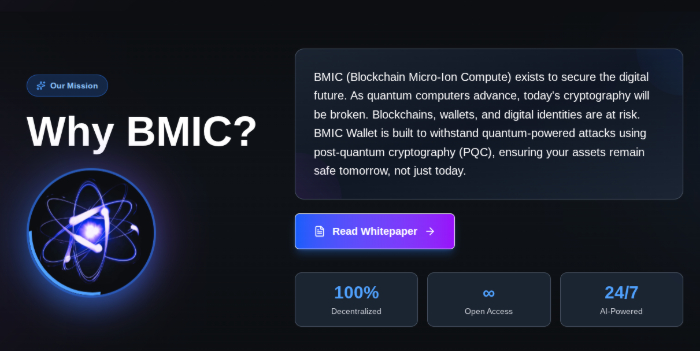
BMIC uses ERC-4337 Smart Accounts to enable zero public-key exposure. This means the sensitive data required to sign a transaction never touches the public network in a vulnerable state. By combining this with an AI-enhanced threat detection system, the platform creates a ‘Quantum Meta-Cloud’, a secure environment where assets can be staked and transferred without the lingering threat of future decryption.
This approach creates a necessary safety layer for the ‘Harvest now, decrypt later’ problem. While other interoperability protocols chase speed, BMIC focuses on longevity. For enterprises and developers building the rails for bank-crypto integration, this security architecture offers a viable insurance policy against the inevitable advance of computing power.
Early Access To The Post-Quantum Financial Stack
While institutional giants sluggishly update their legacy systems, early participants can position themselves in next-generation infrastructure now. The market often undervalues security layers until a crisis hits, but smart money usually locates the ‘picks and shovels’ of the ecosystem long before the narrative hits mainstream media.
$BMIC is currently in its presale phase, offering a distinct entry point into the post-quantum sector.
It has already raised over $433K, validating early interest in quantum-resistant utilities. $BMIC is currently priced at $0.049474, showing an early-stage opportunity for those who are interested in the quantum future and protecting their assets. With its security for the future, it is clear to see why we think it could be one of the best long-term crypto investments.
Frankly, the tokenomics are designed to do more than just facilitate speculation. The token serves as fuel for the quantum-secure wallet and governance, but also enables burn-to-compute mechanisms. This utility loop ensures that as demand for secure processing grows, the supply dynamics of the token respond accordingly. In a market crowded with meme coins and temporary trends, the push for quantum security represents a tangible shift in how value is stored.
This article is for informational purposes only and does not constitute financial advice. Cryptocurrency investments, particularly presales, carry high risk and volatility. Always conduct your own due diligence before making investment decisions.





 English (US) ·