
 1 month ago
58
1 month ago
58
Republican lawmakers are feeling a renewed sense of urgency to pass the Digital Asset Market Clarity (CLARITY) Act before the U.S. Senate breaks for its August recess. The market-structure bill still needs at least seven Democratic votes to clear a 60-vote threshold.
Key Takeaways
Pressure Builds as the Legislative Window Narrows
The push was reported by Eleanor Terrett, host of “ Crypto in America,” who said GOP lawmakers are increasingly anxious to move the bill once senators return from their break. She tied the renewed sense of urgency to heightened political pressure following the fallout from a contentious housing bill, as well as a growing realization that time is running short. She further added:
“Pressure and time constraints could ultimately create the conditions needed to strike a deal.”
Lawmakers and analysts broadly agree that the Senate must act before August for the legislation to have a realistic shot this year. The CLARITY Act would establish a federal framework dividing oversight of digital assets between the Securities and Exchange Commission (SEC) and the Commodity Futures Trading Commission (CFTC). It is a long-sought goal for an industry that has complained for years about regulatory uncertainty in the U.S. The House of Representatives passed its version of the measure in 2025.
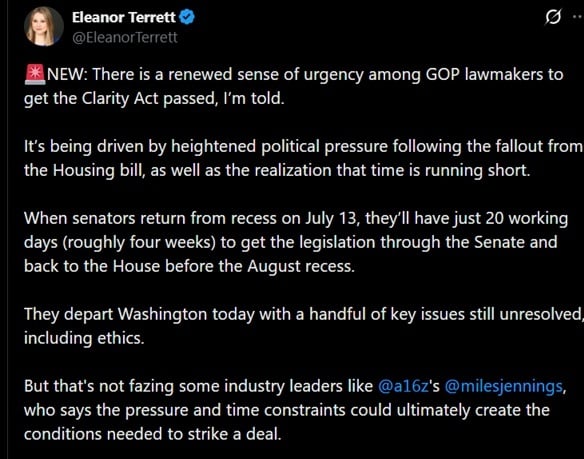 Image source: X
From the outside looking in, the arithmetic seems to be a central hurdle as Republicans hold 53 Senate seats, which means the bill needs at least seven Democratic votes to overcome the 60-vote cloture threshold and reach a final floor vote. The Senate Banking Committee advanced the legislation in a 15-9 vote in May, placing it on the calendar but leaving the floor fight unresolved.
Senator Cynthia Lummis (R-WY) has set an end-of-July target and warned that missing the window could push enforceable digital-asset rules to 2030. Reporting indicates that the House is prepared to move quickly to reconcile the two versions if the Senate passes its bill before the recess, with the lower chamber scheduling back-to-back hearings in July touching on crypto policy.
Industry pressure has also intensified, with more than 200 organizations, including Coinbase and Ripple, urging Senate leaders to bring the bill to the floor. A separate coalition representing over 1,200 technology companies has pressed for swift passage as U.S. crypto rules face mounting global competition. Groups of former national security officials and crypto founders have added their names to the mix as well in recent weeks.
That said, not everyone is on board with these developments, and Senator Elizabeth Warren (D-MA), ranking member of the Senate Banking Committee, recently argued that the bill in its current form could “blow up the economy.” That opposition is part of why supporters need to peel off a handful of Democrats to reach 60 votes.
What Comes Next
The next step is a Senate floor vote, where the bill’s bipartisan support will face its broadest test. Even if it clears that hurdle, the Senate text would still need to be reconciled with the House’s 2025 version before anything could reach the president’s desk.
As things stand, the August recess functions as a hard deadline in the minds of the bill’s backers. The post-recess stretch runs into an election-year calendar that supporters fear could stall momentum, which is why several lawmakers describe the coming weeks as the bill’s best and possibly final opening this Congress.









 English (US) ·