
 1 month ago
33
1 month ago
33
TLDR
- Brent crude advanced 1.7% to reach $106.88 per barrel; WTI increased 1.4% to $97.21 per barrel
- Weekly gains for both benchmarks are tracking toward their largest since the beginning of March
- Approximately 20% of the world’s oil supply remains blocked due to the nearly closed Strait of Hormuz
- President Trump indicated no urgency to finalize a lasting agreement with Iran, prolonging market uncertainty
- Goldman Sachs projects Persian Gulf production has fallen by approximately 14.5 million barrels daily, representing over half of April’s regional output
Crude oil markets experienced significant upward momentum on Friday following remarks from President Donald Trump suggesting he feels no pressure to quickly resolve the current standoff with Iran, injecting additional uncertainty into already volatile energy markets.
Brent crude futures climbed 1.7% to settle at $106.88 per barrel. Meanwhile, U.S. West Texas Intermediate futures advanced 1.4%, reaching $97.21 per barrel. Both oil benchmarks are tracking toward their most substantial weekly gains since the start of March.
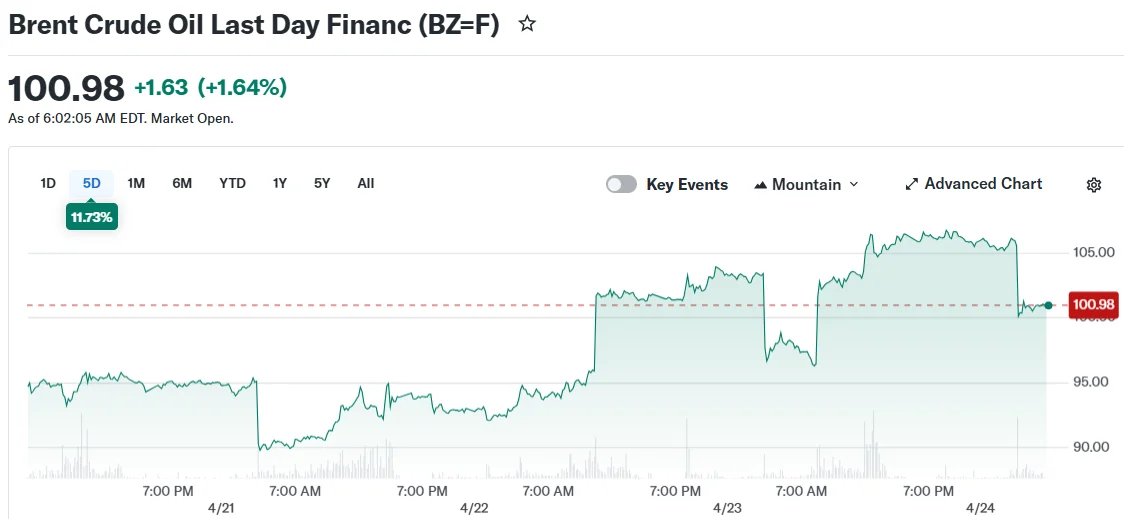 Brent Crude Oil Last Day Financ (BZ=F)
The price surge follows continued disruption at the Strait of Hormuz — a critical maritime chokepoint along Iran’s southern coastline — which has remained largely inaccessible to tanker vessels. Approximately 20% of the world’s petroleum supplies typically transit through this strategic passage.
For several weeks now, the waterway has been effectively blocked. Key Gulf oil exporters, including Saudi Arabia and Qatar, have attempted to establish alternate shipping pathways, though none have successfully compensated for the lost capacity.

 Trump has ordered the U.S. Navy to fire on any Iranian boats caught laying mines in the Strait of Hormuz.
Iran started mining the Strait back in early March.
Pentagon officials told lawmakers this week it could take up to 6 months to fully clear it after the war ends.
A… https://t.co/XjiZ5ABjyQ pic.twitter.com/SzR1PLdlwr
— Mario Nawfal (@MarioNawfal) April 24, 2026
This week witnessed Iranian forces intercepting vessels that attempted passage through the strait. Simultaneously, U.S. military personnel boarded a supertanker transporting Iranian crude in the Indian Ocean, part of Washington’s intensified naval blockade targeting Iranian shipping facilities.
Thursday saw Trump announce via Truth Social that he had authorized the U.S. Navy to “shoot and kill” any Iranian military boats discovered deploying mines within the strait. Iran responded by broadcasting footage showing its special forces boarding a commercial vessel and demonstrating its fast-attack boat capabilities.
Peace Talks at a Standstill
Diplomatic initiatives aimed at restarting negotiations have reached an impasse. According to two U.S. officials speaking with Bloomberg on condition of anonymity, Trump’s social media statements combined with the ongoing naval enforcement actions have undermined mediation attempts being conducted by nations such as Pakistan.
Trump addressed journalists on Thursday, stating his administration wasn’t interested in hastily concluding a permanent agreement, emphasizing that U.S. military action had severely degraded Iran’s armed forces and left the nation destabilized.
While a ceasefire agreement between Washington and Tehran was extended for an indefinite period earlier this week, petroleum markets have shown minimal positive response. Separately, the Lebanon-Israel ceasefire received a three-week extension following discussions in Washington.
Observers reported spotting a U.S.-sanctioned supertanker laden with Iranian crude apparently making an attempt to traverse the Strait of Hormuz on Friday, even as overall vessel movement through the waterway remains virtually nonexistent.
Goldman Sees Months of Supply Disruption
Goldman Sachs commodities analysts, led by Daan Struyven, published findings on April 23 suggesting that crude oil production from the Persian Gulf region could require “a few months” to substantially recover — and that timeline assumes both a complete reopening of Hormuz and an absence of renewed military strikes.
The investment bank’s analysis indicates Gulf production capacity has declined by approximately 14.5 million barrels daily, constituting more than half of the region’s total April output.
“Oil is rising more because of the physical supply shock rather than a geopolitical risk premium alone,” said Charu Chanana, chief investment strategist at Saxo Markets. “The war risk may be fading at the margin, but the flow risk has not gone away.”
Mona Yacoubian of the Center for Strategic and International Studies noted the disruption is proving hard to ignore. “The longer this continues, the more it becomes clear that the disruptive effects of this conflict are going to reverberate for months, if not longer,” she said.
Brent crude was poised for a weekly increase of approximately 17% heading into Friday afternoon trading.
The post Crude Markets Surge as Hormuz Blockade Persists Amid U.S.-Iran Tensions appeared first on Blockonomi.






 English (US) ·