
 1 hour ago
15
1 hour ago
15
TLDR
- Brent crude maintained levels above $108 per barrel following a brief 2.4% decline at Monday’s market opening
- White House unveiled plans to assist commercial vessels trapped in the Strait of Hormuz
- Current proposal excludes direct naval warship convoy protection for vessels
- Projectiles struck a tanker approximately 78 nautical miles north of Fujairah over the weekend
- Trading desks expressed doubt over the initiative’s ability to effectively reopen the waterway
Oil prices maintained stability throughout Monday’s session following initial weakness, as market participants assessed Washington’s latest initiative to extract stranded commercial traffic from the Strait of Hormuz.
Brent crude showed minimal movement above the $108 per barrel threshold after experiencing an intraday decline of up to 2.4% during opening hours. West Texas Intermediate similarly held its ground near the $102 mark.
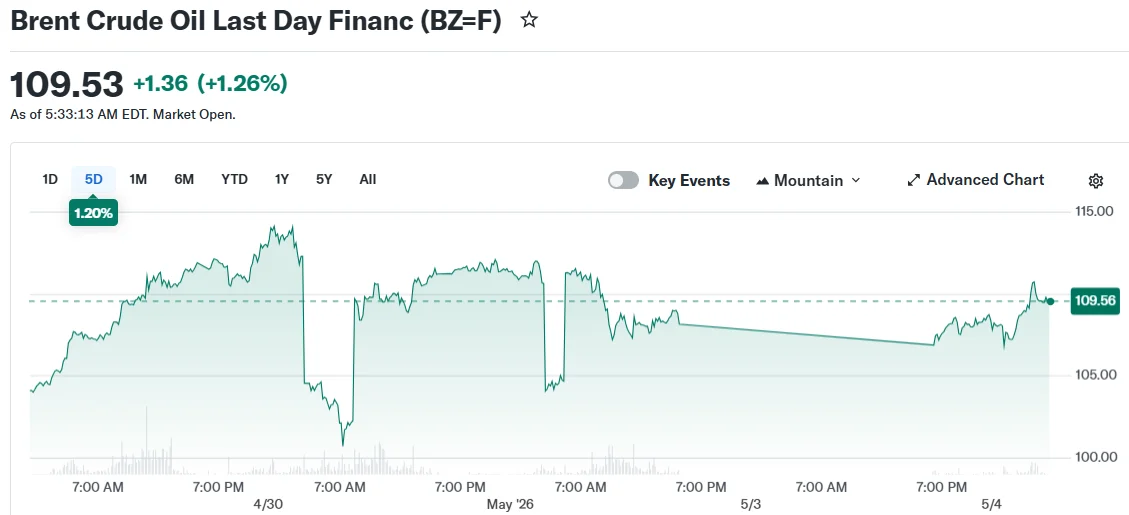 Brent Crude Oil Last Day Financ (BZ=F)
Through social media channels, President Donald Trump declared the United States would commence operations Monday to navigate neutral merchant ships through the strait. “We will use best efforts to get their Ships and Crews safely out of the Strait,” his statement read.
 JUST IN: U.S. TO ESCORT SHIPS OUT OF STRAIT OF HORMUZ
Trump says the U.S. will launch “Project Freedom” to guide neutral ships stranded in the Strait of Hormuz to safety starting Monday.
He called it a humanitarian effort, warning any interference would be met with force. pic.twitter.com/pdl89U126x
— Coin Bureau (@coinbureau) May 3, 2026
US Central Command verified its commitment to deploy military assets, including guided-missile destroyers, aerial units, and unmanned surveillance systems. The Wall Street Journal noted, however, that current operational parameters exclude direct Navy warship escort duties.
The declaration provided only fleeting support to crude markets. Industry experts and trading professionals immediately raised concerns about the strategy’s practical effectiveness.
“Market sentiment suggests limited confidence in this approach,” ING analysts observed. “While the initiative may facilitate outbound vessel movement from the Persian Gulf, inbound maritime traffic will likely remain severely constrained.”
Haris Khurshid, chief investment officer at Karobaar Capital, suggested traders have become desensitized to presidential commentary on the crisis. “Trump fatigue is setting in more and more — I don’t think the market’s really taking it seriously,” he noted.
Weekend Attack Underscores Regional Volatility
A commercial tanker sustained damage from projectile strikes Sunday at a location 78 nautical miles north of Fujairah in the United Arab Emirates. UK Maritime Trade Operations documented the incident. While the vessel’s identity remains undisclosed, all crew members were reported unharmed.
The president additionally suggested potential military action should Iran attempt to prevent vessel departures. He characterized ongoing diplomatic discussions with Tehran as “very positive” while withholding additional specifics.
Iran dismissed Washington’s proposal outright. According to Al Mayadeen, Ebrahim Azizi, chairman of Iran’s parliamentary National Security Commission, characterized any American intervention in the strait as a ceasefire violation.
Hostilities erupted in late February following joint US-Israeli military operations against Iran, justified by nuclear program concerns. A bilateral blockade has since emerged, with Tehran preventing Persian Gulf departures while Washington intercepts traffic associated with Iranian ports.
Supply Constraints Intensify
Treasury Secretary Scott Bessent indicated over the weekend that Iranian well shutdowns could commence “in the next week” as domestic storage capacity reaches maximum levels.
ANZ Group analysts emphasized escalating supply deficits resulting from the extended strait closure. “With the demand response muted, a significant drawdown in inventories has ensued,” their analysis stated.
Recent weeks have witnessed crude prices reach their most elevated levels since 2022 due to the ongoing conflict.
OPEC+ members reached agreement over the weekend on a modest symbolic adjustment to June production quotas, as the coalition aimed to project market confidence following the United Arab Emirates’ departure from the group.
The post Crude Markets Unmoved by Trump’s Strait of Hormuz Navigation Proposal appeared first on Blockonomi.







 English (US) ·