
 3 months ago
75
3 months ago
75
TLDR
- Military confrontation resumed between Israel and Iran, ending a ceasefire established in April
- Brent crude surged over 5% to approach $98 per barrel during Monday’s session
- The Strait of Hormuz continues to face severe restrictions, constraining worldwide energy distribution
- President Trump called for immediate cessation of hostilities, though diplomatic efforts have stagnated
- OPEC+ announced July production increases, though analysts view the decision as primarily ceremonial
Renewed military action between Israel and Iran erupted on Monday, shattering a ceasefire agreement that had held since April. The escalation triggered a sharp rally in crude oil prices as global markets responded to heightened conflict concerns.
Brent crude surged over 5% during early market hours, reaching nearly $98 per barrel. West Texas Intermediate experienced comparable gains, climbing to approximately $94.59 per barrel. Year-to-date, both oil benchmarks have appreciated more than 60%.
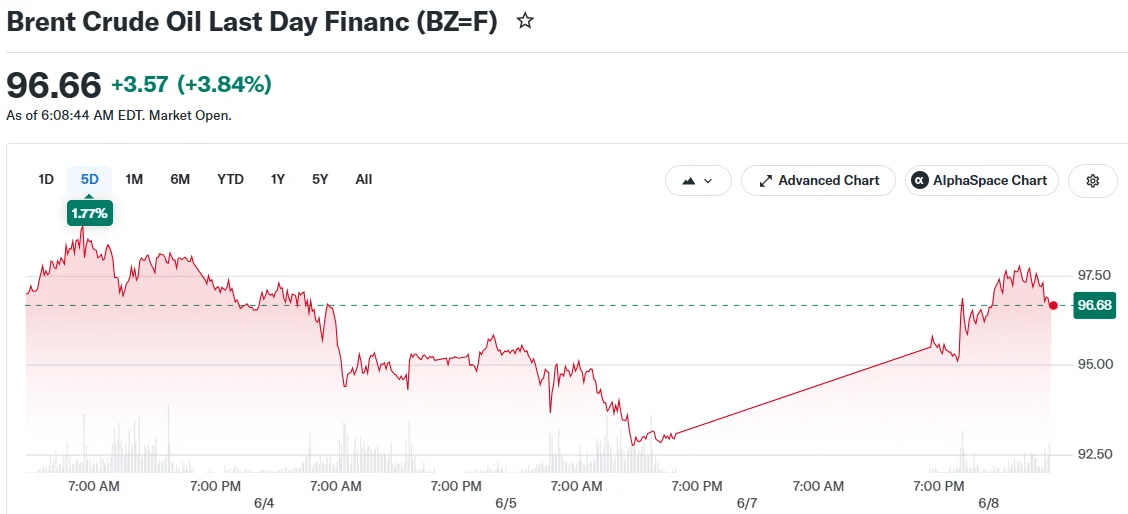 Brent Crude Oil Last Day Financ (BZ=F)
The hostilities occurred despite President Donald Trump’s appeals to both Israeli Prime Minister Benjamin Netanyahu and Iranian leadership to exercise restraint. Trump took to Truth Social, demanding an immediate cessation from all parties involved.
Israeli forces confirmed strikes against Iranian military installations, characterizing the operation as a response to Tehran’s earlier missile deployments. The Israeli Defense Forces indicated the offensive could extend over multiple days and potentially require mobilization of reserve forces.
Speaking with the Financial Times, Trump emphasized his authority over negotiations. “I call the shots. I call all the shots,” he stated regarding prospects for a US-Iran diplomatic arrangement.
Hormuz Remains a Choke Point for Global Energy
The near-blockade of the Strait of Hormuz continues to severely limit the movement of oil, petroleum products, and natural gas to international markets. This waterway serves as an essential corridor for energy shipments from the Persian Gulf region.
US Central Command reported intercepting two Iranian unmanned aerial vehicles that posed threats to commercial shipping in the Hormuz area during the weekend. Additionally, six ballistic missiles targeting Bahrain and Kuwait on Friday were successfully neutralized.
Yemen’s Houthi movement announced a comprehensive prohibition on Israeli-linked shipping through the Red Sea. However, maritime industry observers noted minimal immediate impact, as most carriers had already rerouted away from the contested zone.
European natural gas valuations also climbed on Monday. The continent is currently in its critical summer storage accumulation period, and interruptions to liquefied natural gas shipments are intensifying market pressures.
During the conflict’s most severe phase, Brent crude reached approximately $130 per barrel. While Oil prices remained beneath the $100 threshold on Monday, market analysts cautioned that conditions could deteriorate rapidly.
Ole Hansen from Saxo Bank observed that prospects for sustainable peace appear “increasingly elusive.” He noted that energy sector participants anticipate sustained elevated pricing.
OPEC+ Output Hike Seen as Symbolic
OPEC+ members finalized an agreement Sunday to implement another production increase for July, representing the fourth consecutive monthly expansion. Nevertheless, market experts characterized the decision as having minimal practical significance given ongoing Hormuz disruptions.
Saudi Arabia simultaneously reduced pricing for its primary crude grade to Asian customers by $6 per barrel. This adjustment followed China’s decision to curtail crude purchases amid reduced refinery operations.
Even assuming successful peace negotiations, energy flows would not normalize immediately. Explosive ordnance removal from Hormuz shipping lanes, infrastructure restoration, and the lengthy process of reactivating idled production facilities could require months to complete.
Trump is pursuing a memorandum of understanding with Iran to restore Hormuz operations. Negotiations remain deadlocked over Tehran’s nuclear development activities and Iranian demands for unfreezing financial assets.
The Israel-Lebanon ceasefire agreement reached last week has also encountered complications, with Hezbollah refusing the proposed terms. Armed exchanges between Israeli forces and Hezbollah units persisted throughout the weekend.
The post Crude Oil Soars 5% as Israel-Iran Ceasefire Collapses — $100 Per Barrel in Sight? appeared first on Blockonomi.





 English (US) ·