
 6 months ago
110
6 months ago
110
- CME crypto derivatives volume is currently about 46% higher than its previous record year
- Bitcoin options open interest reached roughly $65 billion in mid-2025
- Decentralized derivatives platforms have expanded market share from about 2% to over 10%
The crypto derivatives market is evolving quickly, and options trading is starting to take center stage. Institutional investors — hedge funds, asset managers, even large trading desks — are increasingly turning to instruments that help define risk more precisely when handling large crypto positions.
Research from Delphi Digital shows just how quickly the space is expanding. Trading volumes on the Chicago Mercantile Exchange, one of the main institutional gateways into crypto derivatives, are currently running about 46% higher than the exchange’s previous record year. That kind of growth doesn’t happen randomly. It usually signals deeper institutional participation.
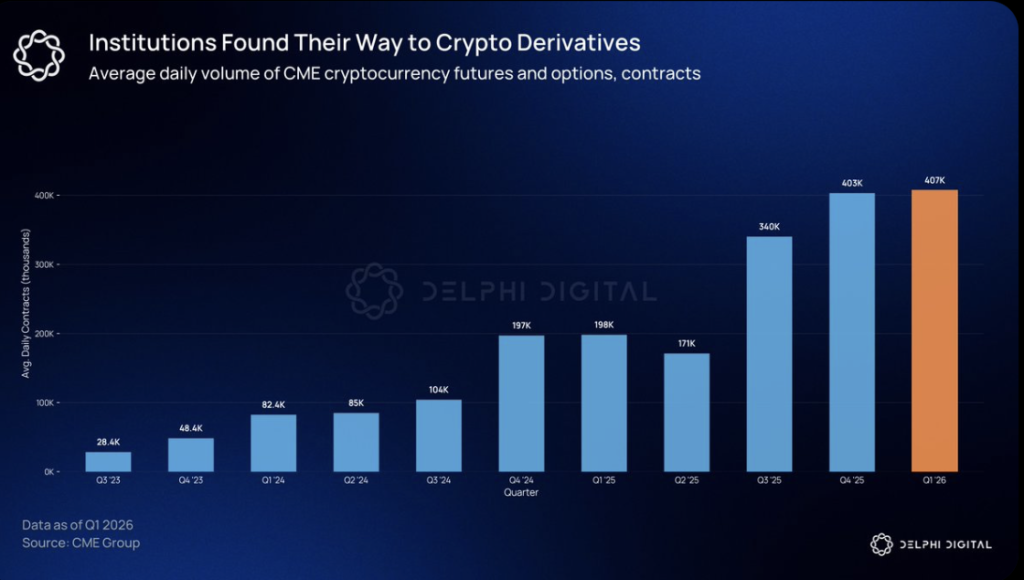
Institutions Prefer Options for Defined Risk
Part of the appeal comes down to flexibility. Options contracts allow investors to control risk in ways that futures simply don’t.
According to Delphi Digital, institutional demand for defined-risk products became especially clear in mid-2025. That was when open interest in Bitcoin options climbed to roughly $65 billion — surpassing Bitcoin futures open interest for the first time ever.
Futures are often used for leveraged exposure, sure. But options work differently. They allow traders to limit downside risk to the premium they pay while still keeping exposure to potential upside.
Imagine managing a $500 million Bitcoin position. A futures contract exposes the full amount to market swings. Options, on the other hand, let investors hedge that position without risking unlimited losses. For large funds… that difference matters a lot.
Centralized Exchanges Still Dominate Options Trading
Most crypto options trading still happens on centralized platforms. For years, the biggest venue has been Deribit, which built its reputation as the go-to exchange for professional crypto derivatives traders.
That dominance strengthened even further in 2025 when Coinbase acquired Deribit in a deal reportedly worth $2.9 billion. The acquisition added institutional credibility and additional liquidity to the platform.
Another major catalyst came from traditional finance. Options tied to BlackRock’s spot Bitcoin ETF, trading under the ticker IBIT, introduced a fresh wave of activity after launching in late 2024.
Those products gave traditional market participants — investors already familiar with ETF derivatives — an easier way to enter the crypto options market.
Decentralized Derivatives Platforms Are Gaining Ground
While centralized exchanges still dominate, decentralized derivatives platforms are starting to capture a growing share of the market.
According to Delphi Digital, decentralized derivatives trading has expanded significantly over the past two years. Market share has climbed from roughly 2% to more than 10%.
One project drawing attention is Hyperliquid, which has shown that decentralized trading platforms can achieve execution speeds and transparency levels that rival centralized exchanges. That’s a big deal, because performance has historically been the biggest weakness for decentralized trading systems.
Still, decentralized options trading itself hasn’t reached the same scale yet.
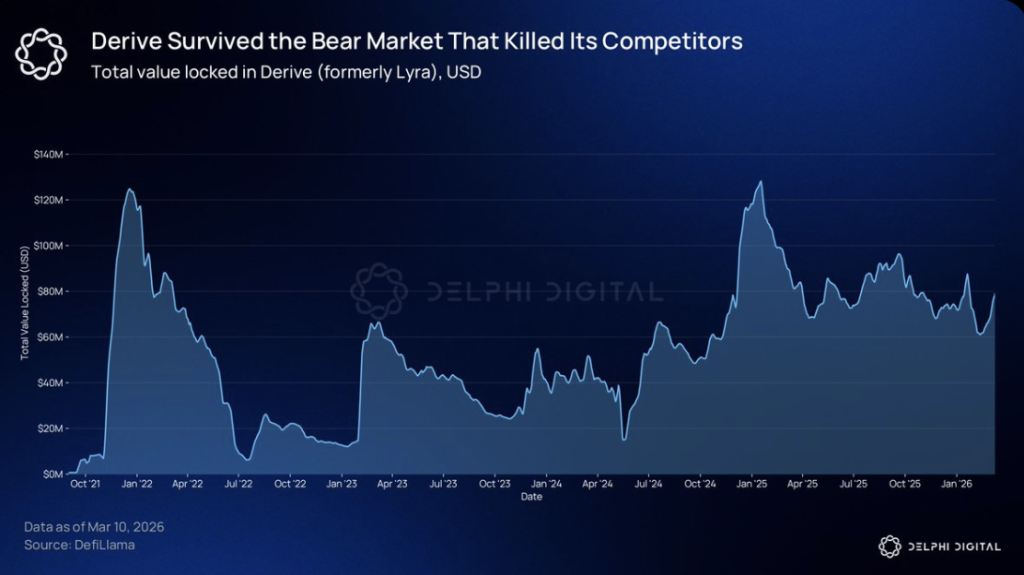
New On-Chain Options Platforms Are Emerging
Among decentralized options platforms, Delphi Digital highlighted Derive as the largest protocol currently operating in the space. Over the past 30 days, the platform processed more than $700 million in notional options volume.
Derive actually started life as Lyra back in 2021. In 2023 the project rebuilt its infrastructure using a gasless central limit order book running on its own OP Stack layer-2 network.
That redesign allows market makers to quote prices directly on the order book while letting traders execute transactions without paying gas fees — a major improvement for active derivatives trading.
Another platform developing similar technology is Kyan Exchange, which is currently operating in beta on the Arbitrum network. A full mainnet launch is expected soon.
Structured Crypto Products Are Driving Demand
Institutional interest in options is also tied to the rise of structured financial products.
Asset managers increasingly rely on derivatives to generate yield while maintaining clear risk boundaries. A common example is the covered-call strategy, where investors sell call options against assets they already hold to generate income.
These types of strategies are already widely used in traditional finance. In fact, derivative income funds collectively manage more than $100 billion in assets.
Crypto is slowly beginning to follow that same playbook.
Regulation Could Shape the Next Phase of Growth
Regulation will likely play a major role in the market’s next phase. Delphi Digital pointed to a joint statement released in September 2025 by the U.S. Securities and Exchange Commission and the Commodity Futures Trading Commission that allowed spot crypto asset trading on regulated exchanges.
That move hinted at a more coordinated regulatory approach.
At the same time, proposed legislation known as the Clarity Act — designed to establish clearer rules for digital assets — has stalled in Congress for now. If the bill eventually moves forward, however, it could mark a major milestone for the crypto industry.
For the options market specifically, clearer regulation could unlock even larger waves of institutional participation.
Disclaimer: BlockNews provides independent reporting on crypto, blockchain, and digital finance. All content is for informational purposes only and does not constitute financial advice. Readers should do their own research before making investment decisions. Some articles may use AI tools to assist in drafting, but every piece is reviewed and edited by our editorial team of experienced crypto writers and analysts before publication.






 English (US) ·