
 3 months ago
63
3 months ago
63
The European Central Bank (ECB) established several agreements with Europe’s largest standards setters, including the ECPC, Nexo Standards, and the Berlin Group, to facilitate the use of the digital euro in payment use cases. These partnerships will insert the digital euro into their existing payment systems.
Published: Apr 25, 2026, 12:05 AM
Key Takeaways:
- The ECB signed 3 agreements with Nexo Standards and others to integrate the digital euro into existing payment systems.
- ECB’s goal is to combat dollar stablecoins, giving new European payment providers an easier market entry.
- Despite these efforts, a 2024 ECB survey reveals that only 45% of Europeans are likely to adopt the digital euro.
ECB Moves To Insert Digital Euro As A Relevant Payment Tool
While many payment methods fail due to the establishment of special rails for their transactions, Europe is betting on easing the use of the digital euro even before its release.
The European Central Bank (ECB) recently signed three agreements with European standards setters, including the European Card Payment Cooperation (ECPC), Nexo Standards, and the Berlin Group, to implement digital euro payments around existing systems.
For example, ECBC’s CPACE standard would allow the digital euro to reuse its tech to execute payments using “tap to pay” near-field communication (NFC)-based transactions between payment terminals and retail devices.
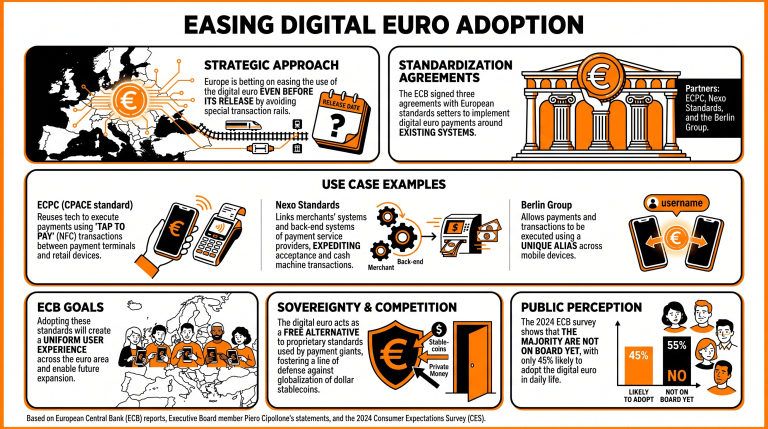
Similarly, Nexo Standards allow linking merchants’ systems and the back-end systems of payment service providers, expediting payment acceptance and cash machine transactions.
Finally, Berlin Group’s standards allow payments and transactions to be executed using a unique alias across mobile devices.
The ECB argues that adopting these standards will “simplify digital euro acceptance and create a uniform user experience across the euro area,” while also enabling the expansion of these for new use cases across an expanded geography.
Piero Cipollone, a member of the ECB’s Executive Board who has been the face behind the digital euro initiative, highlighted the relevance of the digital euro as a free alternative to proprietary standards used by payments giants, stressing that this move will “make it easier for new European providers to enter the market and give European payment service providers and merchants the certainty they need to invest, innovate and compete across the euro area.”
This has been one of the main selling points for the digital euro, being promoted as one of the last lines of defense against the globalization of dollar stablecoins and private money in payment networks.
The 2024 ECB’s Consumer Expectations Survey (CES) shows that the majority of Europeans are still not on board with the digital euro, with only 45% of those surveyed indicating they would be likely to adopt it and use it in their daily lives.






 English (US) ·