
 3 months ago
96
3 months ago
96
- Vitalik Buterin said the Ethereum Foundation plans to sell less ETH and focus on core ecosystem priorities.
- ETH sentiment improved after the comments, but price action remains weak below key resistance levels.
- Ethereum must reclaim the $2,500 zone to strengthen chances of a larger recovery toward higher cycle targets.
Ethereum is still struggling to regain momentum, hovering around the $2,113 level as traders react to fresh comments from Vitalik Buterin about the Ethereum Foundation’s future. The discussion quickly caught attention because Buterin hinted the foundation plans to become leaner, more selective, and ultimately “sell less ETH” over time. For a market already nervous about supply pressure, that line alone sparked a noticeable shift in sentiment.
Even so, ETH hasn’t exactly exploded higher. The token bounced roughly 5% from its recent low near $2,020 over the weekend, but the recovery faded pretty fast and price action drifted sideways again around the $2,100 area. Ethereum is still down close to 9% over the last two weeks, and the Fear & Greed Index remains deep in fear territory at 33, showing traders still aren’t fully convinced the worst is over yet.
Santiment data showed that sentiment around Vitalik-related discussions turned nearly 76% bullish after the comments surfaced. That’s a sharp mood swing honestly, though price didn’t follow with the same enthusiasm. It kind of highlights the current state of the market right now — optimism exists, but buyers still seem hesitant to commit heavily.
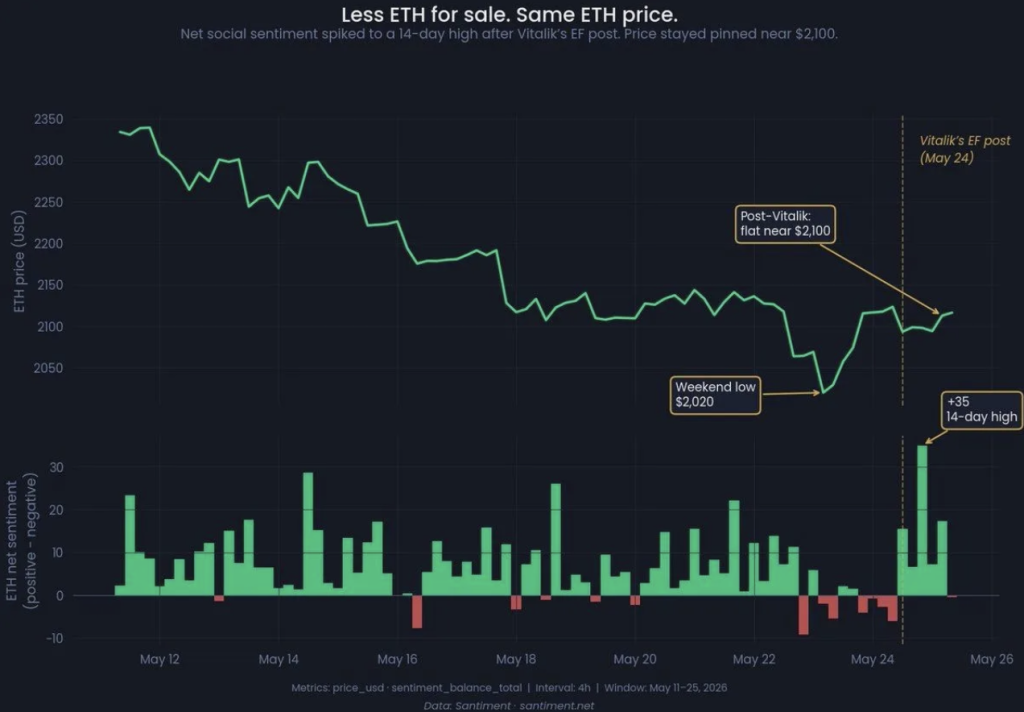
Ethereum Foundation Wants a Smaller, More Focused Position
Buterin explained that the Ethereum Foundation should not be viewed as the “center” of Ethereum. Instead, he described it more like a single participant within a much larger ecosystem, focused mainly on defending core principles such as privacy, censorship resistance, openness, and security. That shift in messaging matters because Ethereum has gradually become far more decentralized in terms of development and ecosystem growth.
He also pointed out that the foundation only controls around 0.16% of ETH’s total supply, which is actually much smaller than many people assume. Compared with treasury allocations held by several competing blockchain foundations, Ethereum’s share is relatively tiny. Because of that, Buterin suggested the organization is prioritizing long-term sustainability instead of trying to expand aggressively into every part of the ecosystem.
Part of that strategy means stepping back from areas other organizations can already handle. According to Buterin, some initiatives tied to supporting ETH as a financial asset don’t necessarily belong under the Ethereum Foundation’s responsibilities anymore. In simple terms, the ecosystem is becoming too large for one organization to oversee everything.
The idea of reduced ETH selling may help ease one lingering concern among investors, especially those worried about constant treasury liquidations weighing on price. Still, the actual impact could end up being smaller than traders expect because exchange flows, ETF demand, whale activity, and macro market conditions still carry far more influence over ETH’s direction.
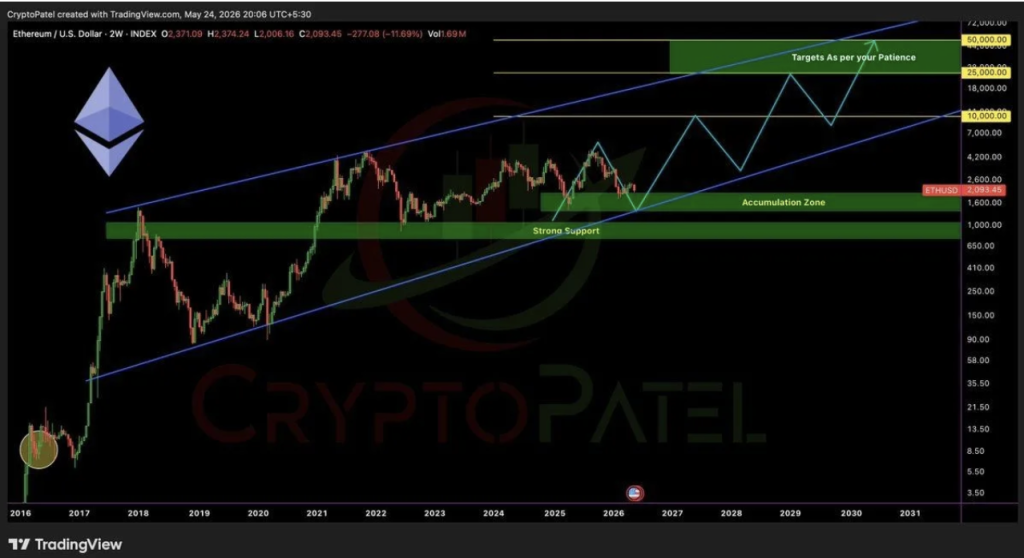
ETH Price Weakness Continues Despite Aggressive Buying Signals
Ethereum has remained trapped in a short-term downtrend since May 11, sliding from around $2,375 to nearly $2,031 by May 23. That marks a decline of roughly 14.5%, and surprisingly, it happened even while some on-chain metrics showed aggressive buying activity underneath the surface.
CryptoQuant analyst Carmelo Alemán noted that spot trading volume dropped significantly during the same stretch. ETH spot volume fell from around 470,770 ETH to 256,963 ETH in just under two weeks, a decline of more than 45%. In dollar value, trading volume collapsed from about $1.1 billion to nearly $521 million, which signals fading participation across the market.
Derivatives data hasn’t provided much bullish confirmation either. Open interest barely moved, climbing only slightly from $15.43 billion to $15.54 billion. Funding rates stayed positive though, meaning long traders continued paying premiums to hold their positions even while ETH price kept slipping lower, which isn’t always a great sign.
Meanwhile, spot taker CVD remained buy-heavy, suggesting aggressive buyers were still stepping in. But despite that demand, ETH kept falling. That usually means sell-side liquidity and overhead supply are still strong enough to absorb incoming buyers without allowing price to meaningfully break upward. Exchange netflows also stayed negative near 80,507 ETH, showing coins were leaving exchanges, but even that failed to trigger a sustained recovery.
Can Ethereum Reclaim $2,500?
For Ethereum to reclaim the $2,500 region, bulls first need to push through nearby resistance zones and bring spot demand back into the market. Right now ETH continues trading below the broader accumulation range between roughly $1,600 and $2,600, keeping the structure somewhat fragile.
Technically, Ethereum is still holding inside a long-term ascending channel that has remained intact through previous market cycles. The lower section of that channel is now getting tested again, and this area could become extremely important. If buyers defend it successfully, ETH may still have room for another run toward the $2,500 level in the coming weeks.
Above that, the next major resistance zone sits between $2,600 and $3,000. Breaking through that range would strengthen the argument for a larger macro recovery toward $4,200 or even $5,000 eventually. Some long-range projections still point toward a possible $10,000 ETH cycle target, though realistically that would require a massive market expansion and a major shift in sentiment across crypto as a whole.
On the downside, traders are closely watching support around $1,984. If ETH loses that level decisively, the next key support sits near $1,937. A deeper breakdown under $1,600 on higher timeframes could seriously damage Ethereum’s long-term bullish structure and potentially expose the market to a much larger drop toward the $1,000 to $1,300 region.
Disclaimer: BlockNews provides independent reporting on crypto, blockchain, and digital finance. All content is for informational purposes only and does not constitute financial advice. Readers should do their own research before making investment decisions. Some articles may use AI tools to assist in drafting, but every piece is reviewed and edited by our editorial team of experienced crypto writers and analysts before publication.









 English (US) ·