
 2 months ago
61
2 months ago
61
- Ethereum whale wallets recently accumulated nearly $126 million worth of ETH during market weakness.
- Corporate Ethereum reserves climbed to around $16 billion, representing roughly 6% of total supply.
- ETF outflows continue pressuring sentiment, though long-term accumulation trends remain strong.
Ethereum’s accumulation trend is beginning to show signs of a deeper structural shift, and honestly, the market is starting to notice. While price action has remained shaky in recent weeks, large holders appear to be quietly stepping in and absorbing weakness across the board. Two newly created whale wallets recently withdrew roughly $125.9 million worth of ETH, adding another layer to the growing accumulation narrative surrounding Ethereum. Interestingly enough, their buying behavior closely resembled the same pattern previously associated with Bitmine’s earlier ETH accumulation strategy, something traders picked up on fairly quickly.
That timing matters because Bitmine itself has been gaining more visibility after its preliminary inclusion in the Russell 3000 index. But Bitmine isn’t alone anymore. Corporate interest in Ethereum has been quietly accelerating in the background, even while broader market sentiment remains mixed. According to CoinGlass data, companies holding strategic Ethereum reserves now collectively control around 7.33 million ETH. At current prices, that stash is worth nearly $16 billion — a surprisingly large figure when you stop and think about it.
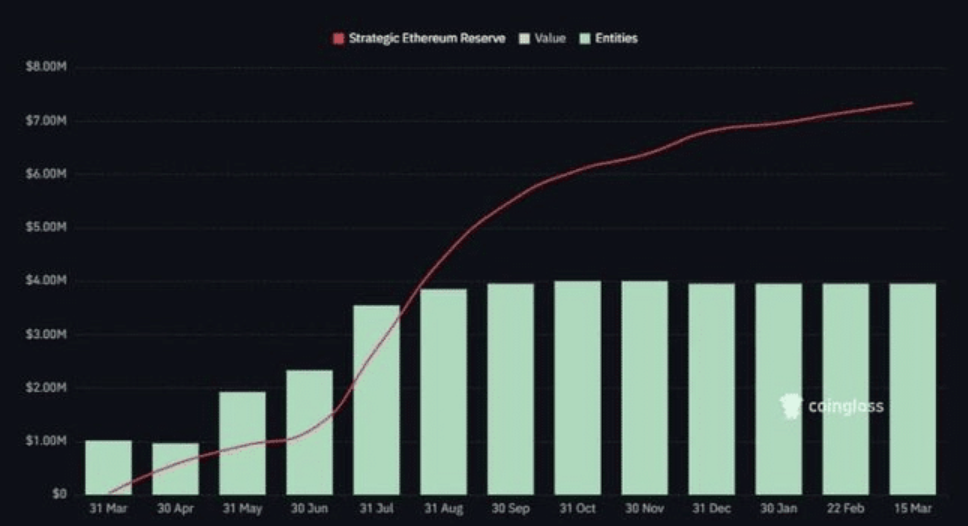
Corporate Ethereum Holdings Continue Climbing
What stands out most is how much Ethereum supply is gradually moving into corporate hands. The latest numbers suggest roughly 6% of Ethereum’s total circulating supply now sits on company balance sheets. That’s not insignificant at all, especially for an asset many institutions were still hesitant about only a few years ago. It also changes the conversation around Ethereum’s long-term structure because these reserves are generally viewed as strategic holdings rather than short-term speculative trades.
Meanwhile, Ethereum ETFs have started showing cracks. So far in May, Ethereum-based ETFs have recorded nearly $300 million in net outflows, signaling that some investors are reducing direct exposure through traditional investment products. Sentiment clearly took a hit from those flows, and Ethereum’s price correction of around 8% this month reflects that pressure to some extent. Still, there’s an interesting contradiction developing underneath the surface — institutional ETF exposure may be declining, but corporate accumulation continues rising at the same time.
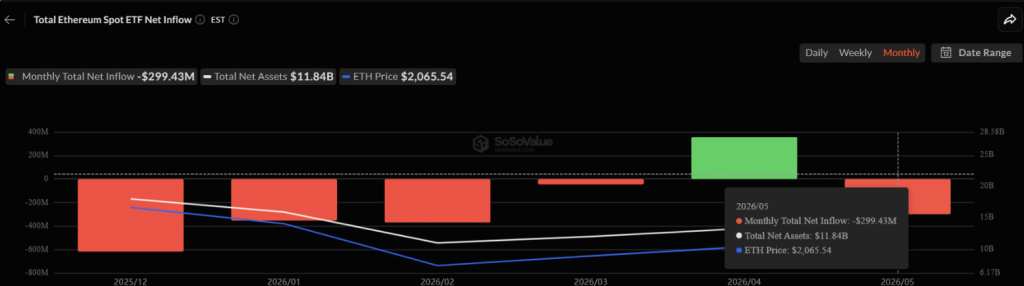
ETF Weakness and Corporate Buying Create a Strange Divergence
Several developments reinforced that trend recently. Reports pointed toward a roughly 5% decline in BlackRock ETF institutional ownership, while Harvard reportedly exited its Ethereum ETF position altogether. Under normal circumstances, that kind of news would probably spark stronger bearish momentum. Yet Ethereum’s corporate accumulation story keeps expanding despite the ETF weakness, which suggests the market may be transitioning into a slightly different phase.
Technically speaking, Ethereum has clearly underperformed Bitcoin during this stretch. ETH fell nearly 8.9% in May, while Bitcoin only slipped around 1.37% during the same period. That gap is pretty substantial and signals Ethereum’s recent weakness may be driven more by internal positioning shifts than broader crypto market conditions. It also marks another important divergence in this cycle, one traders are paying very close attention to now.
Ethereum’s “Holding” Narrative May Be Growing Stronger
The first major divergence earlier in the cycle revolved around Ethereum’s growing “holding” narrative. Even while ETF participation softened and some institutional investors stepped away, long-term accumulation continued building in the background. More ETH keeps moving into staking, treasury reserves, and strategic corporate holdings instead of circulating freely through exchanges. That kind of behavior tends to tighten liquid supply over time, even if short-term price volatility remains frustrating for traders.
So despite recent weakness, Ethereum’s underlying structure may actually be strengthening in quieter ways. Whale accumulation, rising corporate reserves, strategic treasury adoption, and shrinking liquid supply all point toward a market that’s slowly evolving beneath the surface. Price action doesn’t always reflect those shifts immediately — sometimes it takes months before sentiment catches up. But right now, Ethereum’s story looks less like panic selling and more like a transition phase between different types of holders.
Disclaimer: BlockNews provides independent reporting on crypto, blockchain, and digital finance. All content is for informational purposes only and does not constitute financial advice. Readers should do their own research before making investment decisions. Some articles may use AI tools to assist in drafting, but every piece is reviewed and edited by our editorial team of experienced crypto writers and analysts before publication.









 English (US) ·