
 3 months ago
29
3 months ago
29
TLDR
- ETH has experienced six consecutive monthly declines, representing its second-longest bearish streak since the 2018 crash.
- The cryptocurrency is hovering near its 2018 peak price level, currently struggling below the $2,000 mark.
- Multiple headwinds include large holder distribution, derivative market pressure, Layer 2 network competition, and persistent ETF capital outflows.
- Ethereum co-founder Vitalik Buterin suggests artificial intelligence could dramatically accelerate the network’s development timeline and strengthen security protocols.
- Wall Street analysts from Standard Chartered and VanEck maintain bullish long-term projections of $7,500 and $10,000 for ETH.
For the first time since the brutal 2018 bear market, Ethereum has registered six consecutive monthly closes in negative territory, establishing a concerning pattern that has traders questioning when the trend will reverse.
Market data from CoinGlass reveals that the only comparable stretch occurred during 2018’s devastating downturn, when ETH plummeted beneath the $85 threshold.
That previous collapse stemmed primarily from the implosion of the Initial Coin Offering (ICO) boom, as countless projects that had raised capital through ERC-20 token sales on Ethereum’s network simultaneously liquidated their holdings.
Today’s prolonged decline, however, stems from an entirely different combination of pressures.
Market observers identify several concurrent factors: systematic distribution by large wallet holders, aggressive selling in derivatives markets, broader economic instability, sustained withdrawals from spot Ethereum ETFs, and intensifying competition from Ethereum’s own Layer 2 scaling solutions that are siphoning away transaction fee revenue.
ETH currently trades marginally above the peak price it achieved during the 2018 cycle, a threshold that was previously celebrated as a significant psychological barrier.
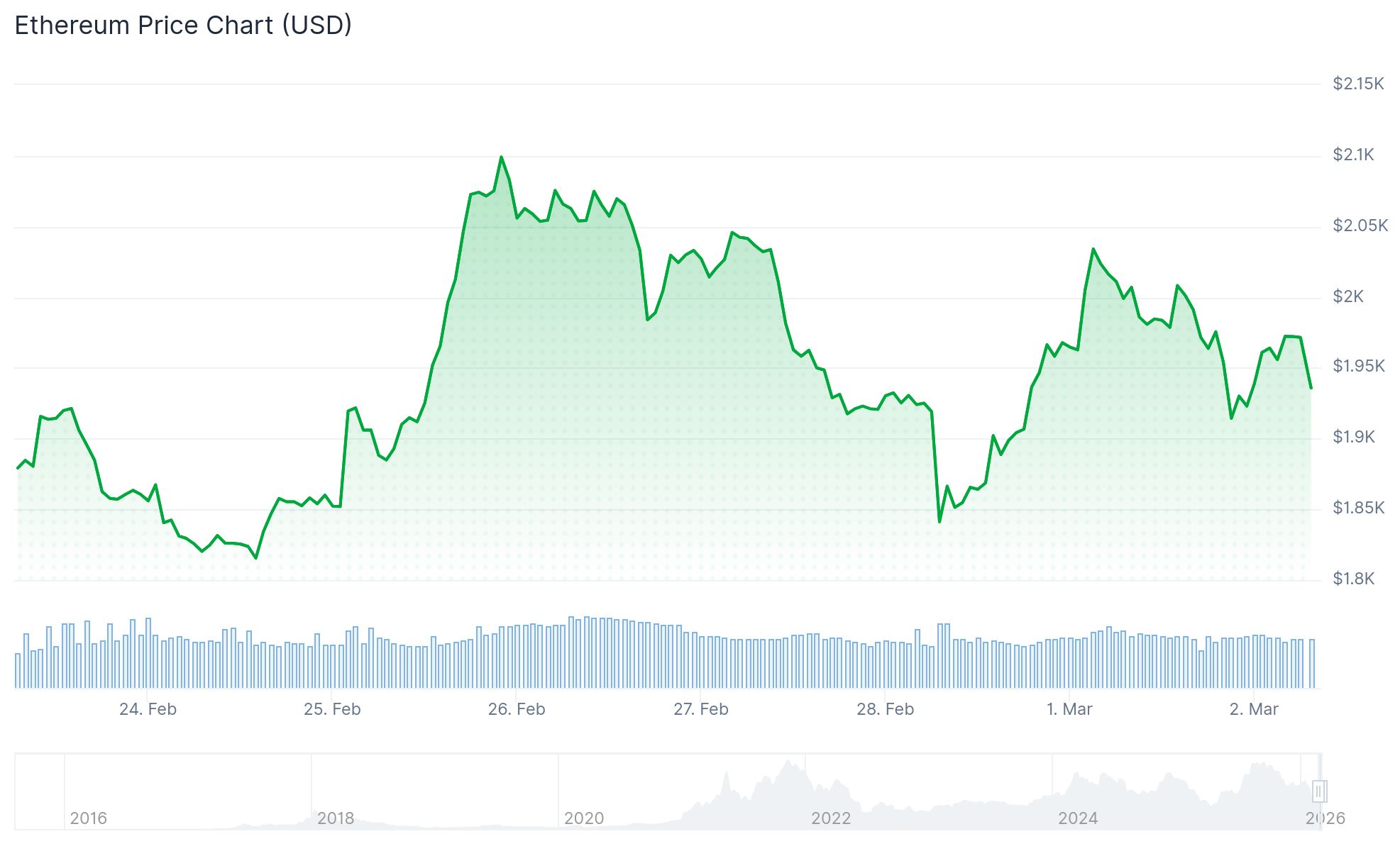 Ethereum (ETH) Price
Following a brief climb to $2,054, the asset retreated below the psychologically important $2,000 level. The price now sits beneath the 100-hour Simple Moving Average, a technical indicator often watched by short-term traders.
Critical Price Zones Under Surveillance
The nearest resistance barrier stands at $2,000, followed by more substantial obstacles at $2,120 and $2,155.
Should Ethereum mount a rally past $2,155, traders would then focus on resistance zones at $2,220 and $2,250.
Conversely, downside protection currently exists at $1,920, with another support layer at $1,880. A breach below $1,880 would likely trigger a test of $1,840 or $1,800, while $1,740 represents a more substantial floor should selling intensify.
Buterin Discusses AI’s Potential Impact on Ethereum Development
Ethereum founder Vitalik Buterin recently shared his perspective on how artificial intelligence tools could dramatically compress the timeline for implementing Ethereum’s technical roadmap.
His remarks followed a demonstration where a developer utilized AI assistance to prototype Ethereum’s entire vision through 2030 in just a matter of weeks.
Buterin personally experimented with AI coding capabilities, successfully building a version of his personal blog software in approximately one hour using only his laptop.
He proposed that approximately half of the efficiency gains achieved through AI should be redirected toward enhancing security measures, including expanded testing protocols and formal verification processes for code.
“People should be open to the possibility that the Ethereum roadmap will finish much faster than people expect,” Buterin wrote.
He further emphasized that completely bug-free code, once dismissed as an unattainable ideal, might soon become the baseline standard throughout cryptocurrency development.
Financial analysts at Standard Chartered maintain their ambitious long-term projection of $7,500 for ETH, grounded in Ethereum’s dominant position within stablecoins, decentralized finance protocols, and asset tokenization infrastructure.
VanEck has established an even more optimistic target of $10,000, pointing to the forthcoming Pectra and Glamsterdam network upgrades, which could theoretically enable processing of 100,000 transactions per second.
ETH continues to maintain a foothold above the $1,900 support threshold following its most recent decline from the $2,054 local high.
The post Ethereum’s Historic Slump: Six Consecutive Monthly Declines Raise Questions About ETH’s Recovery appeared first on Blockonomi.





 English (US) ·