
 1 hour ago
24
1 hour ago
24
Key Highlights
- Dutch and British natural gas futures declined 3.2% during Friday trading sessions as market participants secured gains.
- Weekly losses exceeded 8%, marking the sharpest pullback for both contracts since the middle of June.
- Emerging reports of diplomatic dialogue between Washington and Tehran regarding Strait of Hormuz access helped reduce supply disruption concerns.
- Gas storage facilities across the European Union are currently at approximately 70% capacity, trailing last year’s figures by roughly 12 percentage points.
- Scheduled maintenance operations on Norwegian pipeline infrastructure continues to strain European supply networks.
Natural gas prices across European wholesale markets experienced significant downward pressure Friday. Both the Dutch Title Transfer Facility (TTF) and United Kingdom’s National Balancing Point (NBP) contracts registered identical 3.2% declines.
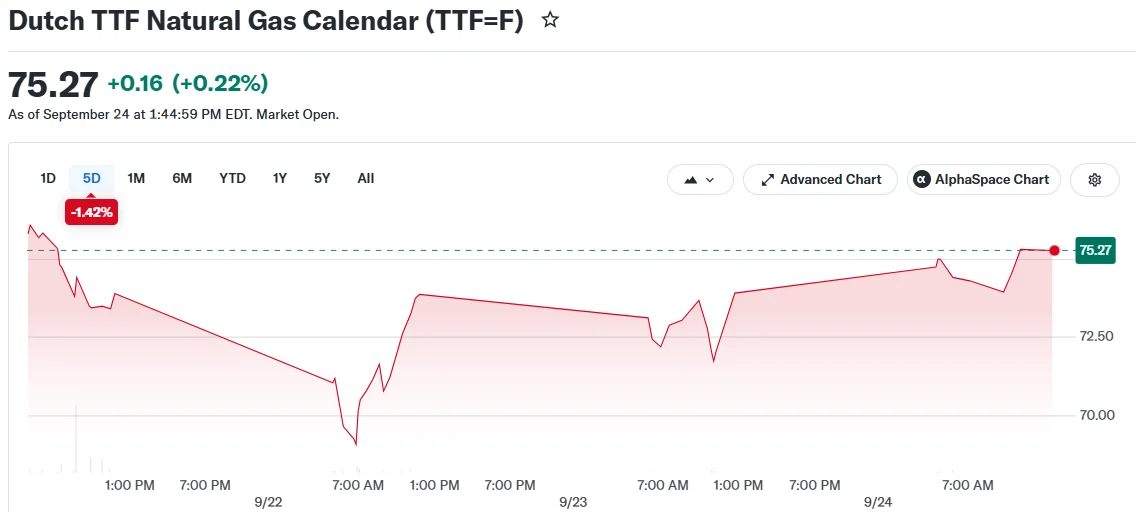 Dutch TTF Natural Gas Calendar (TTF=F)
Market participants capitalized on recent price appreciation by liquidating positions following several weeks of sustained increases. This selling activity positioned both benchmark contracts for their most substantial weekly decline since the June midpoint.
Weekly calculations show losses surpassing 8%, representing a dramatic turnaround from the elevated levels observed during the earlier portion of September.
Factors Driving the Price Correction
The principal catalyst behind this market retreat centers on diminishing concerns surrounding the Strait of Hormuz. Intelligence suggests ongoing diplomatic communications between American and Iranian officials exploring a graduated framework to restore normal passage through the strategic waterway.

 BREAKING: Iran offers U.S. a 7-DAY plan to reopen the Strait of Hormuz and restart negotiations, per FT.
Iranian Foreign Minister Abbas Araghchi says Hormuz could be reopened by the end of the seventh day if certain conditions are met, with broader talks also set to resume.… pic.twitter.com/TcnmfVrcZY
— Coin Bureau (@coinbureau) September 25, 2026
This narrow shipping channel has emerged as a flashpoint in regional hostilities extending nearly seven months. To date, neither Washington nor Tehran has demonstrated willingness to relinquish leverage over the critical passage.
Despite the absence of a finalized accord, commodity markets are recalibrating risk assessments regarding potential military confrontation. This perception adjustment has compressed the security premium previously embedded in Persian Gulf energy commodities.
Liquefied natural gas carriers have begun implementing operational modifications. Vessel operators are increasingly utilizing alternative maritime paths circumventing the Arabian Peninsula, which has alleviated concerns about complete cessation of physical LNG shipments.
The temporary lull in geopolitical tensions prompted traders to liquidate holdings before weekend market closures. This widespread profit realization amplified the downward price momentum.
Storage Capacity Concerns Persist
Despite the favorable price movement, European gas storage capacity continues presenting challenges. According to Gas Infrastructure Europe statistics, underground storage facilities throughout the European Union currently hold approximately 70% of maximum capacity.
This figure represents a deficit of approximately 12 percentage points compared to inventory levels recorded during the corresponding period last year. The shortfall leaves energy suppliers with diminished reserves as the winter season approaches.
Reduced inventory buffers suggest the continent could experience heightened price volatility should unseasonably cold temperatures materialize or supply disruptions recur. The European Central Bank has previously highlighted this vulnerability, noting that natural gas price fluctuations can cascade into broader consumer inflation metrics.
Planned infrastructure servicing across Norwegian facilities compounds existing supply constraints. Diminished pipeline throughput from Norway is constricting European deliveries precisely when storage reserves remain below historical averages.
European buyers are simultaneously competing with Asian purchasers for available LNG cargoes on the global spot market. This competitive dynamic has escalated as both geographical regions attempt to secure adequate supplies before peak winter demand commences.
Notwithstanding Friday’s correction, current price levels remain substantially elevated relative to earlier 2024 benchmarks. The ongoing conflict’s impact on maritime shipping corridors and global supply networks has yet to completely dissipate.
Energy analysts indicate that a comprehensive, durable agreement between the United States and Iran concerning strait navigation would likely trigger additional price moderation. In the interim, natural gas valuations are anticipated to maintain heightened sensitivity to diplomatic developments.
By Friday’s closing, TTF contracts had retreated below the €73 per megawatt-hour threshold, reversing advances registered during the previous trading session.
The post European Gas Futures See Sharp Decline Amid Hormuz Diplomatic Progress appeared first on Blockonomi.




 English (US) ·