
 3 months ago
79
3 months ago
79
Key Takeaways
- Natural gas in Europe extended losses for a sixth consecutive trading day, approaching two-month lows
- An interim peace agreement between Washington and Tehran includes provisions for reopening the Strait of Hormuz
- Dutch TTF benchmark declined to €40.04 per megawatt hour; British gas slipped to 96.45 pence per therm
- President Trump issued a stern warning about resuming military operations if Iran violates the 14-point accord
- Qatari LNG tankers and additional vessels have started returning to Middle Eastern waters
European natural gas markets witnessed their sixth consecutive day of declining prices on Thursday, with benchmarks sliding toward levels not seen since the final days of April.
The TTF Dutch front-month contract, Europe’s primary natural gas benchmark, descended to €40.04 per megawatt hour. Meanwhile, the UK natural gas contract broke below the 100-pence threshold, settling at 96.45 pence per therm.
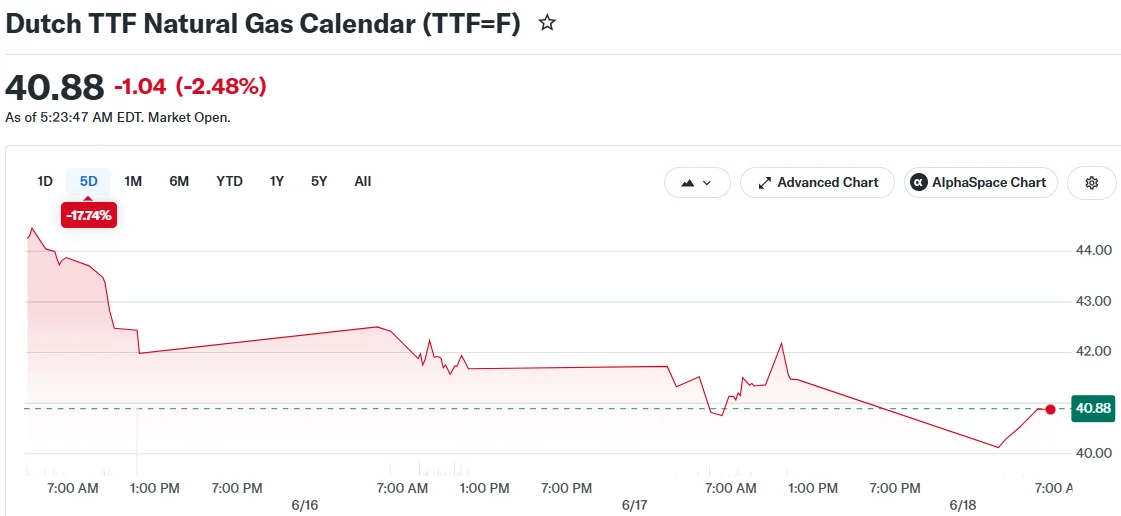 Dutch TTF Natural Gas Calendar (TTF=F)
Both key benchmarks are now trading near their lowest points in approximately two months.
The sustained price decline follows the historic signing of an interim peace agreement between the United States and Iran. The two presidents endorsed the memorandum through remote participation.
According to Pakistan’s prime minister, who helped facilitate the negotiations, the agreement ensures Iran will “instantly reopen” the strategically vital Strait of Hormuz. Simultaneously, the United States committed to “immediately lift” its naval blockade affecting Iranian port facilities.
Geopolitical Risk Premium Evaporates
The Strait of Hormuz represents one of the world’s most critical bottlenecks for global energy shipments. Its effective closure had maintained an elevated war-risk premium embedded within European energy prices throughout recent months.
As the strait prepares to resume normal operations, this geopolitical risk premium has begun systematically unwinding. Natural gas valuations have trended downward since markets first detected signals suggesting a diplomatic breakthrough was imminent.
The interim framework additionally establishes a permanent cessation of hostile activities. It launches a 60-day window for both nations to hammer out a comprehensive final agreement addressing Iran’s nuclear development programme.
President Trump, however, emphasized that the agreement comes with strict conditions attached. He cautioned that military strikes would resume should Iran fail to honor its commitments under the 14-point memorandum of understanding.
Trader Skepticism Persists
Despite the notable price correction, European natural gas valuations have not fully retreated to pre-conflict levels. This persistent gap suggests lingering market uncertainty about the agreement’s durability.
Market participants appear to be maintaining a buffer for the scenario where Trump might abandon the agreement. His explicit warning regarding potential military reengagement has preserved a degree of caution among traders.
Nevertheless, physical commodity markets are already demonstrating tangible responses. Multiple vessels have begun repositioning toward the Middle East, including liquefied natural gas tankers operating from Qatar.
Qatar holds the position as the world’s second-largest LNG exporter. The return of its tanker fleet to regional waters provides an early indication that critical shipping corridors may be reopening for commercial traffic.
European natural gas markets had endured sustained pressure throughout the conflict period. Energy trading desks maintained vigilant monitoring for any indications of diplomatic progress.
The current trading level around €40.6 per megawatt hour represents the lowest valuation recorded since April 20. This marks a substantial departure from the elevated price environment that characterized the conflict’s peak intensity.
Future price movements will largely depend on the complete operational restoration of the Strait of Hormuz and whether the 60-day nuclear negotiation period yields substantive progress.
The post European Gas Prices Plunge to Two-Month Lows Following US-Iran Peace Agreement appeared first on Blockonomi.



 English (US) ·