
 2 hours ago
22
2 hours ago
22
Key Takeaways
- The greenback retreated modestly on Wednesday while maintaining position near multi-week peaks in anticipation of Federal Reserve monetary policy action.
- A 92% probability has been assigned by markets for a quarter-percentage-point rate increase, bringing the target range to 3.75%-4.00%.
- Chair Kevin Warsh’s post-decision commentary will provide critical insight into whether this represents an isolated adjustment or the beginning of a sustained tightening campaign.
- The Japanese currency gained ground, with market pricing indicating an 80% likelihood of a Bank of Japan rate adjustment on Friday.
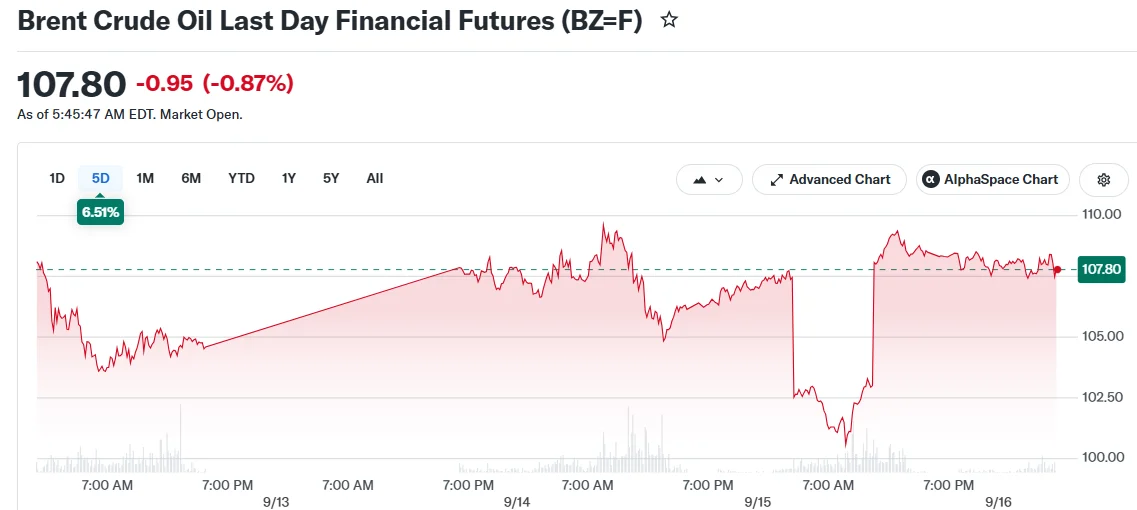
- Crude prices exceeding $113 per barrel, fueled by Saudi infrastructure attacks and Red Sea shipping disruptions, are amplifying inflation pressures driving the policy tightening cycle.
The U.S. dollar retreated modestly on Wednesday, marking its first pullback in seven trading sessions, as currency traders exercised caution before a Federal Reserve interest rate announcement scheduled for later in the day.
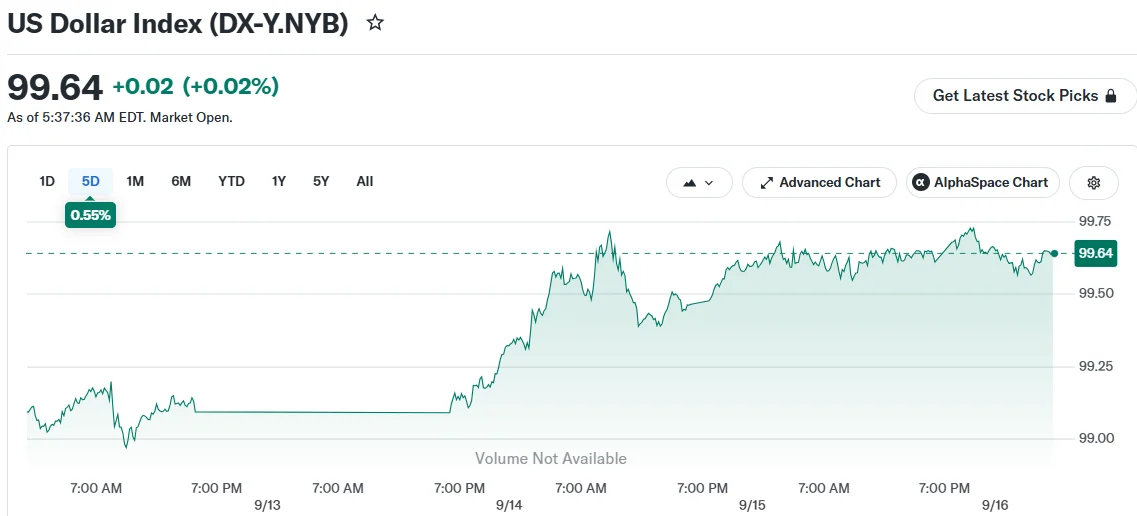 US Dollar Index (DX-Y.NYB)
The Dollar Index, measuring the currency’s performance against a basket of six major counterparts, traded virtually unchanged at approximately 99.59 following multiple consecutive sessions of appreciation.
Market participants have assigned a 92% likelihood to the Federal Reserve implementing a 25-basis-point increase to its policy rate, establishing a new target corridor of 3.75%-4.00%. Such action would represent the first upward adjustment in U.S. rates since the middle of 2023.
While the rate adjustment itself appears largely anticipated, market attention centers on the subsequent messaging from Fed Chair Kevin Warsh following the policy announcement.
Investors seek clarity on whether Warsh will characterize the increase as an isolated precautionary measure against elevated energy costs, or telegraph the initiation of a sustained sequence of rate adjustments.
Accommodative language could trigger dollar weakness as market participants secure gains. Conversely, hawkish rhetoric suggesting additional tightening ahead may propel the currency higher.
Rising Energy Costs Fuel Inflation Pressures
Crude oil prices have surged beyond $113 per barrel in the wake of strikes targeting Saudi Arabian pipeline facilities and Houthi militant actions disrupting Red Sea shipping lanes. These supply constraints have elevated energy costs and intensified inflationary pressures, providing justification for central bank policy tightening.
ANZ strategists communicated to clients their expectation for Federal Reserve rate increases at consecutive policy meetings, while acknowledging that the October gathering coincides with U.S. midterm electoral contests.
The euro traded essentially flat near $1.1554, maintaining proximity to a one-month low point. The European Central Bank implemented a 25-basis-point increase to its deposit facility last Thursday, lifting it to 2.50%, likewise responding to energy-driven inflation dynamics.
The British pound maintained position around $1.3483. United Kingdom inflation accelerated to 3.1% in August from the prior month’s 2.9%, while core inflation remained unchanged at 2.6%. The Bank of England delivers its policy verdict on Thursday. Market pricing suggests approximately a one-third probability of a 25-basis-point adjustment.
Japanese Currency Gains Ground, Central Bank Decision Looms
The Japanese yen rebounded after reaching a one-week weakness of 155.49 against the dollar earlier in the trading session. It subsequently strengthened to approximately 154.97 yen per dollar by midday.
Market pricing reflects an 80% probability that the Bank of Japan implements a 25-basis-point increase to its policy rate, elevating it to 1.25% on Friday. Two rate increases are anticipated by the conclusion of January.
The yen has benefited from increasingly hawkish Bank of Japan expectations, coordinated U.S.-Japan foreign exchange intervention, and repatriation flows from Japanese institutional investors.
Julius Baer economist David Meier indicated the yen’s trajectory will remain significantly influenced by interest rate differential dynamics and adjusted the firm’s USD/JPY projection to 155.
China’s yuan maintained position near 6.71 per dollar notwithstanding an expanding divergence between Chinese bond yields and rates prevailing in other major economies.
Market focus remains concentrated on Warsh’s post-decision press conference as the primary determinant for the dollar’s subsequent direction.
The post Federal Reserve Rate Decision: How a Quarter-Point Increase Impacts Major Currency Markets appeared first on Blockonomi.



 English (US) ·