
 2 months ago
64
2 months ago
64
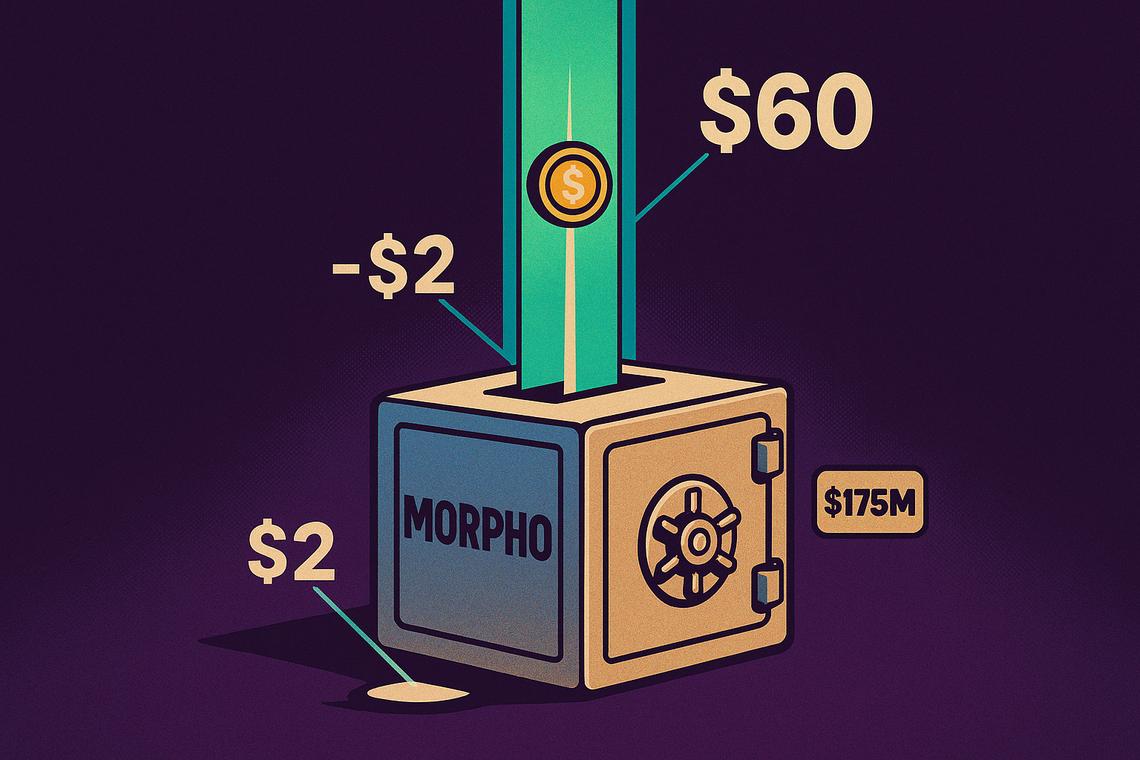
When a major global bank puts a $60 price target on a DeFi lending token that’s currently trading around $2, it’s worth pausing to understand why. Standard Chartered’s initiation of coverage on Morpho — implying roughly 33x upside by end of 2030 — sent the MORPHO token climbing about 5.5% to trade above $2, signaling that institutional attention alone can move markets even in the absence of new on-chain developments.
Key takeaways
- Standard Chartered set a $60 end-2030 price target for MORPHO, implying approximately 33x upside from current levels.
- Morpho is the second-largest DeFi lending protocol, with over $6.5 billion in total value locked, trailing only Aave.
- The Morpho Association recently closed a $175 million funding round — one of the largest in DeFi history — backed by Paradigm, a16z crypto, Ribbit, Apollo Funds, Circle Ventures, VanEck, and Ledger Cathay.
- Standard Chartered forecasts DeFi assets will grow 37-fold by 2030, with Morpho positioned to scale alongside that expansion.
- The bank also initiated coverage on Aave with a $3,500 price target for 2030, reinforcing its broad bullish thesis on DeFi lending infrastructure.
Standard Chartered’s Optimistic Forecast for Morpho
Standard Chartered’s coverage launch frames Morpho not simply as a lending protocol but as a dual-engine business: Morpho Markets, a lending market that has grown to roughly one-quarter the size of Aave by deposits, and Morpho Vaults, which provides infrastructure for on-chain asset management and banking applications. That structural framing matters — it repositions Morpho as a piece of financial plumbing, not just a yield venue.
Geoff Kendrick, head of digital assets research at Standard Chartered, wrote in the Wednesday report: “Given its status as one of the largest DeFi lending protocols and its comfortable financial position (it just raised $175 million in VC funding), we think Morpho can scale to meet the expanding base of assets deployed in DeFi.”
The $60 price target by end of 2030 would also see MORPHO outperform both Bitcoin and Ether over the same horizon, according to the bank’s own projections — a bold claim that underscores just how seriously Standard Chartered views Morpho DeFi growth relative to the broader crypto asset class.
Short-term market reaction
Markets responded quickly. MORPHO gained around 5.5% to trade above $2 on the day of the announcement, with 24-hour gains reaching over 13% at certain points. The token, however, remains nearly 50% below its all-time high, which puts the gap between current price and the bank’s 2030 target in sharper relief.
Morpho’s Position in the Expanding DeFi Market
The core of Standard Chartered’s thesis rests on a macro forecast: the bank expects total DeFi assets to expand 37-fold by 2030. If that materializes, protocols with the infrastructure and capital to capture institutional flows would benefit disproportionately. Morpho, in the bank’s view, is one of them.
With over $6.5 billion in total value locked, Morpho already ranks as the second-largest lending protocol in DeFi, behind only Aave, according to DefiLlama data. That positioning isn’t just a vanity metric — it reflects deep liquidity, user trust, and a track record that institutional capital tends to gravitate toward.
What makes the Morpho DeFi growth story analytically interesting is the Vaults business. Onchain asset management infrastructure — the kind that allows traditional financial institutions to deploy capital without building their own smart contract stack — is arguably the more defensible long-term moat. Lending markets are competitive and rate-sensitive; infrastructure tends to be sticky.
Standard Chartered argued that the combination gives Morpho a differentiated position as DeFi evolves beyond crypto-native lending toward tokenized real-world assets and institutional capital. The bank’s long-term optimism is explicitly tied to Morpho’s ability to deepen relationships with traditional finance players entering the tokenized economy — a transition that is already accelerating across asset management and banking.
Significant Institutional Investment Backing Morpho
The $175 million funding round raised by the Morpho Association — described as one of the largest in DeFi to date — is a meaningful data point beyond the headline number. The composition of the investor group signals broad conviction across both crypto-native and traditional finance circles.
The round was led by Paradigm, a16z crypto, and Ribbit, three of the most influential venture firms in the crypto space. But the strategic backers broaden the picture considerably:
- Apollo Funds — a major alternative asset manager with deep ties to traditional credit markets
- Circle Ventures — the investment arm of the USDC stablecoin issuer
- VanEck — a veteran ETF and asset management firm increasingly active in digital assets
- Ledger Cathay — a fund bridging Asian institutional capital with crypto infrastructure
That investor mix is hard to replicate and practically impossible to dismiss. It suggests Morpho isn’t simply chasing retail flows — it’s building the institutional relationships that Standard Chartered believes will be critical to its scaling ambitions.
What This Coverage Means for DeFi Lending Broadly
Standard Chartered’s move is part of a deliberate push into DeFi protocol coverage. Just the week prior, the bank initiated coverage of Aave with a $3,500 end-2030 price target, framing it as a primary beneficiary of expanding DeFi adoption and tokenized real-world assets. Morpho now joins Aave and Uniswap as protocols that have earned a formal long-term bullish outlook from the UK banking giant.
That accumulation of institutional analyst coverage matters structurally. It creates reference points for asset allocators, family offices, and treasury teams that wouldn’t otherwise have a framework for evaluating DeFi tokens. It also normalizes the sector in the language of traditional finance — price targets, growth multiples, comparative benchmarking against BTC and ETH.
The deeper question the coverage raises is whether Morpho’s Vaults infrastructure can actually attract the scale of institutional capital that justifies the 33x multiple. The 37-fold DeFi growth forecast is ambitious, and Morpho’s share of that growth will depend on execution in a competitive environment where Aave, and potentially new entrants, are all chasing the same institutional tailwinds. The $175 million war chest gives Morpho a meaningful runway — but how effectively that capital converts into institutional partnerships and on-chain assets under management will ultimately determine whether the $60 target is a floor or a ceiling.
FAQ
What price target did Standard Chartered set for Morpho by 2030?
Standard Chartered set a price target of $60 for MORPHO by the end of 2030, implying roughly 33x upside from the token’s price at the time of the announcement.
How much did Morpho’s token price increase after Standard Chartered’s coverage announcement?
MORPHO rose approximately 5.5% to trade above $2 following the coverage announcement, with 24-hour gains reaching over 13% at points during the session.
What is the forecasted growth outlook for the DeFi market according to Standard Chartered?
Standard Chartered forecasts the DeFi market will undergo a 37-fold expansion by the end of 2030, driven by tokenization of real-world assets and growing institutional participation in on-chain finance.
Who are some major investors involved in Morpho’s recent funding round?
The $175 million round was led by Paradigm, a16z crypto, and Ribbit, with additional strategic backing from Apollo Funds, Circle Ventures, VanEck, and Ledger Cathay, among other institutional and crypto-focused investors.
Article produced with the assistance of artificial intelligence and reviewed by the editorial team.




 English (US) ·