
 1 month ago
29
1 month ago
29
Spencer Bogart, general partner at Blockchain Capital, noted that while years ago fintech companies aimed to be bank-like but not banks, this trend has now reversed, with over 20 companies pursuing Office of the Comptroller of the Currency (OCC) charters in 2026.
Key Takeaways:
- Blockchain Capital’s Spencer Bogart notes over 20 crypto firms now seek OCC charters to integrate with banks.
- Securing 1 federal OCC charter gives firms like Ripple credibility to attract serious institutional capital.
- Next, 20+ OCC-chartered crypto firms, like Coinbase, will unlock large banks and sovereign wealth funds.
The End of the Decentralized Fantasy: Why Crypto Firms Are Now Seeking to Become Banks
The cryptocurrency industry has gone from professing a mentality of substituting the current financial system to just seeking to become an alternative and integrate with legacy financial rails.
Spencer Bogart, general partner at Blockchain Capital, explained that this change, which shifted the trend for crypto companies, had to do with how financial rules are enforced now and the conditions set by banks to work with crypto companies.
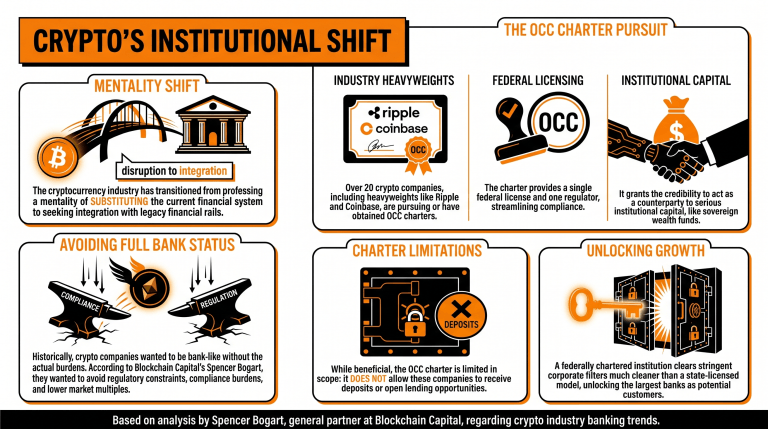
Bogart stressed that crypto companies, while aiming to be bank-like, did not want to become banks because of the burdens that this classification involved. “They didn’t want the regulatory constraints, compliance burden, or the lower market multiples. They wanted to get close but not cross the line,” he assessed.
Nonetheless, over 20 crypto companies, including heavyweights like Ripple and Coinbase, are pursuing or have already obtained Office of the Comptroller of the Currency (OCC) charters.
Bogart explained that this shift is linked to the collapse of the sponsor bank model, as banks were co-opted into dropping some customers, including crypto-linked businesses, elevating the risk of isolation.
While the OCC charter is rather limited in its scope and does not allow these companies to receive deposits or open lending opportunities, he acknowledges that it gives them “a single federal license, one regulator and, perhaps most importantly, the credibility to be a counterparty to serious institutional capital.”
This simplifies regulatory compliance and unlocks the largest banks and sovereign wealth funds as customers, allowing crypto firms to comply with their stringent requirements, opening these markets to grow their customer base.
“A federally chartered and supervised institution clears those filters much cleaner than a state-licensed model does,” Bogart concluded.





 English (US) ·