
 2 months ago
106
2 months ago
106
Key Highlights
- Spot gold advanced 1.1% to approximately $4,095 per ounce during Monday trading
- Crude oil plummeted over 5% following a weekend halt in U.S.-Iran military confrontations
- Trump administration ceased bombing operations against Iranian installations Friday after nearly two weeks of continuous airstrikes
- Dollar depreciation and declining Treasury yields provided additional tailwinds for gold
- Market participants anticipate Federal Reserve monetary policy announcement scheduled for Wednesday
Precious metals experienced upward momentum Monday as currency weakness and retreating energy prices reshaped investor positioning. The temporary suspension of military operations between Washington and Tehran triggered a sharp downturn in crude markets, alleviating inflationary concerns and driving capital toward defensive holdings.
Spot gold appreciated 1.1% to reach $4,095.37 per ounce during early Monday sessions. August-dated gold futures contracts increased 0.7% to settle at $4,097.40 per ounce.
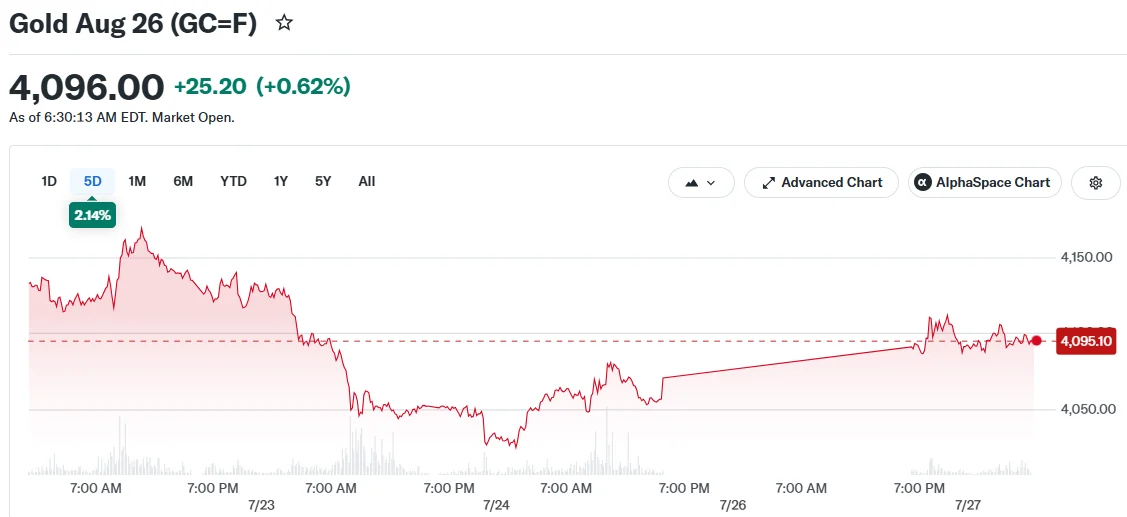 Gold Aug 26 (GC=F)
The yellow metal had already concluded the previous week with approximately 1% appreciation, notwithstanding considerable price fluctuations throughout the period.
Crude Retreats as Regional Hostilities Subside
Oil prices declined more than 5% Monday, erasing a substantial portion of the prior week’s advances. Brent crude had momentarily neared the $100-per-barrel threshold as anxieties mounted regarding possible interruptions to maritime traffic through critical chokepoints including the Strait of Hormuz and Red Sea shipping lanes.
The Trump administration terminated its aerial bombardment initiative Friday following 13 consecutive evenings of offensive operations targeting Iranian infrastructure. Officials characterized the cessation as providing space for potential diplomatic engagement.
Tehran refrained from launching counter-attacks against regional nations harboring American military installations throughout the weekend. This mutual de-escalation contributed to stabilizing energy commodity markets.
The contraction in crude values may alleviate short-term inflationary headwinds. Diminished energy expenses typically cascade through to retail pricing indices, potentially affording the Federal Reserve greater maneuverability regarding monetary policy adjustments.
Central Bank Announcement Approaches Wednesday
Financial markets are concentrating on this week’s Federal Reserve policy gathering. The monetary authority is broadly anticipated to maintain current interest rate levels when deliberations conclude Wednesday.
Nevertheless, CME FedWatch probability models indicate approximately 33% odds of a rate increase. Market participants will scrutinize commentary from Federal Reserve Chairman Kevin Warsh for directional guidance.
Participants seek clarity regarding the timeline for potential rate reductions and policymakers’ assessment of prevailing inflation dynamics. Gold typically benefits from lower borrowing costs, given the non-yielding nature of the commodity.
The U.S. Dollar Index depreciated 0.3% during Monday trading. Dollar weakness enhances gold’s affordability for international purchasers utilizing alternative currencies, generally stimulating demand.
Government bond yields also moderated, with the benchmark 10-year yield registering its steepest single-session decline in approximately 30 days.
Broader Metals Complex Strengthens
Silver appreciated 2.1% to $59.39 per ounce. Platinum advanced 2.3% to $1,630.83 per ounce.
Copper contracts on the London Metal Exchange climbed 0.4% to $13,693.58 per metric ton. Domestically traded copper futures remained essentially flat at $6.36 per pound.
Market observers will maintain focus on forthcoming U.S. inflation metrics and employment statistics for additional indications regarding Federal Reserve policy trajectory.
The post Gold Surges Past $4,095 as Middle East Ceasefire Triggers Oil Sell-Off appeared first on Blockonomi.






 English (US) ·