
 3 months ago
67
3 months ago
67
- SEC Commissioner Hester Peirce defended privacy tools as legitimate financial infrastructure rather than inherently suspicious technology.
- Peirce warned regulators against treating privacy-enhancing technologies differently from other forms of financial innovation.
- Her comments could strengthen the case for privacy-focused blockchain applications as crypto regulation continues to evolve.
Privacy has always been one of crypto’s most debated topics. Mention privacy-focused technologies and the conversation often splits immediately into two camps. Some critics view privacy tools as gateways for illicit activity, while supporters argue they are essential for financial freedom and personal security. SEC Commissioner Hester Peirce recently made it clear which side of that debate she leans toward.
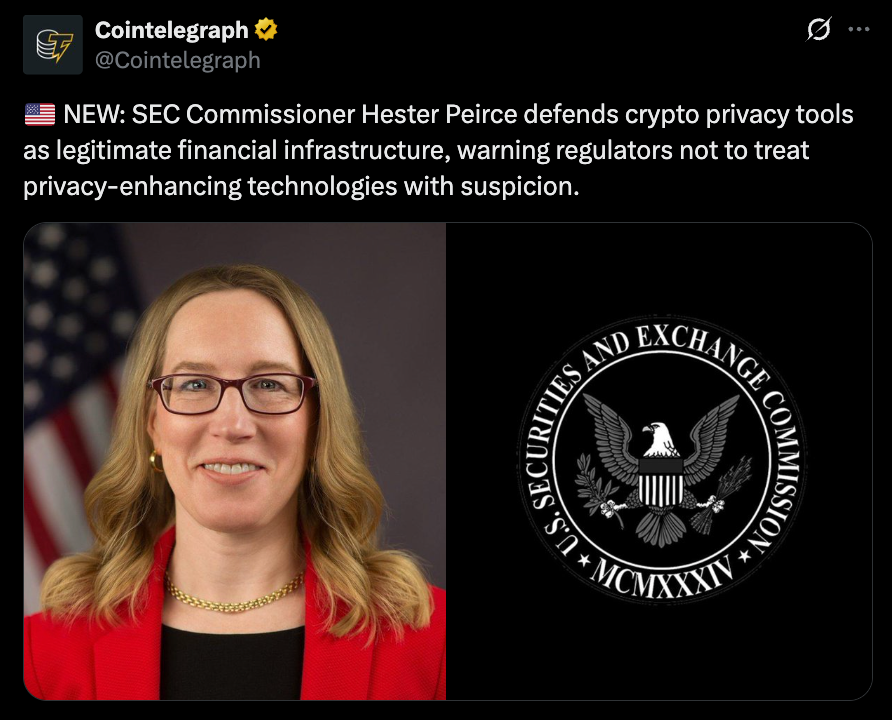
Speaking about privacy-enhancing technologies, Peirce argued that regulators should not automatically assume suspicious intent simply because a technology improves user privacy. Her remarks come at a time when lawmakers and regulators are increasingly examining how privacy can coexist with compliance requirements in digital asset markets. The discussion is becoming more important as blockchain technology moves further into mainstream finance and everyday use.
Privacy and Secrecy Are Not the Same Thing
One of the key points behind Peirce’s argument is that privacy should not automatically be confused with secrecy. Critics often treat the two concepts as interchangeable, but in practice they serve very different purposes. Privacy allows individuals and businesses to protect sensitive information, while secrecy is often associated with concealment and misconduct.
Traditional financial systems already rely on privacy protections. Most people do not publish their bank balances online, and businesses rarely disclose every transaction they make. Financial privacy has long been considered a normal part of commerce. Peirce’s comments suggest that blockchain-based privacy tools should be viewed through a similar lens rather than being subjected to entirely different standards.
Financial Privacy Has Always Existed
The idea that privacy itself requires justification is relatively new. Throughout modern financial history, consumers have expected a reasonable degree of confidentiality regarding their financial activities. Bank accounts, payment systems, and commercial transactions all operate with various forms of privacy protection built into the system.
Peirce’s position effectively extends those same principles into the digital asset space. The technology may look different, but the underlying concept remains familiar. Just because a tool can potentially be misused does not mean the tool itself is inherently problematic. By that logic, cash transactions, encrypted messaging platforms, and even the internet could face similar criticism despite their legitimate everyday uses.
Regulators May Be Shifting Their Approach
The timing of Peirce‘s comments is particularly notable. Privacy-focused crypto projects have spent years operating under regulatory uncertainty as governments expressed concerns about money laundering, sanctions evasion, and illicit finance. Those concerns have not disappeared, but the broader conversation appears to be evolving.

Rather than viewing privacy and compliance as mutually exclusive, regulators are increasingly exploring ways both can coexist. The focus is gradually shifting toward how technologies are used rather than whether privacy features exist at all. That distinction could have significant implications for blockchain developers building privacy-preserving applications and infrastructure.
A Debate That Extends Beyond Crypto
While the discussion often centers on digital assets, the underlying issue reaches much further. As financial systems become increasingly digital, questions surrounding privacy, surveillance, and individual rights will likely become even more important. Technologies that protect user information may eventually become necessities rather than optional features.
Peirce’s message is relatively straightforward: regulators should evaluate technologies based on behavior and outcomes rather than assuming wrongdoing simply because privacy exists. For the crypto industry, that perspective may represent an encouraging signal. As regulatory frameworks continue developing, future policies could focus less on restricting tools themselves and more on addressing how those tools are actually used. That shift would be welcome news for developers, businesses, and users who believe privacy remains a fundamental component of financial freedom.
Disclaimer: BlockNews provides independent reporting on crypto, blockchain, and digital finance. All content is for informational purposes only and does not constitute financial advice. Readers should do their own research before making investment decisions. Some articles may use AI tools to assist in drafting, but every piece is reviewed and edited by our editorial team of experienced crypto writers and analysts before publication.








 English (US) ·