
 2 hours ago
18
2 hours ago
18
Bitcoin’s options market is telling a quieter story than its price action suggests. Saxo Bank’s September 23 analysis of IBIT, BlackRock’s spot Bitcoin ETF, found 30-day at-the-money implied volatility sitting at roughly 37.4%, with an IV rank of just 11.9. That places current volatility expectations near the bottom of their 12-month range.
To put the gap in context: realized volatility over the prior 20 trading sessions ran at 45.5%, meaning Bitcoin was actually moving faster than the options market expected it to. When implied volatility trades meaningfully below realized, it tends to reflect a market that has stopped fearing near-term swings, even if those swings are still happening.
A 37% rebound with surprisingly little drama
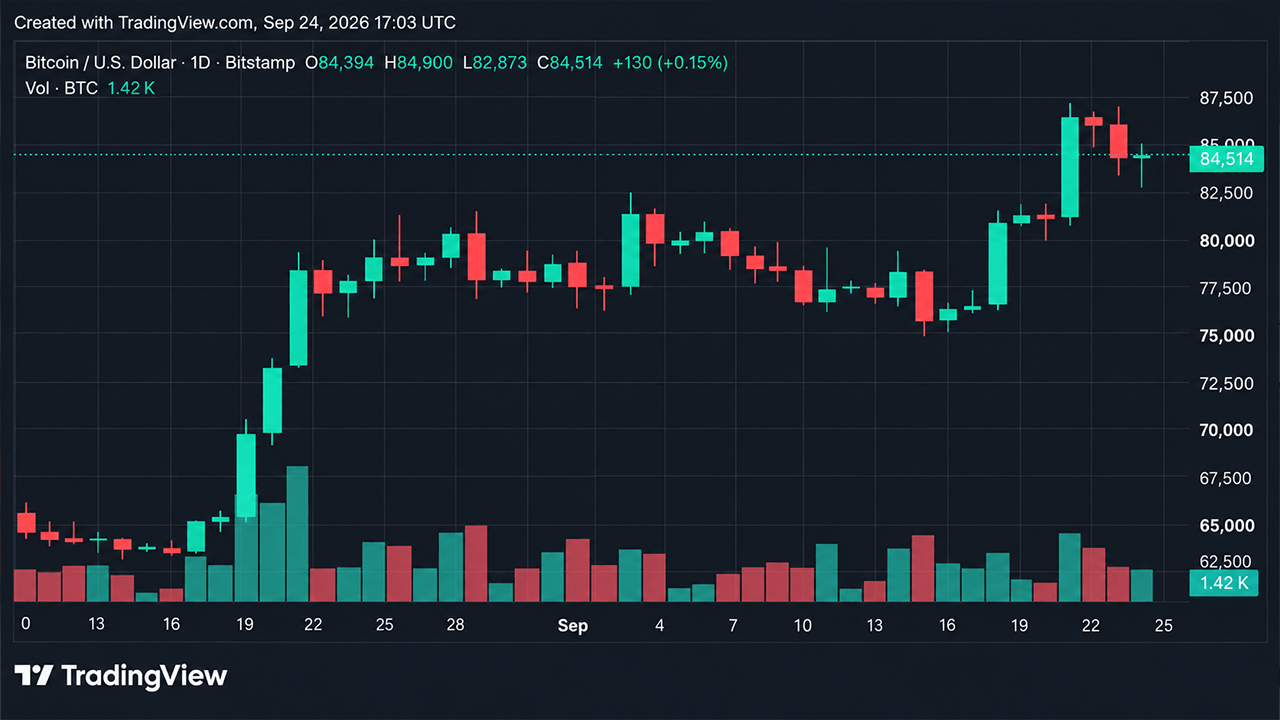
Bitcoin has recovered sharply since mid-August, gaining approximately 37% through September 23. The rebound pulled IBIT shares to around $47.80 on September 24, within a 52-week range of $33.24 to $71.30.
That recovery wasn’t just retail momentum. Net inflows into IBIT totaled roughly $3.76 billion between August 15 and September 22, a meaningful signal that institutional capital was stepping in during the dip rather than running from it.
Even as Bitcoin approached $85,000 heading into September 25, the 30-day implied volatility on IBIT options remained anchored in the 36-37% range. The one-year IV rank floated between the low teens and mid-20s across September 24-25, consistent with Saxo Bank’s earlier reading.
The $15.9B expiry sitting in the background
September 25 brought a notable test: a quarterly Deribit options expiry with roughly $15.9 billion in notional Bitcoin options outstanding.
With IV compressed and Bitcoin trading around $85,000 heading in, the conditions for a dramatic volatility event were relatively muted. Traders watching the IV rank in the low-teens had a data-supported case for positioning around a volatility expansion, since implied vol rarely stays at 12-month lows indefinitely.
What compressed IV actually means for IBIT holders
Implied volatility is the price of insurance. When IV is low, options are cheaper, meaning it costs less to hedge or to place directional bets through puts and calls. An IV rank of 11.9 means current options pricing is cheaper than roughly 88% of the readings from the past year.
For active traders, the spread between 37.4% implied and 45.5% realized is an opportunity signal. Selling options when IV is above realized captures premium; buying them when IV is below realized is structurally cheap, all else being equal.
IBIT’s 52-week high of $71.30 remains well above its current trading level near $47.80. When Saxo Bank points to a historically low IV rank, it’s describing how institutions are pricing Bitcoin risk right now, and right now, they’re pricing it cheaply.
Disclosure: This article was edited by Vivian Nguyen. For more information on how we create and review content, see our Editorial Policy.








 English (US) ·