
 3 months ago
85
3 months ago
85
Tron founder Justin Sun has declared that crypto cards are the next structural phase in how digital assets reach everyday users. This follows a seismic year where stablecoins processed $33 trillion, surpassing Visa’s $14 trillion volume.
Key Takeaways:
- Justin Sun identifies crypto cards as the “next evolution,” capitalizing on a $310 billion stablecoin market that has moved from speculation to real-world utility.
- Tron hosts more USDT in circulation than any other chain, giving it a direct stake in the crypto card distribution race.
- Crypto card volumes grew to rival peer-to-peer stablecoin payments in 2025, with Mastercard and Visa opening the doors to over 150 million merchants and 130 card programs globally
From Wallets to Cards
Sun’s statement, posted on X, frames the shift in distribution terms rather than technology terms, as stablecoins have already crossed the threshold from niche blockchain activity to real-world payment infrastructure. The next phase is embedding digital assets directly into the payment rails most people use every day.
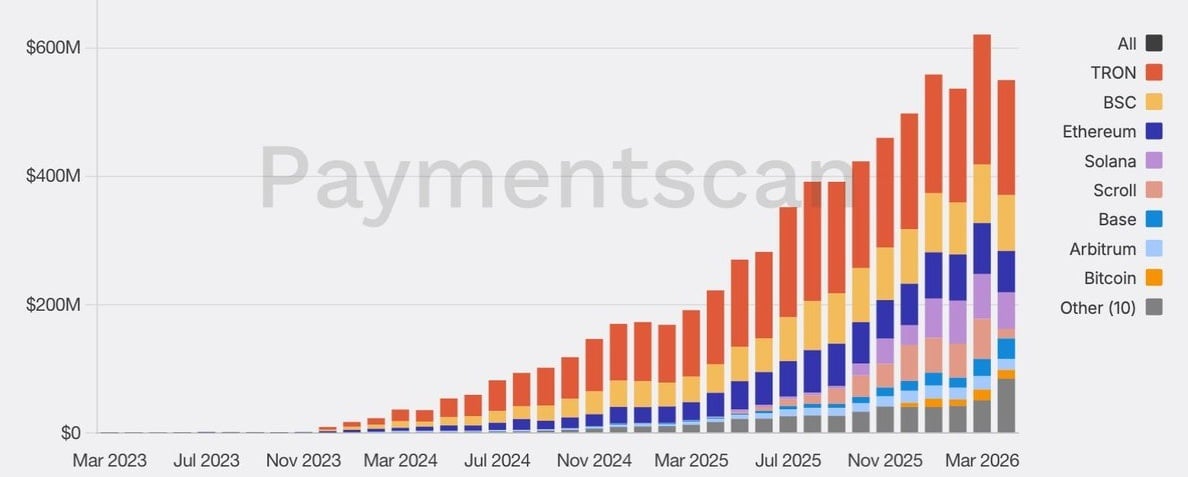 Monthly crypto card volumes by chain.
The stablecoin market opened 2026 at a record $310 billion in total supply, and transaction volumes have expanded rapidly across both crypto-native and traditional payment infrastructure. Binance Research data shows stablecoins processed approximately $33 trillion in 2025, compared with roughly $14 trillion in Visa payment volume over the same period, though the majority of that crypto volume reflects trading and liquidity flows rather than direct consumer spending.
The consumer payments side, too, is growing fast, with data showing that crypto card spending grew significantly last year, reaching volumes that rival direct peer-to-peer stablecoin transfers, a signal that the distribution layer Sun describes is already taking shape.
Where early stablecoin adoption was concentrated in wallet-to-wallet transfers and decentralized finance ( DeFi) protocols, crypto cards are now shifting that spending into merchant payments, everyday purchases, and cross-border transactions.
Mastercard has enabled stablecoin use at over 150 million merchants globally through a partnership with Moonpay, while Visa has scaled its stablecoin settlement rails to nine networks, covering over 130 card programs across more than 50 countries. These are not pilots; they are live infrastructural offerings at scale.
Tron’s Stake in the Distribution Race
Sun’s comments are not made from a neutral position, given that Tron hosts more USDT in circulation than any other blockchain network, making it the dominant infrastructure layer for stablecoin transfers globally. If crypto cards become the primary distribution channel for stablecoin spending, Tron stands to benefit disproportionately from the volume flowing across its rails.
Sun has been positioning Tron around payment use cases for years. His team has developed gasless transaction solutions to reduce friction for end users making stablecoin transfers, and Sun has previously highlighted agentic artificial intelligence (AI) payments on Tron as a convergence point between the stablecoin and AI agent trends taking shape in 2026.






 English (US) ·