
 2 months ago
84
2 months ago
84
A new report from Keyrock, a global crypto investment group leading in market making, asset management, OTC, and options trading for digital assets, finds that artificial intelligence (AI) agents have settled more than $73 million across approximately 176 million transactions since May 2025, while four competing payment architectures have taken shape, backed by some of the largest companies in technology.
Key Takeaways
- Keyrock’s May 2026 report found AI agents settled $73M across 176M transactions in just 12 months, with 98.6% in USDC.
- Coinbase and Stripe each span 5 of 6 payment stack layers, while incumbents deployed over $8B in acquisitions.
- MiCA, the GENIUS Act, and the EU AI Act all hit enforcement by August 2, 2026, with none covering machine-to-machine payments.
Keyrock ‘Who Pays the Agent’ Analysis: USDC Dominates 98.6% of AI Agent Payments
The report, co-published with Coinbase, Tempo, and Virtuals, documents how machine-to-machine payments moved from a theoretical concept to a functioning ecosystem in one year. Agents now pay for API access, data queries, and compute resources in real time, with no human in the loop. The average transaction size has stabilized near $0.48.
Coinbase built x402, a protocol that repurposes the long-dormant HTTP 402 status code to enable stablecoin payments between machines. Stripe and Tempo co-authored the Machine Payments Protocol, known as MPP, a payment-method-agnostic standard that handles stablecoins, credit cards, and Lightning Network payments through a single HTTP flow. Google released AP2, an authorization layer that allows users to delegate spending authority to agents using cryptographic mandates. Visa extended its existing card rails to provision AI-ready tokenized credentials agents can present at checkout.
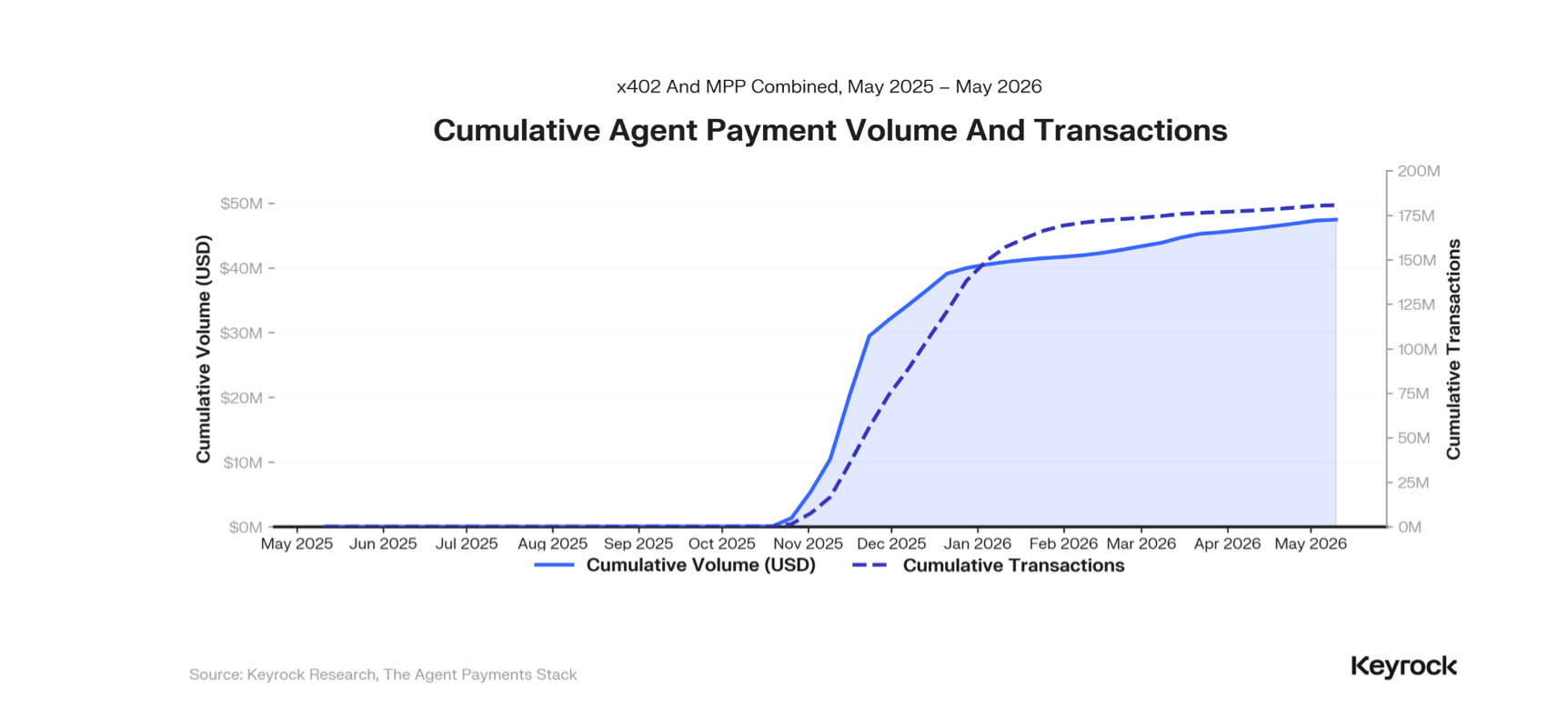 Image source: Keyrock report “Who Pays the Agent? The Race for Frictionless Machine Payments.”
Keyrock’s analysis shows these four protocols are not purely competing. They are assembling into a layered stack. AP2 handles authorization. x402 and MPP handle settlement beneath it. The question the report focuses on is which companies capture the most layers, and therefore attract the most value.
According to the report, Coinbase and Stripe each span five of six stack layers. Coinbase controls settlement through Base, wallets through its AgentKit platform, the payment protocol through x402, and governance as a partner in AP2. Stripe mirrors this through Tempo for settlement, Privy for wallets, Bridge for routing, and MPP for the protocol layer. Circle covers four layers. Google and Visa currently span two and one, respectively.
The economics make crypto rails close to mandatory for this market. Keyrock’s data shows that 76 percent of agent transactions fall below the $0.30 fixed-fee floor charged by card networks. A USDC transfer on Base costs approximately $0.0001, which is roughly 0.03 percent of a $0.31 payment. On Stripe, that same payment would cost $0.309 in fees, leaving the merchant with $0.001.
One of the most concentrated findings in the report is stablecoin dominance. Of the 176 million payments recorded, 98.6 percent settled in USDC. Keyrock flags this as a systemic risk that few in the industry are publicly addressing. If Circle faces a regulatory challenge, a de-peg event, or a technical outage, the agent payments ecosystem has no fallback.
Incumbents moved to secure positions across the stack through acquisitions. Capital One acquired Brex for $5.15 billion. Mastercard purchased BVNK for $1.8 billion. Stripe acquired Bridge for $1.1 billion. Together, these and related deals represent more than $8 billion deployed in twelve months.
Keyrock notes that machines already dominate onchain activity. On Gnosis Chain, AI agents via the Olas network account for over 75 percent of Safe transactions on peak days. On Base and Optimism, bots and automated contracts consume more than 50 percent of gas. The current activity is largely extractive, including arbitrage and volume farming. The shift to productive agent commerce, where agents pay for services that create value for end users, is what the new infrastructure is designed to enable.
The report also points to the failure of OpenAI‘s ChatGPT Instant Checkout, which was shelved in March 2026 after only around 30 Shopify merchants actively used it. The product lacked sales tax collection, fraud prevention, and multi-item cart support. Keyrock interprets the outcome as confirmation that agents transacting through protocol endpoints, not visual checkout flows, is the viable model.
Regulatory uncertainty is the binding constraint identified across all sections. Three major frameworks reach enforcement within weeks of each other: MiCA’s transitional period ends July 1, 2026, the GENIUS Act’s implementation deadline falls July 18, and the EU AI Act’s high-risk obligations take effect August 2. None contain provisions for autonomous machine-to-machine transactions.
Liability is unresolved. With credit cards, merchants bear chargeback risk and consumers receive protection. With stablecoins, once funds land in a merchant wallet they cannot be recalled. As x402 creator Erik Reppel of Coinbase told Keyrock, the risk moves entirely to the consumer. American Express moved first to address this commercially, launching Agent Purchase Protection on April 14, 2026, covering erroneous purchases made by verified agents within its registered ecosystem.
The report concludes that the machine economy already exists. It is not yet doing meaningful commerce. The infrastructure is ready. The regulatory clarity is not.






 English (US) ·