
 7 months ago
80
7 months ago
80
- Litecoin remains in a downtrend, but network usage and integrations continue to grow
- The next halving in August 2027 could tighten supply and support long-term recovery
- A $10,000 LTC position depends on whether demand returns in the next crypto cycle
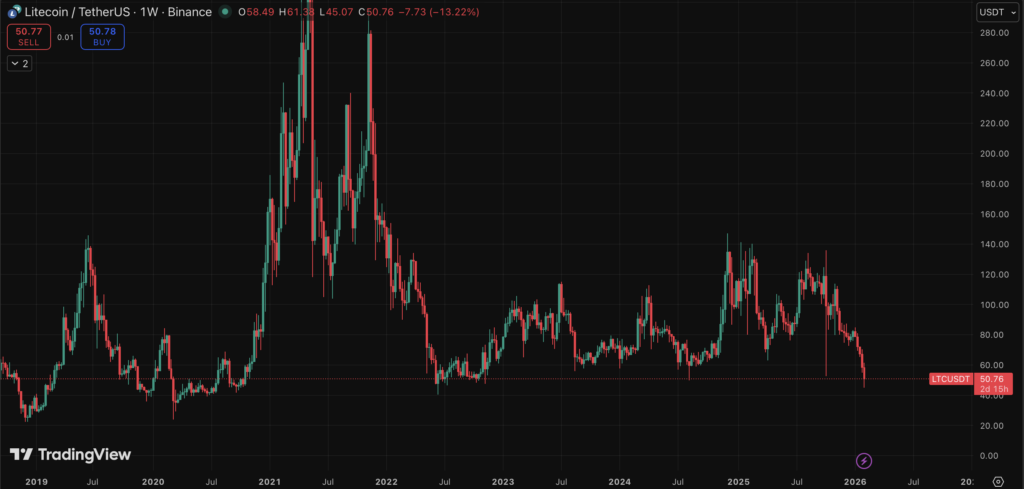
Litecoin has been stuck in a steady downtrend, with the LTC price now trading around $53.86. The chart looks heavy, and honestly, it’s been a rough stretch. But Litecoin is still doing what it has always done best, staying active and staying useful, even when nobody is talking about it.
In recent days, LTC printed a 17-month low near $58 before volume started picking up again. Around the same time, Japan’s SBI expanded lending support, helping Litecoin remain one of the more widely used crypto payment options. Price may be down, but the network is still being used, and that’s the part most people overlook.
Litecoin isn’t a trend coin. It doesn’t need to be. It’s one of the few assets that survives every cycle, even when the spotlight moves elsewhere.
Why Litecoin still matters going into 2027
Litecoin isn’t trying to reinvent crypto, and it’s not chasing meme narratives or complicated ecosystems. Its value comes from something more boring, but more durable: longevity and real usage. People still use Litecoin to move money because it’s fast, low-cost, and reliable. It keeps running no matter what the market is doing, which is a rare quality in this space.
That consistency matters more than excitement, especially when institutions are involved. It’s one reason why companies in places like Japan continue integrating Litecoin into lending and payment systems. Litecoin doesn’t need hype to function. It just needs to keep being Litecoin, and so far, it has.
The 2027 halving is the next major structural catalyst
One of the biggest milestones ahead is Litecoin’s next halving, expected around August 2027. This is the built-in supply event where the block reward drops from 6.25 LTC to 3.125 LTC, cutting new issuance in half. It’s a predictable moment, but markets still tend to react to it, sometimes earlier than expected.
Halvings don’t guarantee a rally. They never have. But they do reduce the amount of new Litecoin hitting the market each day, and over time, that can matter. If demand stays steady, or even returns modestly, reduced supply can become a quiet tailwind for price.
Litecoin also continues to develop slowly around privacy features like MWEB, alongside general network upgrades. None of this is flashy, and it probably won’t trend on crypto Twitter. But it keeps Litecoin relevant as a practical chain rather than a speculative experiment.
Litecoin’s strength is built on trust, not headlines
By 2027, Litecoin’s strength likely won’t come from big announcements. It will come from its continued role as one of the most trusted crypto payment tools, the kind that still works when other ecosystems are busy breaking, rebooting, or rebranding themselves.
That’s the Litecoin trade. It’s not a story of reinvention. It’s a story of survival and utility, and for a certain type of investor, that’s enough.
What happens if you put $10,000 into LTC today?
At today’s price near $53.86, a $10,000 investment buys roughly 185 Litecoin. From here, everything depends on whether Litecoin wakes up in the next cycle and whether broader market demand returns.
If LTC stays near current levels, the position remains close to $10,000 with limited upside. But if the market turns and Litecoin moves back into the $120 to $150 range, that same investment would be worth roughly $22,000 to $28,000. And if a full bull cycle lines up with the 2027 halving narrative, a push toward the $250 region becomes possible, which would turn $10,000 into around $46,000.
Litecoin doesn’t need reinvention. It only needs demand to return. And it’s been around long enough that it’ll probably still be standing when the next cycle arrives.
Disclaimer: BlockNews provides independent reporting on crypto, blockchain, and digital finance. All content is for informational purposes only and does not constitute financial advice. Readers should do their own research before making investment decisions. Some articles may use AI tools to assist in drafting, but every piece is reviewed and edited by our editorial team of experienced crypto writers and analysts before publication.







 English (US) ·