
 1 month ago
120
1 month ago
120
- MetaMask has officially launched Agent Wallet, allowing AI agents to execute onchain transactions within user-defined rules.
- The wallet supports popular AI frameworks, including Claude Code, OpenAI Codex, Cursor, Hermes, OpenClaw, and OpenCode.
- Built-in security features include transaction simulation, Blockaid threat detection, and protection against maximal extractable value (MEV).
MetaMask has officially released Agent Wallet, a new self-custodial crypto wallet that enables artificial intelligence agents to perform onchain transactions while remaining under user-defined controls.
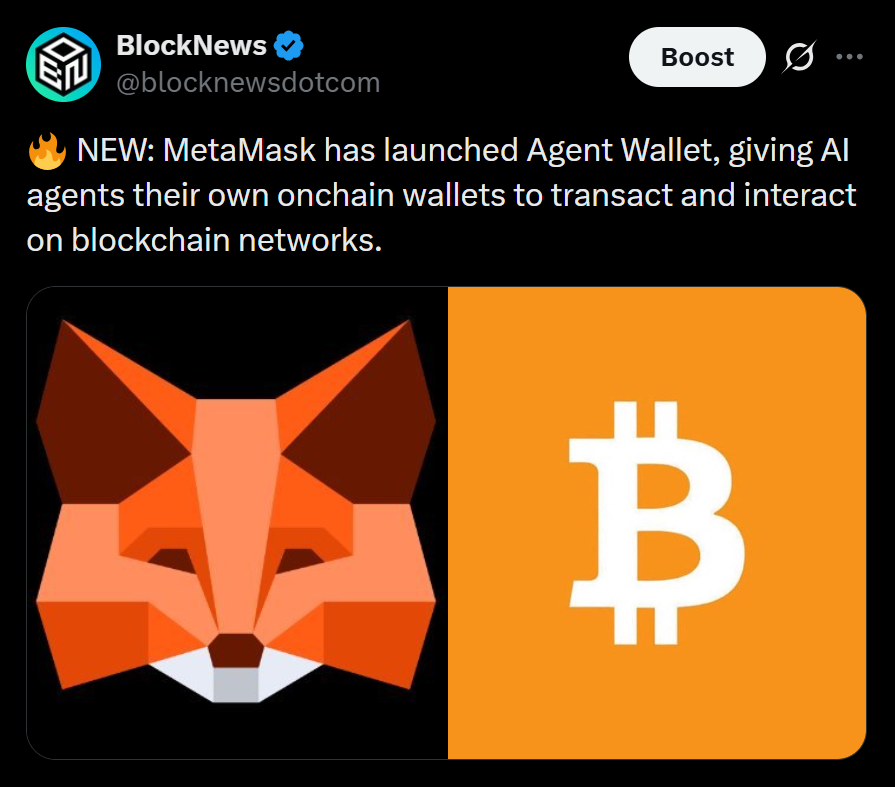
Following a limited early access program that began in June, the product became publicly available on Aug. 6, opening the platform to traders and developers looking to automate blockchain activity using AI.
AI Agents Can Trade Within User-Defined Limits
Agent Wallet allows users to connect several popular AI frameworks, including Claude Code, OpenAI Codex, OpenClaw, Hermes, OpenCode, and Cursor.
Once connected, AI agents can monitor markets, prepare transactions, execute token swaps, transfer assets, and perform other decentralized finance operations through MetaMask’s command line interface.
Before granting an AI agent permission to transact, users can configure daily spending limits, approved protocols, and customized risk settings.
MetaMask offers two operating modes. Guard Mode keeps AI agents within predefined spending limits and approved protocols, while any transaction that falls outside those rules requires two-factor approval through email or the MetaMask mobile app.
For advanced users, Beast Mode removes some policy restrictions to provide greater autonomy, although transactions flagged as malicious still require manual approval. MetaMask said AI agents cannot bypass its security systems under either mode.
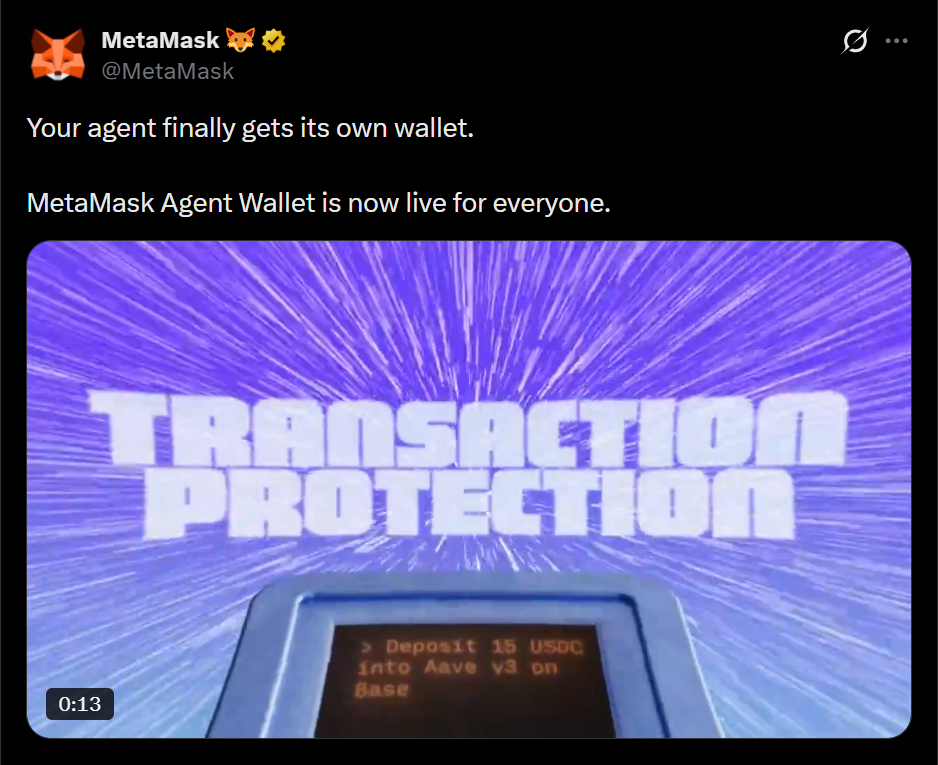
Multi-Layer Security Protects Transactions
Every supported transaction passes through a three-step security process before execution.
First, MetaMask simulates the transaction, showing expected balance changes, token approvals, and gas routing. Next, blockchain security firm Blockaid scans the transaction for potential threats. Finally, MetaMask’s Smart Transactions technology helps reduce losses caused by maximal extractable value (MEV).
Eligible transactions that pass these checks but later suffer a covered loss may qualify for MetaMask Transaction Protection of up to $10,000 per month, subject to the program’s terms and conditions.
Broad Network Support and Flexible Wallet Options
Agent Wallet supports Hyperliquid along with Ethereum Virtual Machine-compatible networks, including Robinhood Chain and Monad.
Users can execute token transfers, swaps, batch transactions, and various DeFi activities without necessarily holding a network’s native gas token. For eligible transactions, gas fees can instead be paid using the token involved in the transaction.
The wallet also supports both server wallets, where keys are stored separately from the primary wallet, and a bring-your-own-wallet option that keeps private keys entirely on the user’s own device.
MetaMask emphasized that users remain in full control of their assets and can export their secret recovery phrase at any time.
Built for the Next Generation of AI-Powered Crypto
Developers can access Agent Wallet through MetaMask’s CLI and install dedicated skills that convert natural language instructions into executable wallet commands. The system returns structured outputs that compatible AI models and agent frameworks can process automatically.
With the official launch of Agent Wallet, MetaMask is expanding beyond traditional self-custody by introducing AI-powered automation while maintaining user control through configurable permissions and multiple layers of security.
Disclaimer: BlockNews provides independent reporting on crypto, blockchain, and digital finance. All content is for informational purposes only and does not constitute financial advice. Readers should do their own research before making investment decisions. Some articles may use AI tools to assist in drafting, but every piece is reviewed and edited by our editorial team of experienced crypto writers and analysts before publication.






 English (US) ·