
 2 months ago
42
2 months ago
42
Strategy Inc. now gives Bitcoin believers two very different seats on the same ship. One rides every wave. The other gets paid while the ship sails.
The company formerly known as MicroStrategy holds 762,099 BTC at an average cost near $75,694 per coin, a treasury valued at roughly $51 billion. That single Bitcoin stack backs both its common stock (MSTR) and its perpetual preferred shares known as Stretch (STRC). Same engine, opposite experiences. And the choice between them may be the most important portfolio decision a Bitcoin-convinced investor makes this year.
Two Products, One Treasury, Completely Different Rides
MSTR is the adrenaline play. Strategy issues shares and debt, buys more Bitcoin, and amplifies price moves in both directions.
During bull markets, MSTR has outperformed BTC by 1.5x to 3x. During downturns, the punishment is equally amplified.
Debt obligations sit ahead of common equity in the capital stack, and ongoing dilution from capital raises compounds losses when Bitcoin stalls or drops.
There is no dividend. No yield. No cushion. MSTR holders bet everything on the price going up. When it does, the rewards are extraordinary. When it doesn’t, the past six months tell the story.
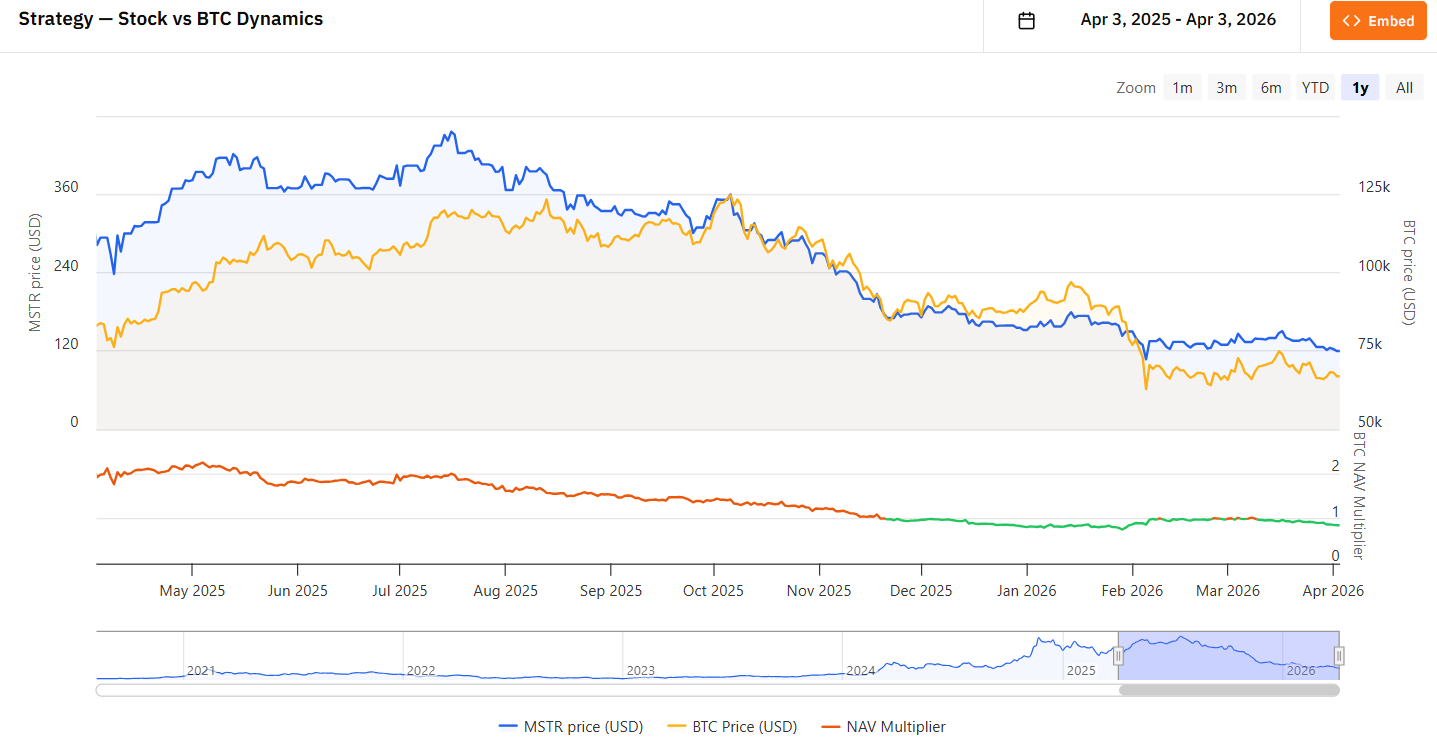 MicroStrategy MSTR Stock vs BTC Performance. Source: Bitcoin Treasuries
STRC is the opposite bet on the same thesis. Launched in July 2025 with a 9% dividend, this perpetual preferred stock pays monthly cash distributions and adjusts its yield to keep shares trading near par value of $100.
That rate climbed through seven consecutive monthly increases to 11.5%, where it held steady for April. The first pause since launch is a signal that the mechanism is working exactly as designed.
The adjustment rules are public. If STRC’s 30-day volume-weighted average price drops below $95, the board recommends hiking the dividend by 50 basis points or more.
Between $99 and $101, nothing changes. Above $101, a cut becomes possible. Bitcoin’s daily price swings get stripped out. Predictable monthly income takes its place.
Strategy CEO Phong Le noted in March that roughly 80% of STRC holders are retail investors, compared to 40% for MSTR common shares.
Follow us on X to get the latest news as it happens
The market is sorting itself. Different investor types self-select into the instrument that aligns with how they think about money, risk, and sleep.
“$MSTR is for people so convinced of bitcoin they want leveraged exposure to it… $STRC is for people who believe in bitcoin but want yield, not volatility,” wrote Bitcoin advocate Halston Valencia in a post.
The Numbers Make the Gap Impossible to Ignore
MSTR closed April 2 at $119.13, inside a tight session range of $116.40 to $120.22. The stock has fallen roughly 56% over the past six months and is 74% below its 52-week high of $457.22. That is leverage working in reverse, in real time, on a real portfolio.
STRC traded flat at $100.00 on the same day. Its entire 52-week range spans just $88.00 to $100.42. Year-to-date returns sit near 4%, almost all from dividends rather than price movement. Boring by design. Profitable by intent.
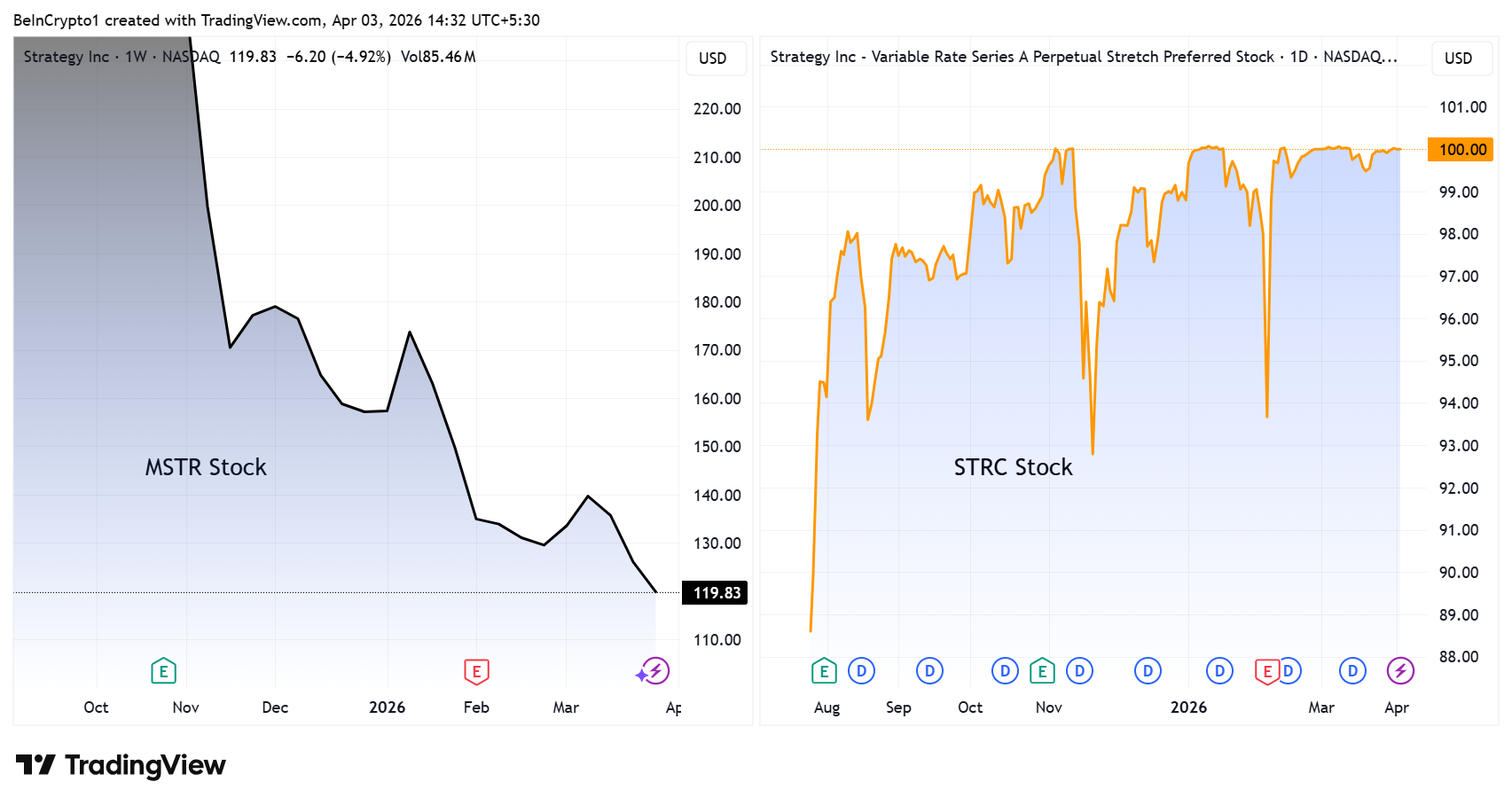 MSTR vs STRC Stock Performance. Source: TradingView
Benchmark-StoneX equity research analyst Mark Palmer described MSTR as a leveraged, non-yielding Bitcoin proxy better suited for sophisticated, risk-tolerant investors.
STRC, he noted, maps to how most retail investors actually think about income because of its predictable return and heavy Bitcoin overcollateralization.
The overcollateralization point matters. Strategy maintains $2.25 billion in cash reserves to service dividend payments, and its BTC treasury dwarfs STRC’s $5 billion notional market cap many times over.
Even in a severe Bitcoin drawdown, the preferred stock sits senior to common equity in the capital structure. MSTR holders absorb losses first.
Strategy also announced a $42 billion at-the-market program, split evenly between common stock and STRC issuance, to continue accumulating Bitcoin toward its public goal of 1 million BTC.
That program makes STRC not just an income instrument but the primary funding engine for the next phase of Bitcoin buying.
Growth or Income. That Is the Whole Question.
The decision reduces to temperament, not conviction. Both MSTR and STRC holders believe in Bitcoin. They just disagree on how to express that belief in a portfolio.
MSTR rewards patience and iron nerves. If Bitcoin recovers from its current range near $67,000 and pushes past previous highs, MSTR holders stand to capture outsized gains that no preferred stock or spot holding can match.
The historical pattern supports this. Over multi-year bull cycles, MSTR has delivered returns exceeding 3,000% while BTC itself returned around 900% in some analyses.
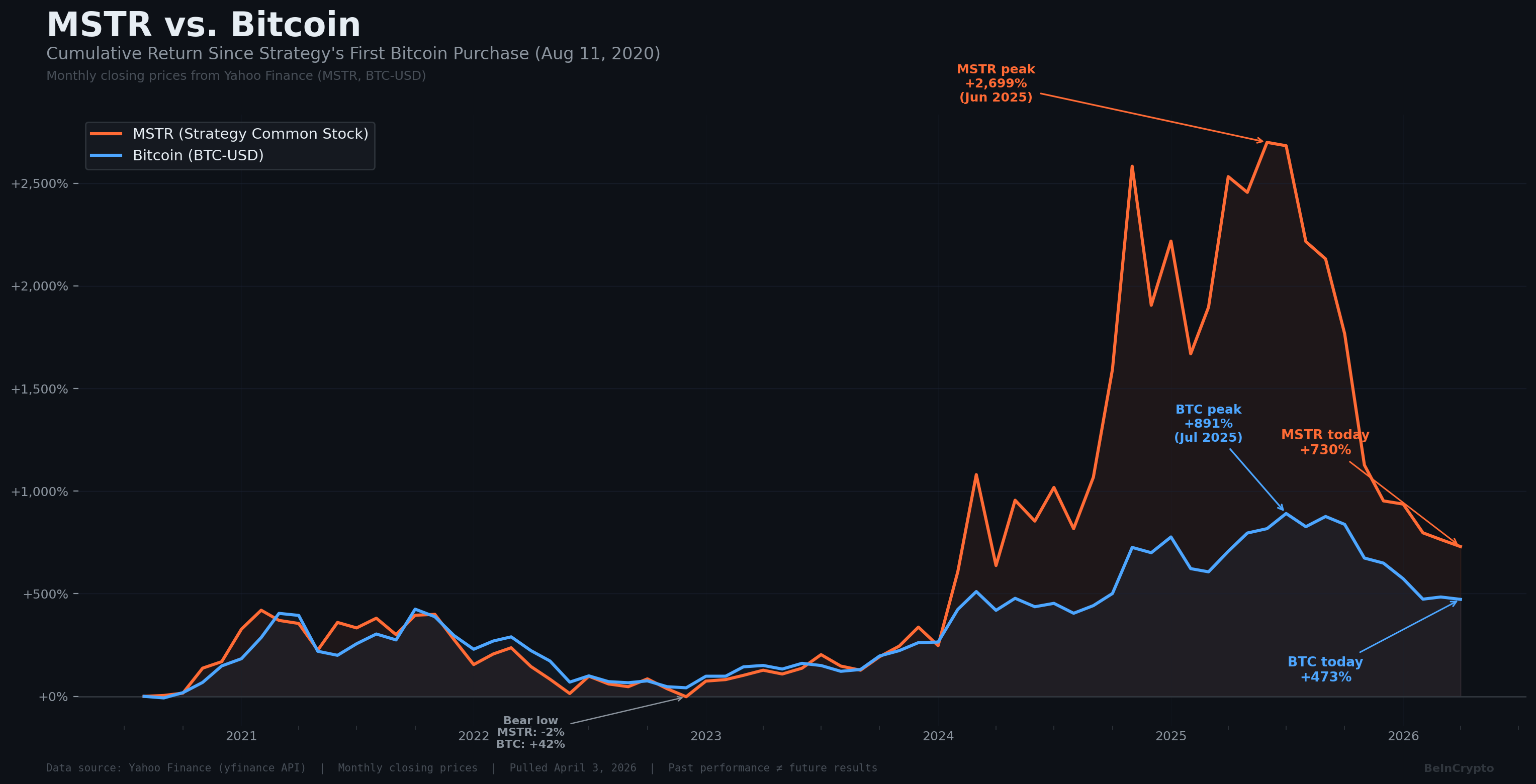 MSTR vs BTC Price Performance. Source: BeInCrypto
However, the current balance sheet shows the cost of that leverage. Strategy’s BTC holdings carry unrealized losses exceeding $5.5 billion.
The company paused its 13-week Bitcoin buying streak last week. Insider selling surfaced, with board director Jarrod Patten offloading 2,100 shares.
The stock trades below all major moving averages, with weak momentum indicators.
STRC rewards consistency and discipline. The 11.5% annualized yield, paid monthly at roughly $0.96 per share, functions more like a high-yield credit instrument than an equity position.
After each ex-dividend date, when the price typically dips, STRC has recovered to par within nine to twelve trading days.
Dividends have so far been classified as non-taxable return of capital, reducing holders’ cost basis rather than generating immediate tax liability.
The trade-off is clear:
- STRC holders will never capture a Bitcoin moonshot.
- The price is engineered to stay near $100.
- The upside is capped.
- The income is the entire point.
The Bigger Picture Most Investors Miss
In March alone, STRC issuance funded $1.18 billion in Bitcoin purchases, roughly 16,800 BTC. Common stock sales raised just $396 million during the same period.
STRC holders are now the primary source of capital fueling Strategy’s accumulation machine.
That shift changes the relationship between the two instruments.
- MSTR benefits when STRC attracts more capital, because more STRC issuance means more Bitcoin purchased without diluting common shareholders as heavily.
- STRC benefits when Bitcoin appreciates, because the treasury backing its dividends grows stronger. They feed each other.
A growing number of investors hold both, alongside spot Bitcoin in self-custody.
- Leveraged upside through MSTR
- Steady income through STRC, and
- Pure sovereignty through direct BTC ownership.
The three do not compete for the same dollar. They serve different parts of the same conviction.
The infighting between Bitcoin maximalists who reject financial products and those who adopt them misses the structural reality.
- All three paths drive more Bitcoin demand.
- All three benefit from the same treasury growth.
The only real question is which mix matches the investor holding the portfolio.
No single answer fits everyone. But ignoring one side of the equation means leaving either growth or income on the table.
The post MicroStrategy’s MSTR vs. STRC: Which Bitcoin Strategy Fits Your Portfolio? appeared first on BeInCrypto.







 English (US) ·