
 3 months ago
68
3 months ago
68
- MoonPay has launched MoonAgents, a macOS application that allows AI assistants like Claude and OpenAI Codex to directly interact with crypto wallets and blockchain services.
- The platform enables AI agents to execute transactions, perform token swaps, and manage onchain activity while users retain custody of their assets.
- MoonAgents enters a rapidly growing market focused on building financial infrastructure for autonomous AI agents.
For the last several years, artificial intelligence companies have focused on making their models smarter, faster, and more capable. MoonPay believes the next major breakthrough may have less to do with intelligence and more to do with financial independence.
The company has officially launched MoonAgents, a new desktop application for macOS that allows AI assistants such as Claude and OpenAI Codex to directly interact with cryptocurrency wallets, stablecoins, token swaps, and blockchain-based payment systems. Instead of simply generating text, writing code, or answering questions, AI agents can now perform real financial actions on behalf of users through a dedicated interface.
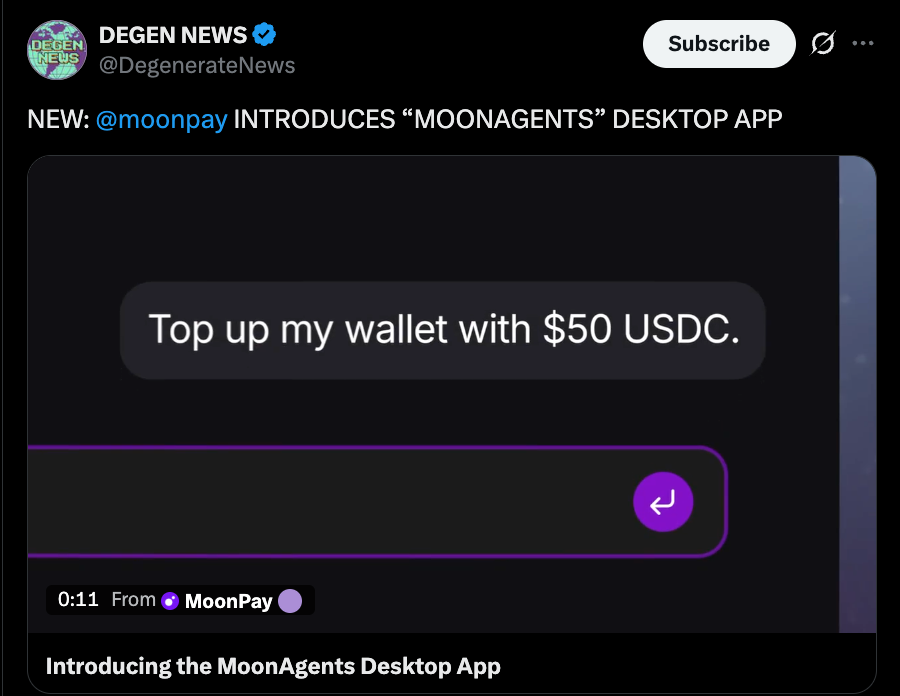
While the launch may initially sound like another AI productivity tool, the implications could extend far beyond that.
AI Is Learning How to Handle Money
One of the biggest limitations facing AI systems today is their inability to independently participate in economic activity.
Modern AI models can generate business plans, analyze markets, write software, and automate workflows. What they generally cannot do is own assets, execute transactions, or directly interact with financial infrastructure. Human users still need to step in whenever money changes hands.
MoonAgents aims to bridge that gap.
Through integrations with wallets, payment rails, and blockchain services, AI assistants can perform a variety of financial tasks while keeping asset custody in the hands of the user. This creates a framework where AI can move beyond recommendation engines and begin acting as an operational participant within digital economies.
That distinction could become increasingly important as AI adoption accelerates.
Crypto Becomes the Financial Layer for AI
The launch also reinforces a growing narrative emerging within both industries.
Artificial intelligence requires a payment system that can operate globally, settle instantly, and function continuously without traditional banking restrictions. Blockchain networks and stablecoins happen to solve many of those requirements. Unlike conventional financial systems that depend on business hours, regional limitations, and intermediaries, crypto infrastructure remains available around the clock.
MoonPay’s ecosystem already supports dozens of crypto-related tools, and the company recently introduced the MoonAgents Card, allowing AI agents to spend stablecoins wherever Mastercard is accepted.
Taken together, these products point toward a future where AI systems can both make decisions and execute transactions.

The Multi-Trillion-Dollar Opportunity
Many investors continue debating whether the next major crypto growth cycle will be driven by institutions or retail adoption.
There may be a third possibility.
If autonomous AI agents become responsible for managing subscriptions, paying vendors, purchasing computing resources, executing trades, or coordinating business operations, they will require financial infrastructure specifically designed for machine-to-machine interactions. Traditional banking systems were built for humans. Blockchain networks may be uniquely suited for software.
This is one reason many industry observers believe AI agents could become one of crypto’s largest growth markets over the next decade.
The potential addressable market extends far beyond individual investors and into the broader digital economy itself.
Why Stablecoins Could Benefit
Stablecoins appear particularly well positioned within this emerging landscape.
AI agents require predictable units of value that can move efficiently across borders and between platforms. Stablecoins offer exactly that. They combine the speed and accessibility of blockchain networks with price stability that makes them suitable for routine economic activity.
As more autonomous systems begin handling financial tasks, demand for digital dollars could increase significantly.
That possibility helps explain why major financial institutions, payment providers, and crypto companies are racing to expand their stablecoin infrastructure.
The competition is no longer focused solely on serving human users.
Building for the Next Internet Economy
The concept of machines managing money may still sound futuristic, but the underlying trend is already beginning to emerge.
Businesses are increasingly deploying AI to automate customer service, software development, operational workflows, and decision-making processes. As those systems become more capable, the logical next step is enabling them to participate directly in financial transactions.
MoonAgents represents one of the earliest attempts to build infrastructure specifically for that future.
Whether the platform ultimately succeeds remains uncertain, but the direction is becoming increasingly difficult to ignore.
More Than Just Another AI Product
MoonPay’s latest launch may ultimately be remembered as more than a convenient tool for crypto users.
It reflects a broader shift where artificial intelligence and blockchain technology are beginning to intersect in meaningful ways. Rather than viewing AI and crypto as separate industries, companies are increasingly exploring how the two can complement one another.
If autonomous agents become a major part of the global economy, they will need a financial system capable of supporting them. MoonPay is making a bet that crypto will be that system.
The future may not simply involve humans using digital assets. It may involve machines using them on our behalf.
Disclaimer: BlockNews provides independent reporting on crypto, blockchain, and digital finance. All content is for informational purposes only and does not constitute financial advice. Readers should do their own research before making investment decisions. Some articles may use AI tools to assist in drafting, but every piece is reviewed and edited by our editorial team of experienced crypto writers and analysts before publication.






 English (US) ·