
 1 hour ago
21
1 hour ago
21
Naver Corp. just made the kind of move that turns a search engine company into an AI infrastructure titan. The South Korean tech giant announced a major expansion of its partnership with Nvidia to build AI factories at gigawatt scale, starting with a 55-megawatt upgrade to its existing hyperscale data center in Sejong, South Korea.
The market noticed. Naver shares climbed roughly 9-14% following the June 7 announcement.
What Naver and Nvidia are actually building
The partnership centers on Nvidia’s DSX platform, a full-stack design that bundles chips, systems, software, and facility architecture into a single integrated package.
The DSX platform is engineered to maximize what Nvidia calls “token throughput per megawatt,” squeezing the most AI processing power out of every unit of electricity consumed and reducing per-query costs for companies running AI inference at scale.
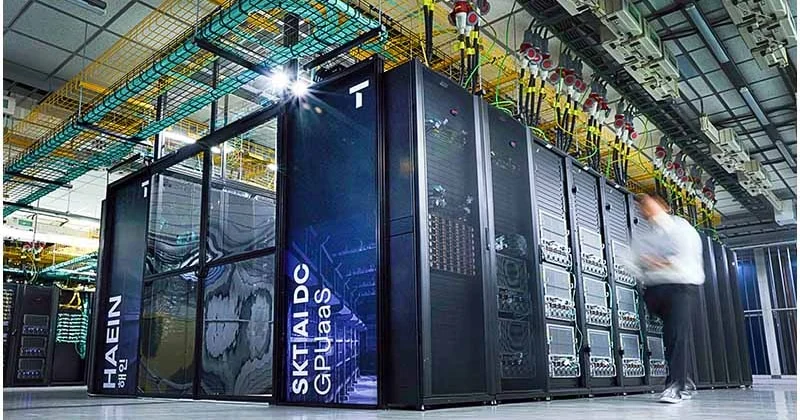
The first concrete step is expanding Naver’s GAK Sejong hyperscale data center by 55 megawatts, with deployment targeted for the first half of 2027. That builds on top of the 4,000-GPU Nvidia B200 installation that Naver completed earlier in 2026.
Naver and Nvidia are planning for gigawatt-scale operations, a threshold that could support hundreds of thousands of GPUs.
The sovereign AI play
Naver chairman Haejin Lee and Nvidia CEO Jensen Huang both emphasized the sovereign AI dimension of the deal—the idea that nations need domestic AI infrastructure rather than depending entirely on foreign cloud providers.
The GAK Sejong facility would serve Korean industry and government clients alongside global cloud customers. Naver and Nvidia also plan to expand these efforts into Europe and the Middle East, regions where governments are similarly interested in reducing their dependence on US-based hyperscalers.
Why this matters for the broader AI infrastructure market
By offering an integrated full-stack solution through the DSX platform, Nvidia is making it easier for companies like Naver to deploy AI infrastructure without assembling disparate components from multiple vendors, while deepening the customer’s dependence on Nvidia’s ecosystem.
Disclosure: This article was edited by Editorial Team. For more information on how we create and review content, see our Editorial Policy.






 English (US) ·