
 4 months ago
51
4 months ago
51
Quick Facts:
 Virginia’s legislative push to allow state investment in Bitcoin validates the asset class for institutional portfolios, likely triggering a supply shock.
- Institutional adoption highlights the need for faster execution layers, as Bitcoin’s L1 cannot handle high-frequency financial applications alone.
- Bitcoin Hyper integrates the Solana Virtual Machine (SVM) to bring sub-second transaction speeds and smart contracts to the Bitcoin network.
- Smart money is accumulating infrastructure plays, with Hyper raising over $31.2M in its ongoing presale.
Legislation advancing in Virginia represents more than just another headline about crypto adoption, it signals a fundamental shift in how sovereign entities view digital scarcity.
By moving to allow state funds to allocate directly to Bitcoin, Virginia is effectively normalizing the asset class for conservative institutional portfolios across the United States. This isn’t just about price appreciation; it’s about legitimizing Bitcoin as a standard treasury reserve asset. Think gold, bonds, and now, Bitcoin.
But the real story goes deeper than the headline numbers. When sovereign entities and pension funds enter the market, they don’t just nibble at the order book; they create a sustained, high-pressure demand shock. This transition from retail speculation to state-sponsored accumulation exposes the network’s glaring bottleneck: scalability.
The base layer is built for security, not the high-frequency throughput a modernized financial system demands.
This disconnect creates a vacuum. As states like Virginia prepare to lock up supply, the market is aggressively pivoting toward Layer 2 solutions that can make that capital productive.
That is where the narrative shifts from simple holding to active utility, driving capital toward projects like Bitcoin Hyper ($HYPER), which are engineered to handle the volume legacy infrastructure simply can’t.
Sovereign Demand Requires High-Speed Infrastructure
Consider the Virginia bill a precursor to a broader trend where Bitcoin becomes the settlement layer for state economies. The problem? The base chain remains too slow for the applications that will be built on top of it.
A state investment fund doesn’t just want to hold an asset; eventually, it needs to utilize it for yield, collateralization, or payment rails. The current Bitcoin network, with its 10-minute block times and limited scripting, can’t support this financial complexity natively.
Bitcoin Hyper addresses this by integrating the Solana Virtual Machine (SVM) directly as a Bitcoin Layer 2. Frankly, this is a critical technical divergence from previous scaling attempts. Instead of relying on sluggish sidechains, Hyper utilizes a modular architecture where Bitcoin L1 handles settlement while the SVM L2 executes transactions with sub-second finality.
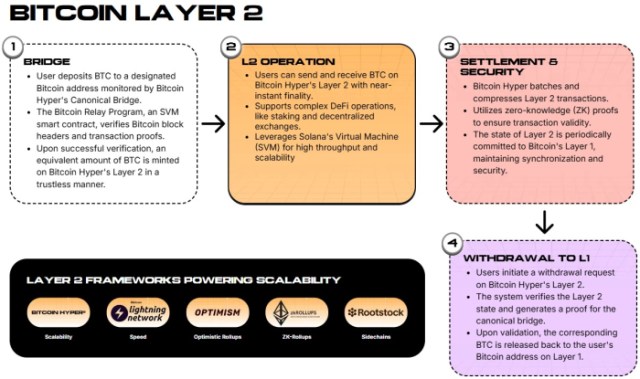
It brings the speed of Solana to the security of Bitcoin, a combination essential for the institutional-grade DeFi applications that inevitably follow state adoption.
Traders are noticing this technical leap. The project focuses on ‘breaking through Bitcoin’s core limitations,’ specifically high fees and a lack of programmability. By enabling fast, scalable smart contracts via Rust, while preserving Bitcoin’s trust model, Bitcoin Hyper positions itself as the execution layer for the liquidity that bills like Virginia’s will eventually bring on-chain.
Learn more about Bitcoin Hyper here.
Smart Money Targets the $31M Presale
While legislators debate policy in Richmond, on-chain data suggests that forward-looking capital is already positioning itself in the infrastructure that will support this new era.
The discrepancy between Bitcoin’s growing store-of-value status and its lack of utility is driving significant flows into development protocols.
According to the official presale page, Bitcoin Hyper has successfully raised over $31.2M, a figure that underscores high conviction in the Layer 2 thesis. With tokens currently priced at $0.0136752, the project has attracted a mix of retail and high-net-worth participants looking for beta exposure to the Bitcoin ecosystem.

The capital raise suggests the market is pricing in a future where Bitcoin requires a robust, high-speed application layer to function as a global currency.
Deep-pocketed investors seem to be taking notice. On-chain data from Etherscan shows 3 whale wallets accumulated over $1M in recent transactions, signaling accumulation behavior typical before major roadmap milestones.
The largest single transaction of $500K indicates that larger players are securing positions early. Plus, the protocol’s staking model offers high APY with a 7-day vesting period for presale stakers, incentivizing long-term alignment rather than quick flips.
Disclaimer: The content provided in this article is for informational purposes only and does not constitute financial advice. Cryptocurrency investments are highly volatile and carry a high risk of loss. Always conduct your own research before making investment decisions.








 English (US) ·