
 2 months ago
34
2 months ago
34
- NFT pricing has largely moved from ETH to USD across markets
- Shift reflects changing behavior after crypto volatility
- Raises questions about crypto adoption versus financialization
Something subtle has changed in crypto, and once you notice it, it’s hard to ignore. NFTs, which used to be almost exclusively priced in ETH, are now mostly quoted in dollars. Not occasionally, not as a secondary reference, but as the default, and that shift says more about the market than it might seem at first.
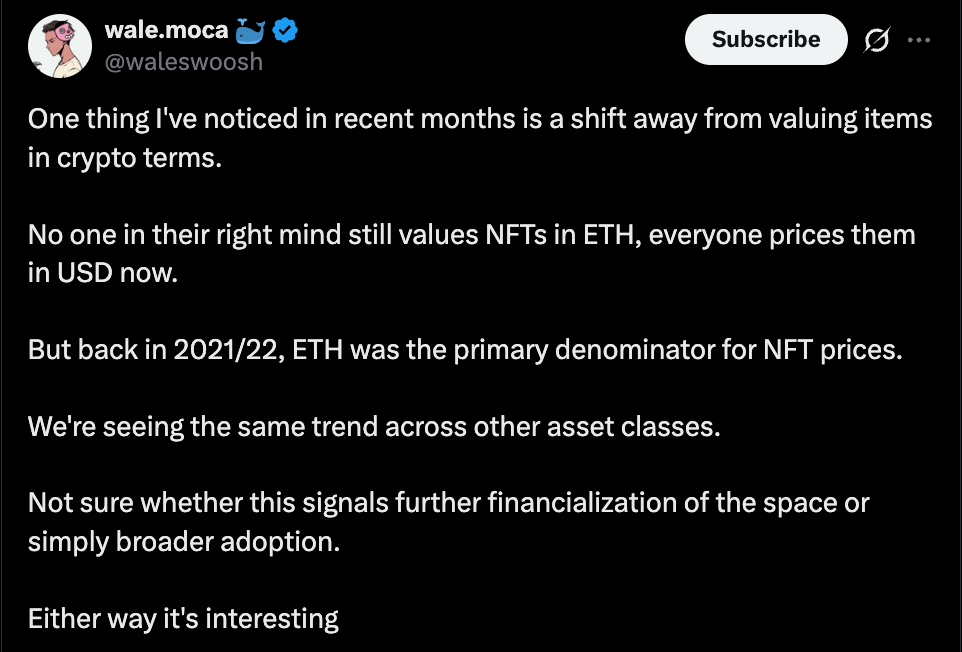
Back during the 2021 boom, pricing in ETH wasn’t just practical, it was cultural. It signaled you were part of the ecosystem, thinking in crypto terms, not translating back to fiat. Saying something cost “3 ETH” meant something different than saying it cost a dollar equivalent. It felt native, almost like its own language.
ETH Was Once the Native Unit of Account
At the peak of the NFT cycle, everything revolved around ETH. Collections like Bored Apes and CryptoPunks were priced, traded, and mentally valued in it. The volatility didn’t matter much, people accepted it as part of the system.
In a way, ETH wasn’t just currency, it was identity. Quoting prices in dollars almost felt out of place, like you were stepping outside the ecosystem to explain it to someone else. Inside crypto, ETH was enough.
Volatility Changed How People Think
Then things shifted, and fast. ETH lost significant value from its highs, and suddenly pricing assets in it became less intuitive. When your unit of account swings wildly, it stops feeling stable and starts feeling like extra work.
USD, on the other hand, doesn’t move like that. It’s predictable, familiar, and easier to process. So the market adapted. Quietly, without much discussion, it just moved on to something simpler.
A Shift Toward Simplicity, or Something Bigger
The interesting question isn’t just why it happened, but what it means. One view is that this reflects financialization, crypto becoming more aligned with traditional systems, adopting their standards and conventions. Another view is that it’s just a sign of maturity, a step toward broader usability.
It’s probably both. Markets don’t usually move for a single reason, especially in crypto. The shift to USD pricing makes things easier for new participants, but it also moves the ecosystem closer to traditional finance logic.
The Culture Around NFTs Has Changed
This change also reflects a broader shift in how NFTs are perceived. The early culture, experimental, identity-driven, a bit chaotic, has faded. What’s left is more structured, more practical, and maybe a bit less distinct.
Pricing in dollars fits that new environment. It’s clearer, more accessible, but it also removes some of the uniqueness that defined the earlier phase. Whether that’s progress or loss depends on how you see it.
Crypto Is Quietly Redefining Itself
When an asset class stops pricing itself in its own currency, it usually means something deeper is happening. Either it’s integrating into a larger system, or it’s adapting to survive, maybe both.
NFTs aren’t gone, but they’re different now. And this shift, from ETH to USD, is one of those small signals that reveals just how much the space has changed, even if nobody made a big announcement about it.
Disclaimer: BlockNews provides independent reporting on crypto, blockchain, and digital finance. All content is for informational purposes only and does not constitute financial advice. Readers should do their own research before making investment decisions. Some articles may use AI tools to assist in drafting, but every piece is reviewed and edited by our editorial team of experienced crypto writers and analysts before publication.








 English (US) ·