
 1 hour ago
20
1 hour ago
20
Key Highlights
- Stock futures declined Monday following the breakdown of trade discussions between the United States and Canada
- Washington implemented a 50% tariff on approximately $20 billion worth of Canadian goods with immediate effect
- Canadian Prime Minister Mark Carney announced retaliatory tariffs to begin September 8, matching US measures
- Wednesday’s Nvidia earnings release represents a critical moment for AI sector valuations
- Escalating tensions with Iran are driving energy costs upward while inflation holds at 3.4%
Equity markets opened the trading week under pressure as participants assessed a deepening trade standoff with Canada, climbing energy costs, and anticipation around Nvidia’s quarterly results.
Futures contracts showed mixed sentiment Monday morning. Dow Jones futures ticked down, with S&P 500 and Nasdaq futures declining 0.1% and 0.3% respectively.
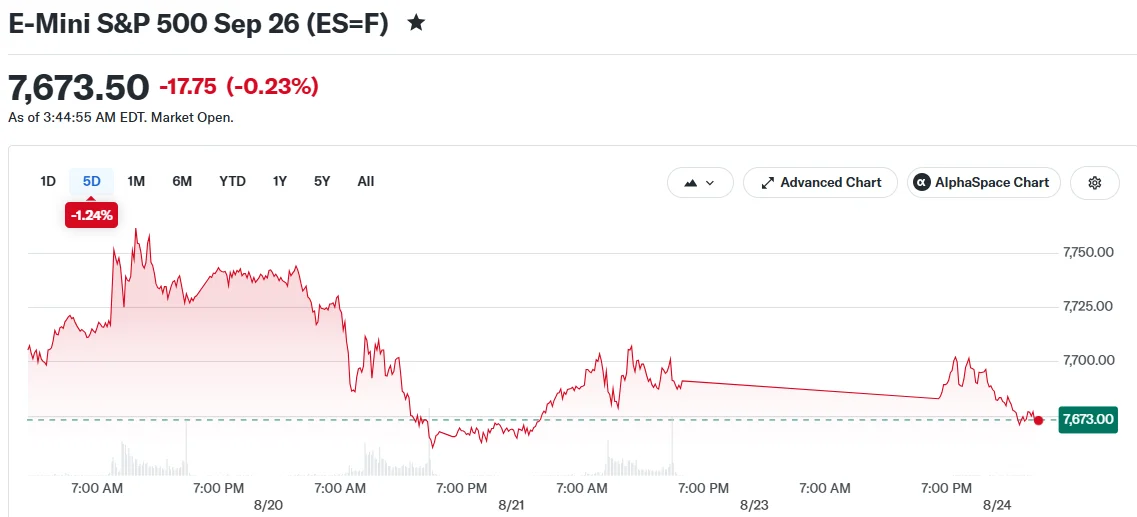 E-Mini S&P 500 Sep 26 (ES=F)
The previous week concluded with losses across major benchmarks. The Dow retreated 0.85%, while the S&P 500 declined 1.4%, and the Nasdaq registered a 2.1% drop.
Trade Negotiations With Canada Break Down
Diplomatic trade discussions between Washington and Ottawa reached an impasse late Friday evening. In response, the United States imposed a 50% duty on roughly $20 billion in Canadian imports, with implementation beginning at 12:01 a.m. Saturday morning.

 UPDATE: The 50% U.S. tariffs on $20 BILLION of Canadian goods are now officially in effect.
Canada's PM Carney has set September 8 for dollar-for-dollar retaliation targeting U.S. steel, dairy, appliances, agricultural equipment and electronics.
No further talks are… https://t.co/3ttNGaByNS pic.twitter.com/X03UFPDKBt
— Coin Bureau (@coinbureau) August 23, 2026
The levies affect diverse product categories, spanning dairy products and alcoholic beverages to lumber materials and apparel.
Prime Minister Mark Carney characterized the action as an “attack” and a “miscalculation.” He pledged matching tariffs effective September 8 to safeguard Canadian employment, agricultural interests, and commercial enterprises.
President Trump shared on social platforms that “Canada wants the benefits of being a State, without being one!!!”
Middle East Tensions Elevate Energy Costs and Inflation Concerns
Simultaneously, Washington remains embroiled in military confrontation with Iran, centered around strategic control of the Strait of Hormuz shipping corridor.
Neel Kashkari, President of the Minneapolis Federal Reserve, cautioned that the standoff is elevating energy prices and creating inflationary pressures.
“The longer it goes on, the bigger effect it ends up having on the US economy and on inflation,” Kashkari stated during a CBS News interview.
Brent crude surged 6.63% during the previous week, reaching $94.39 per barrel. Retail gasoline prices averaged $4.099 per gallon on Sunday, compared to $3.150 one year prior.
Consumer price inflation registered 3.4% in July. Kashkari expressed skepticism about inflation returning to the Federal Reserve’s 2% objective in the near term.
Treasury Secretary Scott Bessent plans to unveil specifics of additional economic sanctions targeting Iran on Monday. He characterized the strategy as “an economic D-Day.”
Market attention then pivots to Nvidia on Wednesday. The semiconductor manufacturer releases second-quarter financial results, with analysts viewing the report as a crucial indicator of sustained AI investment momentum.
Wednesday also brings the July personal consumption expenditures data and an updated second-quarter GDP revision.
The Federal Reserve’s annual Jackson Hole Symposium convenes this week as well, contributing additional significance to an already event-packed market calendar.
The post Nvidia (NVDA) Earnings in Spotlight as Canada-US Trade War Intensifies appeared first on Blockonomi.






 English (US) ·