
 1 month ago
58
1 month ago
58
Peter Schiff pushed back against claims that bitcoin is undervalued following recent declines, arguing that the asset lacks conventional valuation benchmarks as Strategy-linked securities faced steep losses.
Key Takeaways
- Peter Schiff argued bitcoin cannot be considered “cheap” because it lacks traditional valuation metrics such as earnings, yield, or book value.
- Schiff warned that steep declines in Strategy’s stock and preferred shares signal growing risks for bitcoin-linked investment vehicles.
- Bitcoin supporters counter that the asset should be valued as a scarce monetary network rather than through conventional financial metrics.
Peter Schiff Challenges Bitcoin Valuation Claims After Price Weakness
Economist and gold advocate Peter Schiff renewed his criticism of bitcoin on June 23, targeting the narrative that recent price drops have made the asset inexpensive.
His critique focused on the absence of traditional valuation metrics. Schiff questioned how investors determine value for an asset that does not generate earnings, yield, or measurable economic output.
“Bitcoiners claim bitcoin is cheap. Cheap relative to what? Maybe relative to its bubble high, but not relative to its historic lows,” he wrote, asserting:
“With no earnings, yield, book value, or productive use, bitcoin has no valuation anchor. ‘Cheap’ just means buyers hope a greater fool pays more.”
Expanding institutional access through exchange-traded funds (ETFs), corporate treasury allocations, and publicly traded vehicles has intensified scrutiny over bitcoin’s valuation framework. The lack of standardized metrics continues to divide market participants.
Many bitcoin supporters have dismissed Schiff’s criticism as a long-running bearish stance that has consistently underestimated bitcoin’s long-term performance. They argue that bitcoin should not be valued using traditional metrics such as earnings or book value because it is a scarce, decentralized monetary asset rather than a cash-flow-producing business.
Instead, proponents point to its fixed supply of 21 million coins, growing institutional adoption, expanding ETF participation, and increasing corporate treasury holdings as factors supporting its value, while contending that Schiff has repeatedly predicted bitcoin’s collapse despite its appreciation over the past decade.
Strategy-Linked Securities Deepen Focus on Bitcoin Exposure
In addition, Strategy Inc. (Nasdaq: MSTR) emerged as a focal point in Schiff’s broader warning. The company’s bitcoin treasury strategy has made its stock a widely followed proxy for BTC exposure in equity markets.
To finance its accumulation strategy, Strategy has relied on a mix of equity issuance, convertible debt, and preferred shares. This capital structure has tied its market performance closely to bitcoin price movements.
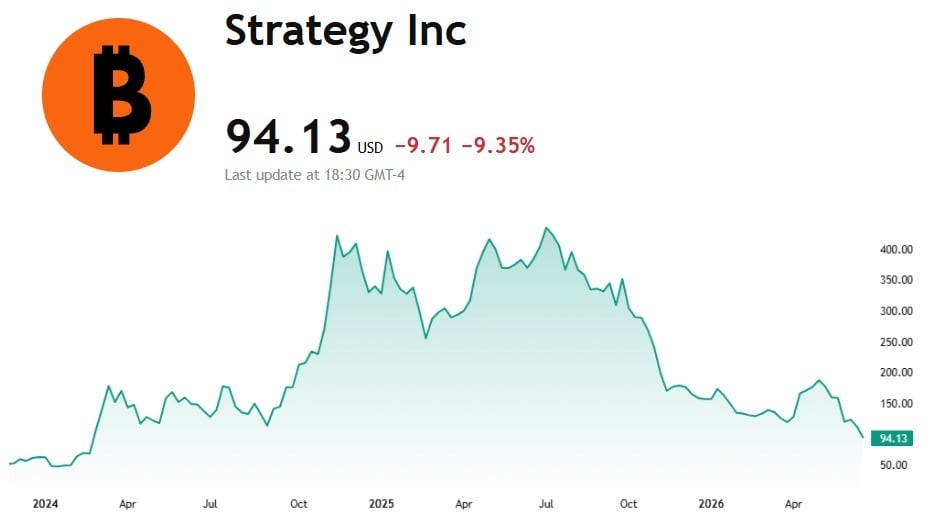 Strategy stock (Nasdaq: MSTR) price as of June 24 via Tradingview.
“Bitcoiners are way too complacent. $MSTR, the biggest Bitcoin owner and its bridge to Wall Street, is collapsing,” the gold advocate wrote, claiming:
“Shares are down 80% from the peak, 20% in just the last five days. Its flagship preferred STRC is down nearly 13%, ‘yielding’ 13.2%. Bells don’t ring any louder!”
The decline in STRC added pressure beyond the common stock’s performance, drawing attention to investor sentiment around the company’s financing instruments. The decline also raised questions about investor confidence in Strategy’s financing model and capital-raising strategy.
MSTR’s volatility has reinforced its role as a barometer for how public markets price corporate bitcoin exposure, especially when acquisition strategies depend on repeated access to equity, preferred stock, and convertible-debt financing.






 English (US) ·