
 2 months ago
38
2 months ago
38
- Polygon is raising up to $100M for a stablecoin payments business
- $250M acquisitions gave it U.S. licenses and wallet infrastructure
- The shift to payments is now Polygon’s core crypto strategy
Polygon isn’t just tweaking its strategy, it’s rewriting it. After years of being known as an Ethereum scaling darling, the company is now leaning hard into payments, and not in a casual way. With talks to raise between $50 million and $100 million for a stablecoin-focused business, the message is pretty clear, this isn’t a side experiment anymore.
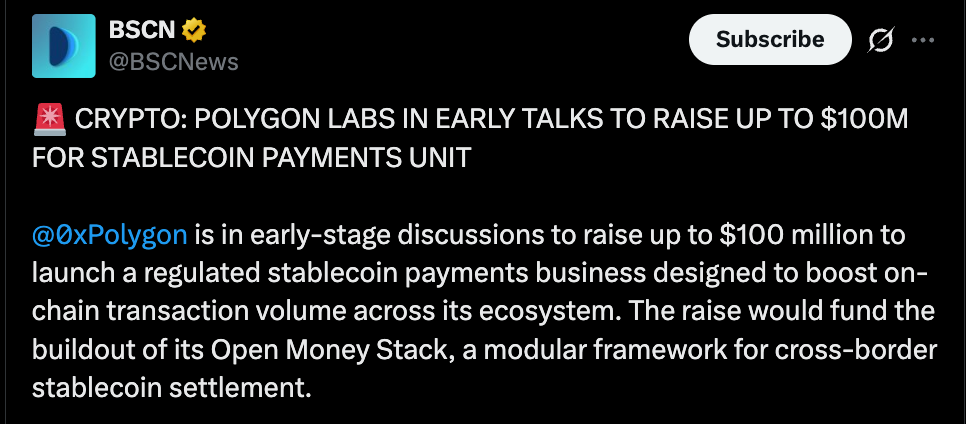
The backdrop matters here. POL has dropped roughly 90% over the past two years, and the broader Layer-2 narrative has cooled as competition intensified. Instead of trying to win that same game again, Polygon is shifting toward something more grounded, moving actual money, not just enabling cheap transactions.
From Crypto Scaling Narrative to Payments Focus
Polygon once thrived on speed, low fees, and developer adoption, and for a while, that was enough. But as more chains reached similar performance levels, those advantages stopped standing out. The market changed, and Polygon had to decide whether to keep chasing relevance or redefine it.
CEO Marc Boiron seems to have made that call already. By acquiring Coinme and Sequence in a deal worth over $250 million, Polygon secured something most crypto firms struggle to get, regulated access to U.S. payment rails across 48 states, plus wallet infrastructure. That’s not hype, that’s distribution, and in payments, distribution is everything.
The $100M Raise Is About Building Real Infrastructure
The planned fundraising isn’t just about capital, it’s about building what Polygon calls an “Open Money Stack.” That includes fiat on- and off-ramps, cross-chain coordination, and enterprise-grade payment tools. It’s less about crypto rails in isolation and more about competing directly with traditional payment giants.

Boiron has been pretty direct on this point. If every blockchain becomes fast and cheap, then speed alone stops being a moat. What matters instead is who can actually move real-world money at scale, within regulatory frameworks, without friction. That’s the game Polygon is trying to enter now.
The Data Suggests This Isn’t Just a Narrative Shift
There’s at least some substance behind the pivot. Stablecoin supply on Polygon reached around $3.4 billion by early 2026, more than doubling from the previous year. Monthly transfer volume climbed to nearly $298 billion, with cumulative volume hitting $2.4 trillion, numbers that start to look less speculative and more like actual payment activity.
At one point, the network processed roughly 178 million USD-stablecoin transactions in a single month. That’s not small. It begins to resemble real infrastructure already being used, even if it’s still early in terms of monetization.
A Reset, Not Just a Pivot
One detail that can’t be ignored is the timing. Polygon cut about 30% of its workforce in early 2026, right around the same time it began pushing this payments narrative and exploring new funding. That combination usually signals something deeper than a simple expansion, it’s more like a reset.
The company is narrowing its focus, shedding broader ambitions from the previous cycle, and concentrating on one core use case. That puts it on a path to compete, at least in theory, with players like Stripe or PayPal. Whether it can actually get there is another question, but the intent is hard to miss.
Polygon’s Crypto Bet Is Now About Moving Money
Polygon isn’t alone in chasing payments. Ripple, Solana-based ecosystems, and a growing list of stablecoin players are all moving in the same direction. The difference here is how aggressively Polygon is committing, both financially and strategically.
The $100 million raise won’t define success on its own, the acquisitions already locked in the direction. What it does show is how serious Polygon is about execution. This isn’t about rebuilding hype. It’s about proving that blockchain can actually handle real-world money flows, at scale, and maybe do it better.
Disclaimer: BlockNews provides independent reporting on crypto, blockchain, and digital finance. All content is for informational purposes only and does not constitute financial advice. Readers should do their own research before making investment decisions. Some articles may use AI tools to assist in drafting, but every piece is reviewed and edited by our editorial team of experienced crypto writers and analysts before publication.






 English (US) ·