
 3 hours ago
14
3 hours ago
14
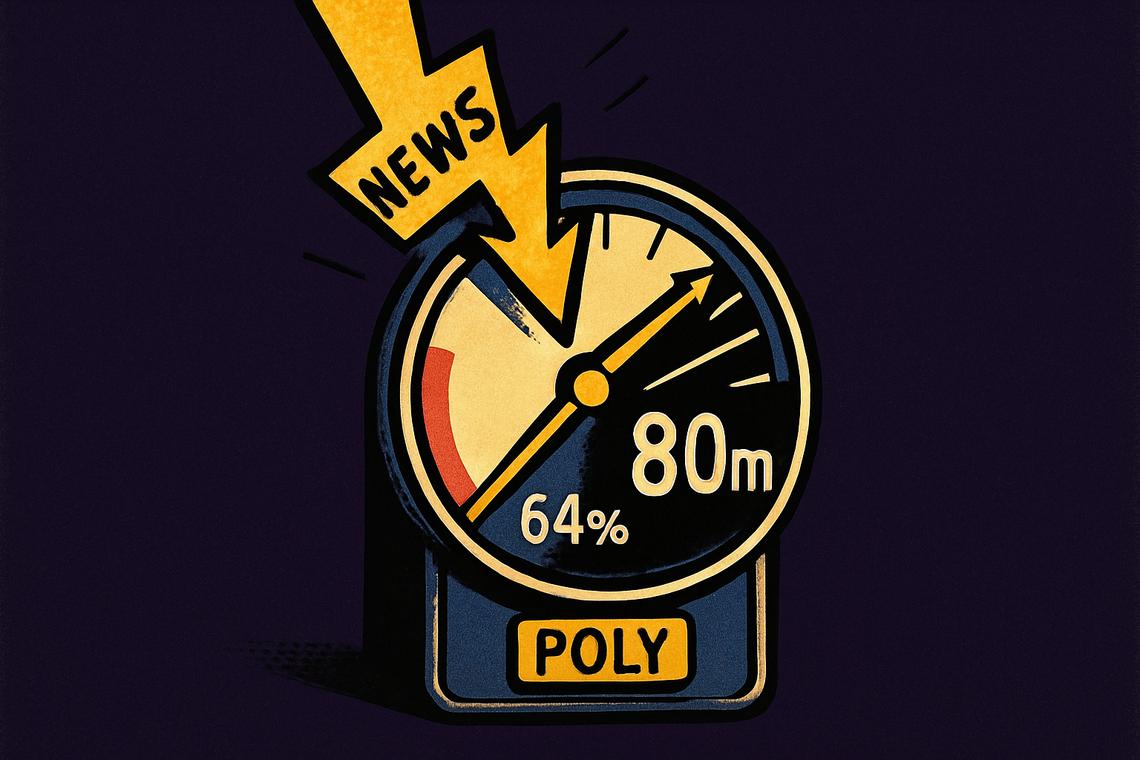
Blockchain settlement is supposed to be instant. Yet new research into Polymarket, the world’s largest prediction market, shows that speed and accuracy are not the same thing. Despite running on infrastructure that can settle trades in seconds, Polymarket price repricing after major breaking news actually takes far longer than most traders assume — closer to an hour and a half than a heartbeat.
Key takeaways
- Polymarket prices take roughly 80 minutes to fully reprice after major news events, according to research on the platform’s high-frequency trading behavior.
- Prediction markets initially move only about 64% of the way toward the corrected price when news breaks, with most of the retracement happening within a 1-to-30-minute window.
- This underreaction shows up across multiple prediction market platforms, not just Polymarket, suggesting a structural pattern rather than a platform-specific flaw.
- Thin liquidity makes the lag worse, stretching out the time needed for prices to fully catch up to new information.
- Separately, Polymarket faced scrutiny in early 2026 over trades tied to Iranian geopolitical developments, and a Stanford and Singapore Management University study found 821 accounts earned $8.2 million by manipulating five-minute bitcoin settlement windows.
Polymarket Price Repricing and the 80-Minute Lag
Full price adjustment on Polymarket after a major news event takes about 80 minutes, far longer than the near-instant settlement its blockchain rails are technically capable of. That gap between infrastructure speed and market speed is the core finding driving renewed scrutiny of how prediction markets actually process information.
Polymarket has built its reputation on being fast — a place where crowds absorb breaking news and spit out a probability almost immediately. The research complicates that story. Instead of snapping to a new fair value the moment headlines hit, prices drift toward it gradually, more like a crowd slowly reaching consensus than an algorithm executing a calculation.
Quantifying the underreaction: from 64% to full correction
The numbers behind that lag are specific. When new information suggests a contract should move by a given amount, prices on prediction markets initially shift only about 64% of the way there — a coefficient of roughly 0.64 relative to benchmark probabilities built from public data. If a fair-value swing should be 10 percentage points, the market typically only moves about 6.4 points at first.
The rest of the correction doesn’t happen all at once, either. Most of the observable price movement toward the new fair value occurs within a 1-to-30-minute window after the news breaks, with the full adjustment stretching out toward that 80-minute mark. In other words, the market gets most of the way there quickly, then spends a much longer tail closing the remaining gap.
This underreaction isn’t limited to one type of event or one type of trader. It shows up consistently enough to be treated as a measurable feature of how these markets absorb information, rather than a one-off quirk tied to a single news cycle.
A structural pattern, not a Polymarket-only glitch
Perhaps the most important detail in the research is that this pattern isn’t unique to Polymarket. The same underreaction to breaking news appears consistently across multiple prediction market platforms, pointing to something built into the mechanics of these markets rather than a flaw specific to any single venue.
That distinction matters for how the industry is judged. If the lag were a Polymarket-specific bug, it would be a fixable engineering problem. Because it appears structural, it suggests prediction markets as a category still behave more like slow-moving crowds absorbing new information than like high-frequency systems reacting instantly to it.
Why Liquidity and Trader Behavior Slow Price Repricing
Thin trading activity is one of the clearest drivers behind slower prediction market delays. When fewer traders are actively pricing a contract, the gap between where a price should sit and where it actually sits widens, and the time required to close that gap stretches out even further.
Liquidity acts almost like a shock absorber for information. Deep markets with plenty of active participants tend to correct faster because more capital is competing to capture the mispricing. Shallow markets, by contrast, leave more room for prices to sit at an outdated level simply because not enough traders have shown up yet to push them toward fair value.
Trader psychology plays a role too. The 0.64 coefficient implies that even traders who react quickly to news aren’t fully confident in their read on the situation, or aren’t willing to commit enough capital to move the price all the way to fair value in a single move. They nudge the price rather than snap it into place, and the market inches toward accuracy in steps rather than jumping there in one motion. That caution is rational on an individual level — nobody wants to be the trader who overcommits on a headline that turns out to be wrong — but collectively it produces the systematic underreaction the research documents.
Trading Volumes, Iranian Trade Scrutiny and the Manipulation Study
Polymarket’s growth has been explosive enough to put every pricing quirk under a brighter spotlight. Trading volumes surged during the 2024 US presidential election cycle and kept climbing through 2025 and into 2026, pulling in a larger and more diverse base of traders than the platform had ever handled before. That scale is exactly why questions about repricing speed and information access carry more weight now than they might have a few years ago.
Part of that scrutiny landed directly on Polymarket in early 2026, when the platform faced questions over trades connected to Iranian geopolitical developments. Critics raised concerns about whether certain traders may have had access to information before it became public — a concern that plugs directly into the underreaction research, since any structural lag in price discovery creates a window where informed traders can act before the broader market catches up.
The Stanford-SMU manipulation study: 821 accounts, $8.2 million
Separately, a peer-reviewed study from researchers at Stanford University and Singapore Management University identified a more specific and more severe integrity problem: settlement manipulation on Polymarket’s short-dated crypto contracts. The researchers examined roughly two months of five-minute bitcoin markets and found 821 accounts that collectively made $8.2 million during settlement windows classified as likely manipulated.
The mechanism relied on Polymarket’s single-price settlement snapshot. Traders would build a position on Polymarket, then place large orders on Binance in the final seconds before a contract settled, pushing bitcoin’s price across the strike threshold just long enough for the snapshot to capture it before the price reverted. According to the study, contracts the market treated as near-certain were overturned roughly one time in three during manipulated windows, and 93% of the losses in those windows fell on retail traders once market makers were excluded. Polymarket responded on August 7, 2026, by replacing the instant snapshot with a time-weighted average price, using Chainlink Data Streams and committing $1 million in liquidity rewards to cushion the transition — a fix that mirrors the moving-average settlement approach already used by rival platform Kalshi.
What This Means for Traders and Market Integrity
For active traders, the underreaction research points to a real, if narrow, edge. Because prices don’t fully adjust to breaking news right away, the first traders to act after an event can position against the stale price before the rest of the market drags it into line. That’s the flip side of market underreaction news: what looks like inefficiency to a passive holder looks like opportunity to someone fast enough to exploit the lag.
It’s worth separating that structural underreaction from the settlement manipulation issue, even though both point to the same underlying truth: speed on the blockchain doesn’t automatically mean speed — or fairness — in pricing. Near-instant settlement infrastructure can execute a trade in seconds, but it can’t force a market full of cautious, capital-constrained traders to price new information correctly in the same instant. And as the manipulation study showed, the design of a settlement mechanism itself can create its own vulnerabilities, separate from ordinary underreaction, that require deliberate fixes rather than faster hardware.
That combination — a structural pricing lag on one side, and a settlement-design vulnerability on the other — is likely to keep drawing attention as prediction markets grow larger and more consequential. The more capital and information flow through platforms like Polymarket, the more the gap between how fast these markets claim to be and how fast they actually reprice becomes a story in its own right.
FAQ
How long does Polymarket take to fully reflect major news in its prices?
Polymarket takes roughly 80 minutes to fully reprice after major news events, according to research on the platform’s price behavior.
Is the delayed price adjustment unique to Polymarket?
No. The underreaction is a structural feature seen across multiple prediction market platforms, not something specific to Polymarket alone.
What causes delays in price correction after news breaks on prediction markets?
Lower liquidity and cautious trading behavior are the main drivers. Traders tend to move prices only partially at first, and thinner markets take longer to fully close the gap between the old price and the corrected one.
Has Polymarket faced any scrutiny related to its trading activity?
Yes. Polymarket faced scrutiny over trades linked to Iranian geopolitical events in early 2026, and a separate Stanford and Singapore Management University study found 821 accounts made $8.2 million by manipulating settlement prices on the platform’s five-minute bitcoin contracts, prompting Polymarket to overhaul its settlement mechanism.
Article produced with the assistance of artificial intelligence and reviewed by the editorial team.


 English (US) ·