
 1 hour ago
17
1 hour ago
17
Revolut is rolling out EURR, its first euro-backed stablecoin, to customers in Denmark, Poland and Portugal before a wider European expansion. With more than 80 million customers globally, the fintech could give euro stablecoins one of their largest consumer distribution channels yet.
Key Takeaways
- Revolut launched EURR in 3 countries, opening euro stablecoin access to its 80M+ customers.
- EURR could reshape Europe’s stablecoin market by reducing reliance on USDC and USDT.
- Revolut plans wider EEA rollout in 2026 as Bridge and MiCA rules shape EURR adoption.
Revolut Targets 80 Million Users With EURR Stablecoin
Revolut is turning part of its global currency business into blockchain infrastructure.
The fintech has begun a phased rollout of EURR, a euro-pegged stablecoin designed to maintain a value of €1. The token will initially be available to eligible customers in Denmark, Poland and Portugal, with broader availability across the European Economic Area expected later this year.
For Revolut’s more than 80 million customers, including over 16 million crypto users, EURR creates a direct bridge between bank balances, crypto markets, external wallets and supported blockchains.
The launch also gives Europe’s relatively small stablecoin market a potentially powerful distribution boost. Euro-backed stablecoins total roughly €450 million, compared with about $300 billion for dollar-denominated tokens.
Revolut Removes the Dollar Stablecoin Detour
For European crypto users, the main attraction is straightforward.
Instead of converting euros into USDC or USDT before moving onchain, customers can potentially go directly from euros into EURR and then into crypto markets or decentralized applications.
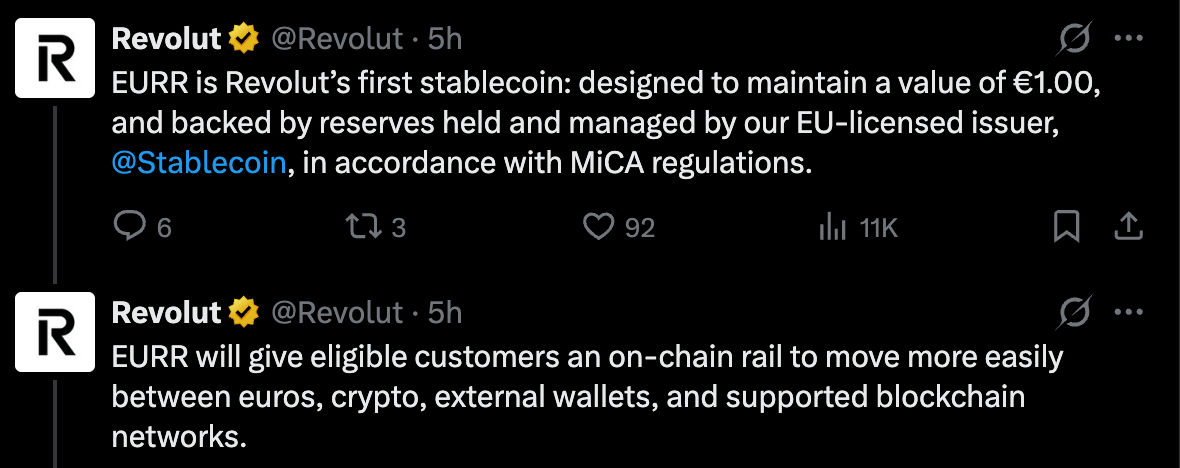 Source: Revolut on X
“EURR is only the beginning,” Revolut said, adding that stablecoins linked to other currencies are already under development.
Revolut itself is not the legal issuer. EURR is issued by Bridge Building S.A., part of Stripe-owned Bridge, which holds the reserves and redemption obligation. Bridge is regulated in Luxembourg, while Revolut Digital Assets Europe distributes the token under its CySEC-regulated MiCA framework.
That structure allows Revolut to move quickly while keeping the customer relationship inside its own app.
Regulation Still Shapes How Onchain Money Moves
EURR may make euro-denominated crypto transfers simpler, but it will not remove the compliance checks surrounding them.
DeFi commentator Ignas noted that users moving funds between Revolut and decentralized protocols could still face source-of-funds reviews or additional account checks. His broader point is that stablecoins can make settlement faster, while regulation still determines how easily money moves between crypto and regulated financial platforms.
There is also a branding complication. Market commentator Max Karpis pointed out that the EURR ticker is already used by StablR Euro, a separate token with a different issuer and smart contracts. That overlap could create confusion if Revolut’s token reaches exchanges and wallets more broadly.
Still, the larger strategy is clear. Revolut is not treating EURR as a standalone crypto experiment. It is beginning to place its multi-currency platform on blockchain rails, with the euro serving as the first test of how far its enormous retail distribution network can push stablecoins into mainstream finance.




 English (US) ·