
 2 months ago
66
2 months ago
66
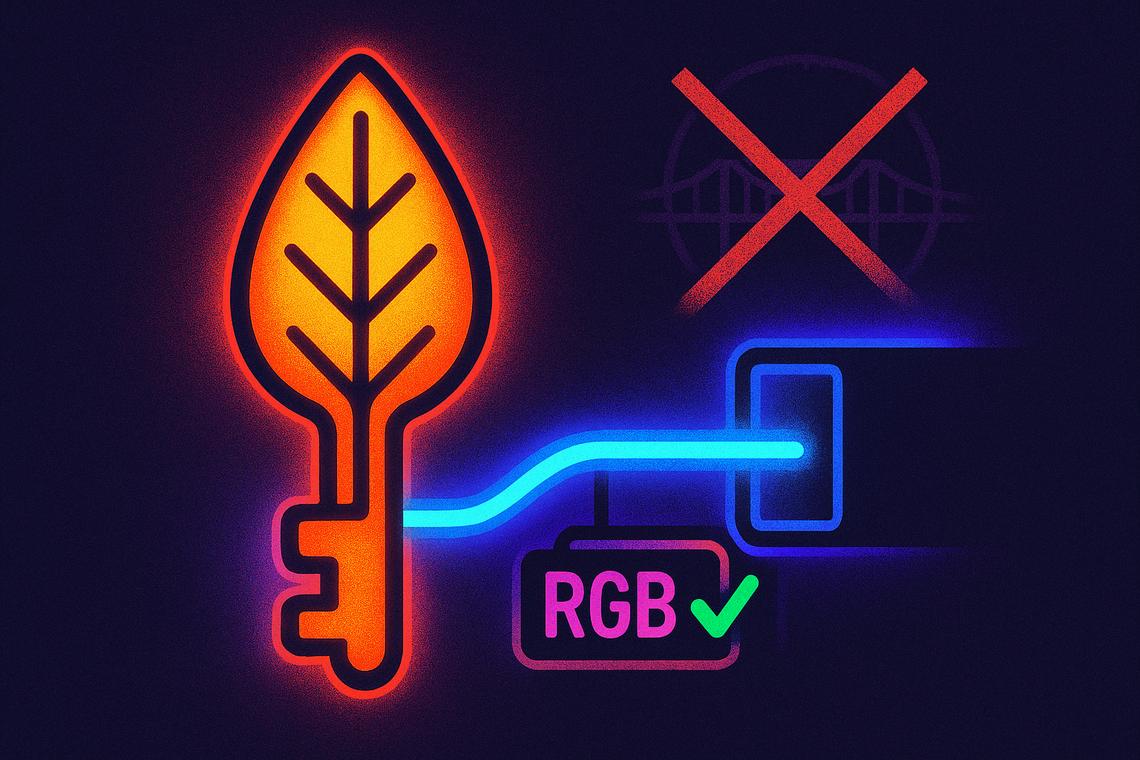
It took just 207 lines of code to do something the broader blockchain community assumed would require far more heavy lifting. KaleidoSwap has demonstrated that native RGB assets can run directly on Blockstream’s Liquid sidechain — no bridge, no custodian, no architectural overhaul required. The key insight turned out to be hiding in plain sight: both Bitcoin and Liquid use an identical Taproot output format under BIP-341, which meant the RGB protocol’s commitment mechanism slotted into Liquid almost without friction.
Key takeaways
- KaleidoSwap ran native RGB assets on Liquid using only 207 lines of backward-compatible code across seven files, with zero changes to the existing 45-test suite.
- Bitcoin and Liquid share an identical Taproot output format under BIP-341, allowing RGB verifiers to accept Liquid transaction outputs as valid commitments without modification.
- A real RGB20 asset was issued on Liquid, and a custodian-free atomic swap between RGB assets on Bitcoin and Liquid was successfully demonstrated.
- Liquid’s Simplicity smart contract language — live on Liquid mainnet since July 2025 — enables KaleidoSwap to enforce RGB commitment rules at the consensus layer through a covenant.
- The RGB patch for Liquid integration has been submitted as an RFC to the official RGB repository and is awaiting maintainers’ approval.
KaleidoSwap Enables Native RGB Assets on Liquid Sidechain
The technical premise sounds deceptively simple. RGB anchors asset transfers to the blockchain by embedding a cryptographic commitment inside a standard Taproot output. Because both Bitcoin and Liquid implement Taproot outputs according to BIP-341, that commitment looks identical to RGB’s verification layer regardless of which chain produced it. The standard RGB verifiers accepted Liquid transaction outputs as valid commitments without any modification whatsoever.
What that meant in practice was that the only new code needed was the logic to read a Liquid transaction rather than a Bitcoin one. The result: 207 lines of code across seven files, a small abstraction layer over three verification calls. All 45 tests in the existing suite passed untouched. Four downstream production libraries rebuilt cleanly without a single source change.
Why Minimal Code Changes Matter So Much
The smallness of this delta is arguably the most strategically significant part of the story. A 207-line patch that passes an existing test suite without modification is not just a technical curiosity — it signals that the RGB protocol’s architecture was designed with enough generality to accommodate networks beyond Bitcoin without requiring a fork of the protocol itself. That has real implications for how quickly other chains or sidechains with BIP-341 Taproot outputs could theoretically follow the same path.
Demonstration of RGB20 Asset and Atomic Swap Security
Proving that RGB commitments work on Liquid is one thing. Proving that they work in a real, end-to-end production scenario is another. KaleidoSwap went further than a theoretical proof: the team issued an actual RGB20 asset on Liquid, complete with a live contract, a transfer with change, and fully verified end-to-end anchoring on the sidechain.
Then came the more striking demonstration. The team executed a custodian-free atomic swap between an RGB asset on Bitcoin and an RGB asset on Liquid. The swap relied on a shared secret binding both legs of the transaction together — either the exchange completes in full for both parties, or it does not happen at all. At no point can one participant hold both assets simultaneously. That all-or-nothing guarantee eliminates the counterparty risk that typically requires a trusted intermediary in cross-chain transfers.
The significance here extends well beyond the technical mechanics. Cross-chain asset movement has historically depended on bridges — infrastructure that has been the source of some of the largest hacks in blockchain history. A bridge-free, atomic approach that works at the protocol layer represents a fundamentally different security posture.
Leveraging Liquid’s Simplicity Smart Contracts for RGB Enforcement
The deeper reason KaleidoSwap targeted Liquid specifically comes down to Simplicity, Blockstream’s formally verifiable smart contract language, which has been active on Liquid mainnet since July 2025. Unlike more permissive scripting environments, Simplicity allows spending conditions to be proven correct before deployment — a property that matters enormously when those conditions govern asset transfers.
How Covenants Lock RGB Asset Rules at Consensus Level
Because an RGB seal is ultimately just a coin on the underlying chain, whatever spending rules the chain enforces on that coin become, in effect, spending rules on the asset itself. KaleidoSwap exploited this by writing a Simplicity covenant that the network enforces for every spend of an RGB seal: the transaction must carry a valid RGB commitment. If it does not, the network rejects the spend outright.
Simplicity is already deployed in production on Liquid for use cases including post-quantum signatures and collateralized loan contracts. The ability to extend that infrastructure to enforce RGB asset semantics at the consensus layer — rather than relying on application-level validation — marks a meaningful step in how programmable Bitcoin-adjacent assets can behave on a sidechain.
Future Prospects and Community Adoption
The patch enabling RGB on Liquid integration has been submitted as a formal RFC to the official RGB repository. The decision now rests with the RGB maintainers, and whether they accept the proposal will determine how quickly this integration moves from a KaleidoSwap demonstration into a protocol-level standard.
Strategic Positioning Within the RGB Protocol Association
KaleidoSwap is not approaching this as an outsider. The company is a founding member of the RGB Protocol Association alongside Bitfinex and Tether — two of the most influential entities in the Bitcoin-adjacent financial ecosystem. The association’s backing lends the Liquid integration proposal institutional weight that an independent submission would lack.
The strategic framing is explicit: with RGB already running on Bitcoin and Lightning, Liquid is positioned as the natural third network. KaleidoSwap’s network of market makers already operates across RGB and Lightning, and extending that infrastructure to Liquid would give the protocol access to Liquid’s privacy features, its faster settlement, and most importantly, its Simplicity-based programmability.
The RFC’s fate in the hands of RGB maintainers is the open question that determines whether this integration becomes a footnote or a turning point. If accepted, it would formalize a path for any developer to build RGB-native applications on Liquid using the same tooling they already use on Bitcoin — a prospect that could reshape how the RGB ecosystem approaches scalability and smart contract functionality well beyond what Bitcoin’s base layer alone can support.
FAQ
How did KaleidoSwap enable RGB assets on the Liquid sidechain?
KaleidoSwap adapted RGB commitments to Liquid by writing only 207 lines of backward-compatible code across seven files. The integration was made possible by the identical Taproot output format that both Bitcoin and Liquid share under BIP-341, allowing existing RGB verifiers to accept Liquid transaction outputs without any modification.
What security measures protect the atomic swaps between Bitcoin and Liquid RGB assets?
Atomic swaps between Bitcoin and Liquid RGB assets are secured by a shared secret. The mechanism ensures the swap either completes fully for both parties or does not happen at all, preventing any scenario where one party could hold both assets simultaneously and eliminating the need for a custodian.
What role does the Simplicity smart contract language play in RGB assets on Liquid?
Simplicity, active on Liquid mainnet since July 2025, allows KaleidoSwap to enforce RGB asset spending conditions at the consensus layer. A covenant written in Simplicity requires every spend of an RGB seal on Liquid to carry a valid RGB commitment — without it, the transaction is rejected by the network itself.
What is the future outlook for RGB assets on Liquid according to KaleidoSwap?
KaleidoSwap aims for Liquid to become the next major RGB network after Bitcoin and Lightning. The RGB patch enabling this integration has already been submitted as an RFC to the official RGB repository, and its adoption depends on approval from RGB maintainers. KaleidoSwap, as a founding member of the RGB Protocol Association alongside Bitfinex and Tether, is actively pushing for this outcome.
Article produced with the assistance of artificial intelligence and reviewed by the editorial team.





 English (US) ·