
 3 months ago
75
3 months ago
75
- Ripple is integrating RLUSD with Wormhole’s Native Token Transfers technology.
- The upgrade allows RLUSD to move natively across more than 40 blockchain ecosystems.
- The expansion strengthens Ripple’s position in stablecoins, tokenization, and institutional blockchain adoption.
The stablecoin market is rapidly becoming one of the most competitive sectors in crypto, and Ripple appears determined to secure a larger share of it. The company has announced that RLUSD will integrate with Wormhole’s Native Token Transfers (NTT) framework, a move designed to make the stablecoin available across more than 40 blockchain ecosystems without relying on wrapped assets or fragmented liquidity pools.
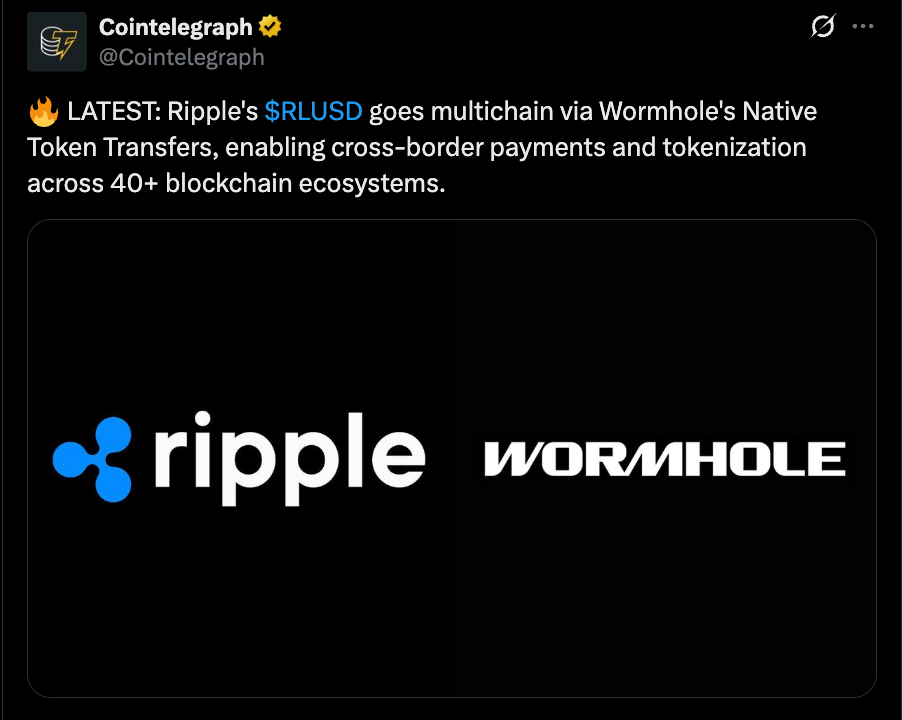
At its core, the upgrade is about accessibility. Ripple wants RLUSD to function wherever developers, institutions, and users choose to operate. Instead of creating separate versions of the stablecoin on every network, the NTT framework enables RLUSD to maintain a unified supply while moving seamlessly between chains. It’s a technical change, sure, but one that could have significant implications for adoption as blockchain ecosystems continue expanding.
Why Multichain Access Is Becoming Essential
One of the biggest challenges facing stablecoins has always been fragmentation. A stablecoin may dominate activity on one network while remaining largely absent from others. As a result, liquidity becomes scattered, users encounter additional friction, and developers often face difficult decisions about which blockchain ecosystem deserves their focus.
Wormhole’s Native Token Transfers framework is designed to address exactly that issue. Rather than creating wrapped versions of assets that depend on external liquidity providers, NTT allows assets to move natively across supported networks while preserving supply integrity and fungibility. For RLUSD, this means access to dozens of blockchain ecosystems without sacrificing consistency or creating unnecessary complexity for users.
That capability becomes increasingly important as stablecoins evolve from simple trading tools into core components of blockchain infrastructure.
Ripple’s Vision Extends Beyond Payments
Ripple is widely recognized for its focus on cross-border payments, but RLUSD’s multichain expansion points toward a much broader strategy. The blockchain industry is increasingly moving toward a world where tokenized assets, decentralized finance platforms, treasury products, and real-world asset applications operate across multiple networks simultaneously.
A multichain RLUSD gives institutions access to a dollar-denominated asset that can follow liquidity and opportunities wherever they emerge. Whether it’s tokenized bonds, on-chain money market products, or decentralized lending platforms, interoperability is becoming a critical requirement. Ripple appears to be positioning RLUSD as a foundational asset within that growing ecosystem.
As blockchain adoption expands among traditional financial institutions, having a stablecoin that can move freely across networks may prove just as valuable as the stability of the asset itself.
Stablecoins Are Entering a New Growth Phase
The timing of Ripple‘s announcement is particularly noteworthy. Stablecoins have become one of the fastest-growing sectors in crypto as regulators move closer to establishing clearer frameworks and financial institutions accelerate blockchain initiatives.
Large asset managers, payment providers, and banks are increasingly exploring tokenized dollars as a way to improve settlement efficiency and support digital financial products. As that trend continues, demand is likely to shift toward stablecoins capable of operating across multiple ecosystems rather than remaining tied to a single blockchain.
Projects that solve interoperability challenges may find themselves in a strong position as adoption expands beyond crypto-native users and into mainstream financial markets.
A Strategic Bet on the Multichain Future
Ripple’s RLUSD integration with Wormhole represents far more than a technical enhancement. It reflects a broader strategy centered on the belief that the future of blockchain will be inherently multichain. Rather than competing to dominate a single network, successful digital assets may be the ones capable of moving effortlessly across many of them.
As stablecoins, tokenized assets, and cross-border financial infrastructure continue converging, interoperability is becoming a competitive advantage rather than an optional feature. RLUSD’s expansion into more than 40 blockchain ecosystems marks a meaningful step toward that future. In a market increasingly defined by connectivity, Ripple is making it clear that it intends to play on every chain that matters.
Disclaimer: BlockNews provides independent reporting on crypto, blockchain, and digital finance. All content is for informational purposes only and does not constitute financial advice. Readers should do their own research before making investment decisions. Some articles may use AI tools to assist in drafting, but every piece is reviewed and edited by our editorial team of experienced crypto writers and analysts before publication.





 English (US) ·