
 1 hour ago
16
1 hour ago
16
Ripple, Ondo Finance, Mastercard and Kinexys by J.P. Morgan have completed a pilot transaction connecting the XRP Ledger with interbank settlement rails, marking a notable test of how tokenized assets can be redeemed across public blockchain infrastructure and global bank networks. The transaction involved a redemption of Ondo’s tokenized US Treasury product, OUSG, with the asset leg processed on XRPL and the fiat settlement routed through Mastercard and J.P. Morgan infrastructure.
Ondo said the pilot represents the first near real-time cross-border, cross-bank redemption of a tokenized US Treasury fund. The transaction was designed to show how tokenized fund redemptions can move beyond isolated onchain transfer activity and connect directly with traditional banking systems used for cross-border money movement.
According to Ondo, Ripple redeemed a portion of its Ondo Short-Term US Government Treasuries holdings on the XRP Ledger. Ondo processed the redemption, while Mastercard’s Multi-Token Network routed the payment instruction to Kinexys by J.P. Morgan. Kinexys then debited Ondo’s Blockchain Deposit Account and delivered US dollar proceeds to Ripple’s bank account in Singapore through J.P. Morgan’s correspondent banking network.
Ripple, JPMorgan And Mastercard Test XRP Ledger
That structure matters because tokenized real-world assets have often remained dependent on conventional settlement rails at the redemption stage. Onchain tokens may transfer quickly, but the movement back into fiat bank accounts can still involve wire systems, manual workflows and banking-hour constraints. This pilot tested a more integrated model: one leg on a public blockchain, the other on bank infrastructure, with the two coordinated as a single transaction flow.
Ondo described the transaction as a milestone for tokenized finance. “This milestone marks the first time tokenized US Treasuries have settled across borders and banks in near real time and outside traditional banking windows,” the company said in its announcement on X. “For the first time, a public blockchain and global banking infrastructure settled a cross-border transaction of a tokenized fund together in real time. Together, we’re laying the groundwork for 24/7 global markets that never close.”
Ripple framed the test in similar terms, calling it “a meaningful step toward 24/7 global financial markets.” The company said that combining XRPL with global banking infrastructure showed how institutions could execute cross-border transactions “in a single integrated flow.”
The asset leg was handled on XRPL, where the press release said the transaction was processed in under five seconds. Vet, an XRP Ledger validator and community figure, said he had identified two recent Ripple transactions that appeared to match the OUSG redemption activity connected to the Mastercard and J.P. Morgan settlement funnel. He said the transactions “settled for fractions of a penny in a few seconds.”
For Ripple, the pilot gives XRPL another institutional settlement use case at a time when public blockchains are increasingly being tested as execution environments for tokenized funds, Treasuries and other real-world assets. Markus Infanger, SVP of RippleX, said the transaction showed tokenized assets moving between public blockchain systems and existing financial infrastructure.
“This marks a meaningful step forward in demonstrating that tokenized assets can move seamlessly between public blockchain infrastructure and the global financial system,” Infanger said. “The XRP Ledger enables real-time asset movement, and when paired with global banking infrastructure, this pilot shows how institutions can execute cross-border transactions as a single, integrated flow.”
The involvement of Mastercard and Kinexys by J.P. Morgan is central to the institutional angle. Mastercard’s Multi-Token Network was used to route the settlement instruction, while Kinexys initiated fiat settlement execution on J.P. Morgan’s blockchain infrastructure and supported onward instruction through the bank’s correspondent network. That makes the transaction less about a standalone blockchain transfer and more about interoperability between public-chain asset movement and regulated bank settlement.
Zack Chestnut, Global Head of Commercialization at Kinexys by J.P. Morgan, said the pilot was aimed at a broader institutional framework rather than a one-off demonstration. “This pilot is an important step towards establishing a framework for institutional-scale tokenized asset markets. To see widespread adoption of tokenized financial products, we need wholesale cross-industry collaboration across geographies, global banking infrastructure and public blockchains. We’re excited to continue working with Ondo, Ripple and Mastercard to bring this to life.”
Mastercard also positioned the transaction around scale and interoperability. Raj Dhamodharan, the company’s executive vice president for Blockchain and Digital Assets, said institutional demand for tokenized assets is shifting attention toward real-time settlement infrastructure. “As tokenized assets continue to see strong institutional momentum and engagement, the focus is quickly shifting to how tokenized commerce can operate at scale in real time,” he said. “With the Mastercard Multi-Token Network, we’re enabling near real-time, cross-border settlement using existing bank accounts—bringing coordination, trust, and interoperability to institutional on-chain flows.”
Ondo said the framework is designed to support redemptions from any public blockchain where OUSG is issued, including XRPL. OUSG itself remains a restricted product, available only to eligible accredited investors and qualified purchasers, according to the company’s legal disclosures.
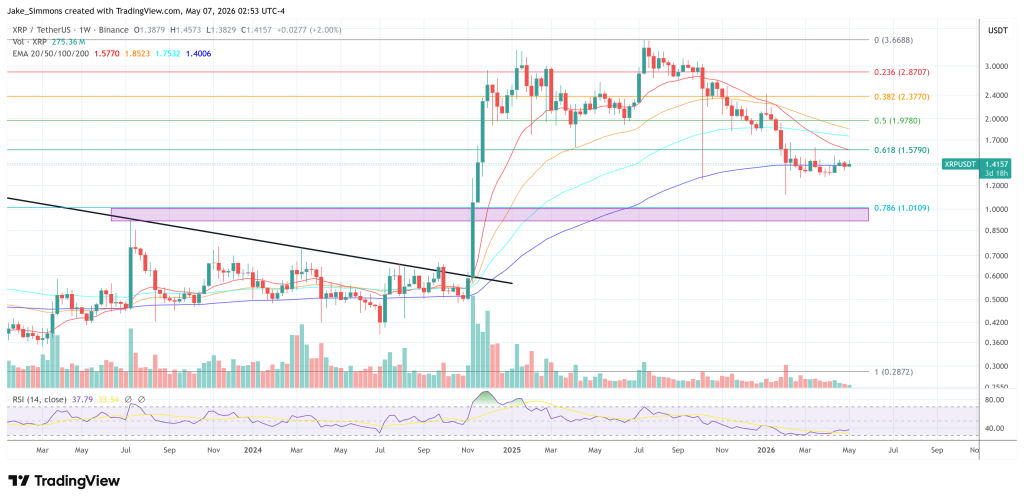
At press time, XRP traded at $1.4157.




 English (US) ·