
 16 hours ago
26
16 hours ago
26
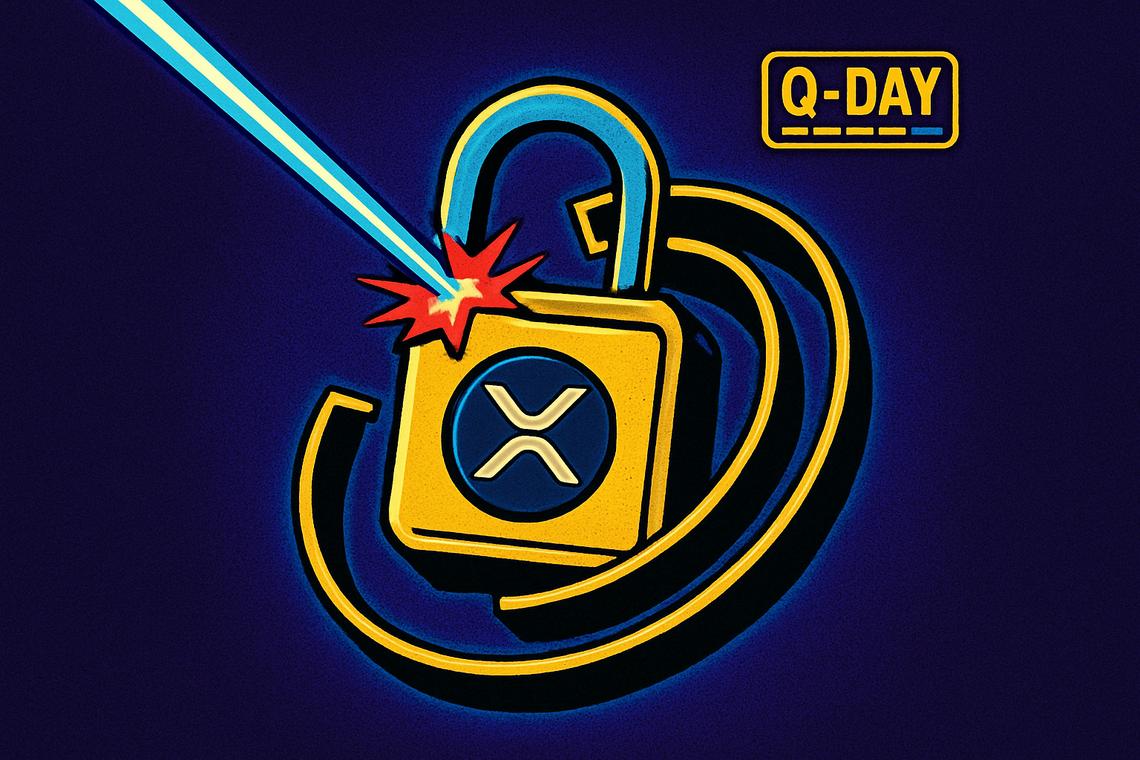
Ripple isn’t waiting for a crisis to force its hand. Engineers at the payments-focused blockchain firm are moving now to strengthen Ripple XRP quantum security years before quantum computers are expected to pose any real danger to blockchain networks, rolling out a four-stage roadmap designed to protect the XRP Ledger long before the day researchers call “Q-Day” ever arrives.
Key takeaways
- A four-stage plan has been presented by Ripple to ready the XRP Ledger against quantum computers capable of potentially revealing private keys.
- The strategy includes assessing vulnerabilities, testing quantum-resistant cryptography, running old and new security systems in parallel, and keeping an emergency response ready.
- A separate report from Crypto Briefing ties the effort to a broader roadmap targeting full quantum readiness by 2028, with testing of NIST-standard algorithms like ML-DSA and Dilithium already underway alongside Project Eleven.
- Google’s Quantum AI team estimated in March 2026 that just 500,000 physical qubits could be enough to derive a private key from an exposed public key in roughly nine minutes.
- An independent audit cited by Crypto Briefing found only 0.03% of XRP’s total supply sits in dormant accounts with exposed public keys, a much smaller exposure than Bitcoin’s older P2PK addresses.
Ripple’s Four-Stage Plan to Quantum-Proof the XRP Ledger
Ripple’s response to the quantum question is built as a long-term infrastructure project rather than a rushed patch job. “The goal is not to wait until quantum computing becomes an immediate threat,” Ayo Akinyele, Ripple’s senior director of engineering, told CoinDesk. “It is to make sure critical financial infrastructure can evolve well before that point without disrupting the systems, assets and users that depend on it.”
Assessing vulnerabilities and testing new cryptography
The plan begins with a network-wide audit to identify which parts of the XRP Ledger would be exposed if current cryptography failed. From there, Ripple moves into testing alternative cryptographic methods against the actual workload the ledger handles today, rather than in isolated lab conditions. According to Crypto Briefing, that testing phase is already underway, with Ripple evaluating NIST-standard post-quantum algorithms, specifically ML-DSA and Dilithium, in partnership with Project Eleven, a firm focused on quantum security research and benchmarking. The collaboration is meant to confirm that adding quantum resistance doesn’t slow the network down or degrade the experience for everyday users.
Parallel operation and emergency readiness
Later stages call for running today’s security alongside quantum-resistant alternatives at the same time, a dual-track approach meant to smooth the eventual handover rather than force it in one disruptive leap. Ripple has also built in an emergency route in case quantum computing advances faster than expected. Crypto Briefing describes this as “Phase 1: Q-Day readiness,” an emergency contingency designed to trigger rapid migration of accounts to quantum-safe alternatives if a credible threat emerges before the full upgrade is finished. Testnet deployments were expected throughout mid-2026, with Ripple aiming for full quantum readiness by 2028.
Why Quantum Computing Threatens Blockchain Security
The danger is mathematical, not theoretical folklore. A sufficiently powerful quantum computer could eventually work backwards from publicly available information to calculate the private keys that control digital assets, breaking protections that both blockchains and traditional banks currently rely on.
That threat gained sharper definition in March 2026, when Google’s Quantum AI team estimated that around 500,000 physical qubits could be enough to break elliptic curve cryptography, the mathematical backbone protecting private keys across nearly every blockchain. At that scale, a quantum machine could reportedly derive a private key from an exposed public key in about nine minutes. Previous estimates had assumed millions of qubits would be required, and the sharply lower figure compressed the timeline the industry believed it had to work with.
AI is accelerating the pressure on cryptography
Quantum computing isn’t the only force squeezing the timeline. AI systems are increasingly used to hunt for flaws in cryptography, work that once took specialist researchers far longer to complete. That creates a second, tougher problem: any system built to resist quantum attacks must also hold up against faster, cheaper AI crypto attacks that don’t need a quantum computer at all. Akinyele said the two forces are technically distinct but are pushing the industry in the same direction. “AI is driving more automation and increasingly autonomous economic activity, while quantum computing is forcing the industry to think further ahead about how those systems are secured,” he said.
Migration Tools and the Validator Coordination Challenge
The XRP Ledger already has a built-in advantage for this kind of transition: it allows users to replace the keys controlling an account without changing the account itself. Ripple says that feature could make a future migration to quantum-resistant cryptography considerably smoother, since it avoids forcing users into entirely new addresses or wallets.
Coordinating an XRP Ledger upgrade across independent validators
Technical readiness is only part of the equation. Any wider change to the rules governing transactions still requires coordination among the network’s independent validators, a governance hurdle that applies to any major XRP Ledger upgrade. Akinyele was blunt about the scope of the task ahead. “That upgrade will go well beyond swapping out one cryptographic algorithm for another,” he said. “It will require more agile infrastructure, stronger key management, clearer upgrade paths and systems that can evolve without disrupting the financial activity they support.” Crypto Briefing notes that Ripple’s later-stage plans include a formal XRPL amendment to add native post-quantum support, the kind of network-level change that depends on validator consensus.
There’s a reassuring data point buried in the exposure math. An independent audit cited by Crypto Briefing found that only about 0.03% of XRP’s total supply sits in dormant accounts with exposed public keys, since active accounts that haven’t broadcast a transaction don’t reveal their public keys on-chain in the first place. Bitcoin’s exposure looks larger by comparison, given that coins sitting in older pay-to-public-key addresses, including those widely believed to belong to Satoshi Nakamoto, have public keys fully visible on the blockchain. That contrast matters because of a scenario researchers call “harvest now, decrypt later,” in which attackers collect encrypted data and signed transactions today and simply wait for a quantum computer strong enough to break them retroactively.
A Deliberate Transition, Not a Crisis Response
Ripple’s underlying philosophy is that the earlier this work starts, the more options the network has when the threat becomes real, rather than being forced into rushed decisions under pressure. “The objective is to make the eventual transition deliberate and orderly, rather than something the ecosystem has to undertake in response to a crisis,” Akinyele said.
AI-driven payments raise the stakes further
This isn’t happening in a vacuum. AI agents are already beginning to transact and pay for services without a person approving each action, a shift Akinyele linked directly to the urgency around securing payment rails. “For financial services specifically, we’re already starting to see this shift with agentic payments, where AI agents can transact and pay for services autonomously,” he said. “That creates new demands for always-on, internet-native payment infrastructure.” Ripple isn’t alone in facing this pressure: Bitcoin and Ethereum developers are separately working on ways to replace the digital signature schemes their networks use today, ahead of the point when quantum computers could break them. For Ripple, and for the broader blockchain industry watching closely, the real test won’t be whether new cryptography exists on paper — it will be whether it can be deployed at financial-network scale without disrupting the very systems it’s meant to protect.
FAQ
What is Ripple’s plan to protect the XRP Ledger against quantum computing?
Ripple has a four-stage plan involving assessing vulnerabilities, testing quantum-resistant cryptography, running old and new security in parallel, and maintaining an emergency response to prepare the XRP Ledger for quantum threats. Related reporting describes this as part of a broader roadmap targeting full quantum readiness by 2028, with NIST-standard algorithms like ML-DSA and Dilithium already being tested alongside Project Eleven.
Why is quantum computing a threat to blockchain security?
Quantum computers could break current cryptographic protections by deriving private keys from public keys, endangering wallets and digital assets. Google’s Quantum AI team estimated in March 2026 that around 500,000 physical qubits could allow a private key to be calculated from an exposed public key in roughly nine minutes.
How does the XRP Ledger facilitate migration to quantum-resistant security?
The XRP Ledger allows users to replace the keys controlling an account without changing the account itself, making a future migration to quantum-resistant cryptography easier. An independent audit found only about 0.03% of XRP’s supply sits in dormant accounts with exposed public keys, limiting the network’s current exposure.
How does AI impact Ripple’s approach to quantum security?
AI accelerates the discovery of cryptographic vulnerabilities, creating urgency for quantum-resistant upgrades, while also driving autonomous “agentic payments” that place new demands on always-on payment infrastructure.
Article produced with the assistance of artificial intelligence and reviewed by the editorial team.




 English (US) ·