
 2 months ago
74
2 months ago
74
- Robinhood has launched 24/7 tokenized stock trading and crypto perpetual futures, choosing Arbitrum instead of Solana.
- Solana remains the dominant blockchain for tokenized equities, but Robinhood’s massive user base could reshape the market.
- Institutional partnerships may become the key factor in determining whether Solana can maintain its leadership.
Robinhood has made one of its biggest blockchain moves yet, and while it may look like a win for tokenized finance overall, it could create a new challenge for Solana.
On July 1, the trading platform rolled out 24/7 tokenized stock trading across more than 120 countries. At the same time, it introduced perpetual crypto futures through the decentralized exchange Lighter.
The biggest surprise wasn’t the products themselves—it was the blockchain Robinhood chose to build on.
Instead of partnering with Solana, the company selected Arbitrum, an Ethereum Layer-2 network. That decision could make competition in the tokenized asset space much more intense over the next few years.
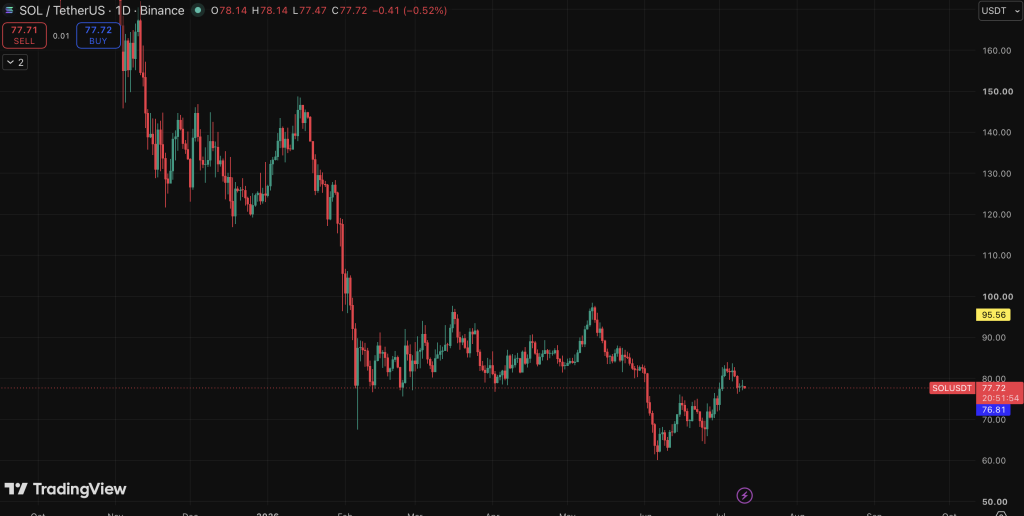
Solana Still Dominates Tokenized Equities
Despite Robinhood’s announcement, Solana remains the leading blockchain for tokenized stock trading.
Industry data shows tokenized stock trading reached roughly $5.8 billion in volume during the second quarter of 2026, reflecting growing interest in bringing traditional financial assets onto blockchain networks.
Today, Solana reportedly settles more than 95% of global tokenized equity trading volume. The network currently hosts approximately $568 million worth of tokenized stocks, a figure that has grown more than 60% over the past month alone.
That leadership hasn’t happened by accident.
Solana’s combination of low transaction costs, high throughput, and near-instant settlement has made it one of the preferred destinations for tokenized assets. Those technical advantages have helped it steadily gain ground on competitors over the past several years.
In terms of total tokenized equity value, only Ethereum currently sits ahead, though the gap has continued narrowing.
Robinhood Chose a Different Path
Rather than integrating with Solana or Ethereum directly, Robinhood built its new tokenized stock platform on Arbitrum.
From a technical standpoint, some may view that as surprising.
Arbitrum currently hosts only a small fraction of the tokenized equity market compared with Solana. It’s generally slower and more expensive than Solana as well.
Yet Robinhood brings something blockchain networks can’t easily replicate—a massive built-in audience.
The company now serves more than 28 million funded customer accounts across 38 countries. Those users already trust Robinhood’s interface and may never even realize which blockchain is operating behind the scenes.
For many retail investors, convenience often matters more than technical performance.
That means Arbitrum doesn’t necessarily need to outperform Solana on speed or fees if Robinhood continues driving users through its own ecosystem.
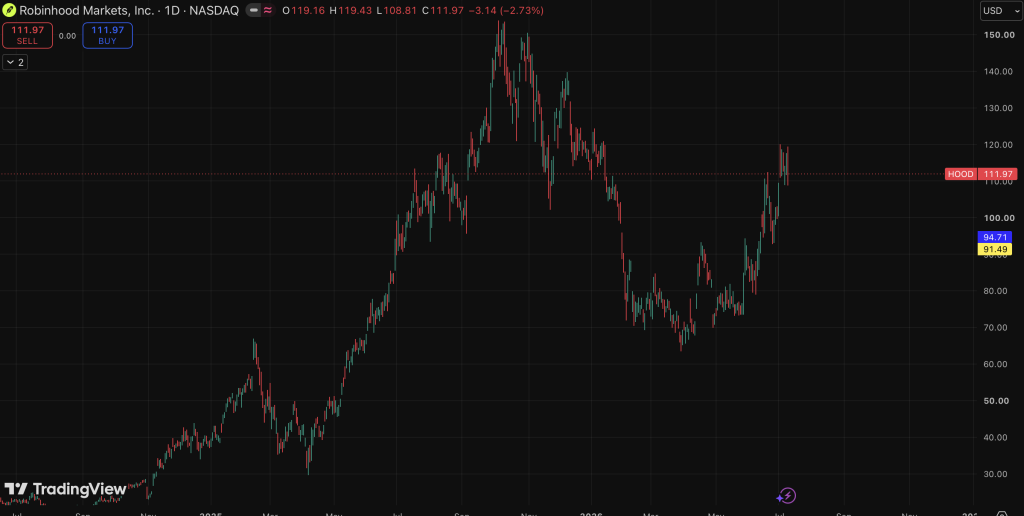
Solana’s Biggest Growth Opportunity Faces New Competition
Tokenization has become one of crypto’s fastest-growing sectors.
As more traditional assets move onto blockchains, many investors have viewed Solana as one of the biggest beneficiaries thanks to its performance advantages.
Robinhood’s entrance changes that equation.
Instead of allowing blockchain networks to compete solely on technology, the battle may increasingly revolve around distribution, user experience, and access to millions of existing customers.
Robinhood also generates revenue in ways blockchain networks cannot.
The company earns recurring income from trading, subscriptions, premium services, and other products, reportedly generating around $157 annually for each funded account. Solana, by comparison, primarily captures value through network activity, transaction fees, and token burns.
That creates two very different business models competing for the same users.
Institutions Could Still Be Solana’s Biggest Advantage
Despite the new competition, Solana still has several important strengths.
Its real-world asset (RWA) ecosystem has expanded rapidly this year, growing from approximately $1.4 billion to more than $3.3 billion between January and early July.
That growth has attracted major financial institutions and asset managers, including Bitwise, State Street, Galaxy, and Amundi.
Those firms may ultimately prefer building on an open, permissionless blockchain rather than relying on infrastructure tied to a brokerage platform.
Institutional adoption has long been viewed as one of Solana’s strongest long-term opportunities, and continued partnerships in that space could help offset any retail market share Robinhood captures.
The Tokenization Race Is Just Beginning
Robinhood’s expansion doesn’t necessarily weaken Solana overnight, but it does introduce a powerful new competitor into one of crypto’s fastest-growing markets.
The brokerage giant has scale, brand recognition, and tens of millions of users already inside its ecosystem. Solana, meanwhile, continues offering one of the fastest and most efficient blockchain networks available for tokenized assets.
The next chapter may come down to who attracts more long-term adoption.
If Robinhood dominates retail while Solana continues winning institutional issuers and global asset managers, both platforms could end up playing major—but very different—roles in the future of tokenized finance.
Disclaimer: BlockNews provides independent reporting on crypto, blockchain, and digital finance. All content is for informational purposes only and does not constitute financial advice. Readers should do their own research before making investment decisions. Some articles may use AI tools to assist in drafting, but every piece is reviewed and edited by our editorial team of experienced crypto writers and analysts before publication.





 English (US) ·